roadwise.Open study app

Louisiana driving lesson · Signs, Signals & Markings

Pavement markings & lane lines

A 3-minute lesson from the Louisiana course. Read the rules and examples, follow the handbook page references, and check your understanding before you move on.

Read time
3 minutes
Course unit
Signs, Signals & Markings
Checkpoint questions
6
Source pages
39, 40, 41, 42

Lines on the pavement talk to you. Yellow lines separate traffic going in opposite directions; white lines separate lanes going the same way. Solid lines generally say 'stay put' and broken lines say 'you may cross when it's safe.'

Yellow center lines

Yellow center lines
MarkingMeaning
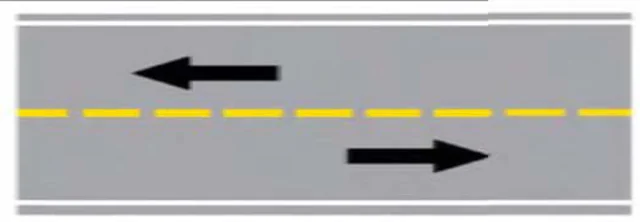
Single broken yellowTwo-lane road: cross to pass or turn when safe
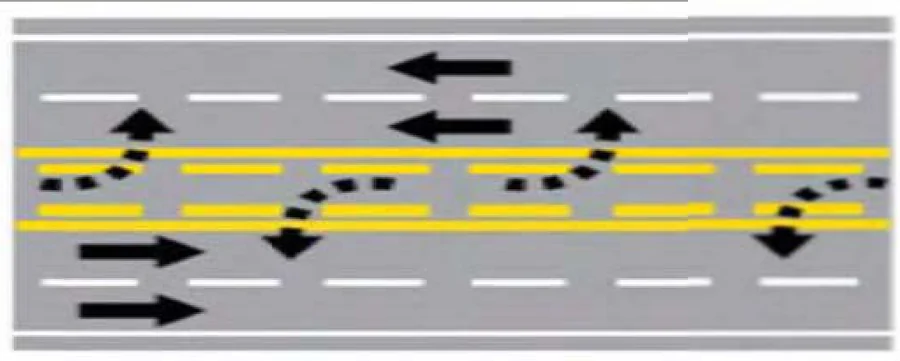
Double solid yellow4+ lanes: never cross to pass; may cross to turn
Single solid yellow (no-passing)Two-lane road: no passing; may cross to turn
Handbook p. 39 ↗
Broken yellow center line
Single broken yellow center line
Multi-lane road with double yellow and lane markings (diagram)
Double solid yellow center lines

White lines

White lines
MarkingMeaning
Single solid whiteLane change is hazardous; wider line = greater hazard
Single dashed whiteCross only when you can do so safely
Double solid whiteSame-direction lanes; crossing is prohibited
White edge lineMarks the right edge of the roadway
Yellow edge lineLeft edge on divided streets and highways
Handbook p. 40 ↗

Know the rule

You may cross a single solid white line only with great care. Double solid white lines are most common on interstates.

Handbook p. 40 ↗

Know the rule

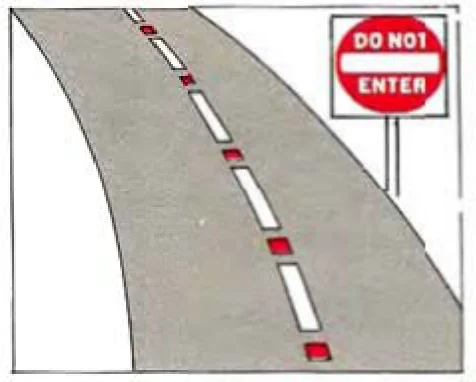
Red pavement markings or reflectors mark a roadway you must not enter.

Handbook p. 40 ↗
Red pavement markings (wrong-way warning)
Red reflectors: wrong way, do not enter

Know the rule

Railroad crossing markings: a large white X with two R's painted in the lane, a solid yellow center line to prevent passing, and a white stop line.

Handbook p. 40 ↗

Know the rule

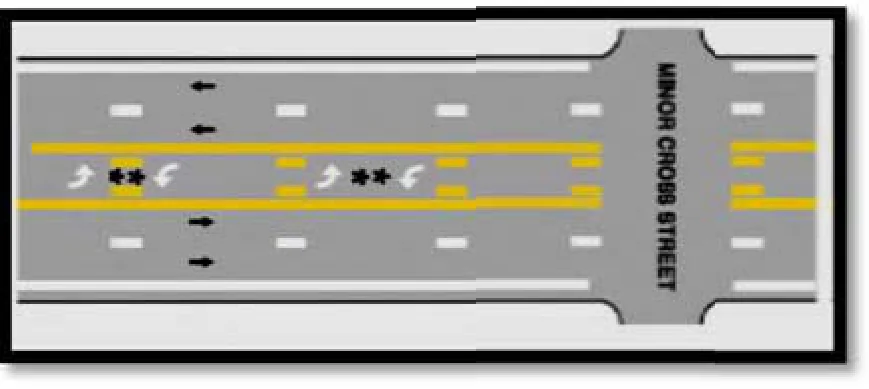
Two-way left-turn lanes (solid plus dashed yellow lines) are for left turns ONLY, by traffic from either direction, and must never be used for passing.

Handbook p. 41 ↗
Two-way left turn lane pavement markings (diagram)
Two-way left-turn lane

Know the rule

Stop lines are solid white lines across the lane at intersections and crosswalks showing exactly where to stop.

Handbook p. 41 ↗

Know the rule

Crosswalks are usually two solid white lines, sometimes with diagonal or longitudinal lines added. Pedestrians in them have the right-of-way and you must stop. Mid-block crosswalks may also have a pedestrian crossing sign.

Handbook p. 41 ↗

Know the rule

Directional arrows show which way you must go from that lane. Where arrows show more than one direction, you may choose any of them.

Handbook p. 41 ↗

In a turn-only lane but want to go straight?

  • Don't change lanes suddenly; other drivers won't expect it
  • Don't stop and wait for a gap; you'll block traffic and risk a rear-end crash
  • Make the turn, drive around the block, and return to the street you want
Handbook p. 42 ↗

Put it into practice

You're on a two-lane road with a single solid yellow center line. You can't pass here, but you may cross the line to turn left into a driveway once oncoming traffic clears.

Check your understanding

Read the question, decide on an answer, then open it to check the explanation. These are Roadwise study questions based on the source handbook.

A single broken yellow line marking the center of a two-lane road means:
  1. You may pass when it's safe
  2. You may never cross it
  3. It marks a bicycle lane
  4. It's only used on one-way streets

Answer: You may pass when it's safe

A single broken yellow centerline allows passing when safe on a two-lane road.
Handbook p. 39 ↗
Double solid yellow lines are used to mark the center of the road on:
  1. Any two-lane road
  2. Roads with four or more lanes of traffic
  3. One-way streets only
  4. Two-lane roads in no-passing zones

Answer: Roads with four or more lanes of traffic

Double solid yellow lines mark the center where there are four or more total lanes.

Handbook p. 39 ↗
Can you cross a double solid yellow centerline to make a turn?
  1. No, it can never be crossed for any reason
  2. Only if a police officer directs you to
  3. Yes, to turn, but not to pass
  4. Only on divided highways

Answer: Yes, to turn, but not to pass

Double solid yellow lines block passing but still permit crossing to make a turn.

Handbook p. 39 ↗
Double solid white lines, commonly seen on interstates, indicate that:
  1. Crossing between lanes is banned
  2. Crossing is allowed with great care
  3. The lanes merge ahead
  4. Only trucks may use the right lane

Answer: Crossing between lanes is banned

Double solid white lines separate same-direction lanes and may not be crossed.

Handbook p. 40 ↗
A two-way left-turn lane in the middle of the road (solid plus dashed yellow lines) may be used for:
  1. Passing slower traffic
  2. Left turns only, from either direction
  3. Straight-through travel for short distances
  4. Merging in from a side street

Answer: Left turns only, from either direction

This shared lane is strictly for left turns from either direction; it must never be used for passing.

Handbook p. 41 ↗
If you realize too late that you're in a lane requiring a turn you don't want to make, what should you do?
  1. Make the turn, then circle back
  2. Stop in the lane and wait for a gap to merge
  3. Reverse to get back into the correct lane
  4. Drive straight through against the lane markings

Answer: Make the turn, then circle back

Stopping to merge blocks traffic and surprises drivers behind you; it's safer to complete the turn and circle back.

Handbook p. 42 ↗
Take the lesson checkpoint in the app

More in Signs, Signals & Markings