roadwise.Open study app

Louisiana driving lesson · Night, Weather & Highways

Interstate driving

A 4-minute lesson from the Louisiana course. Read the rules and examples, follow the handbook page references, and check your understanding before you move on.

Read time
4 minutes
Course unit
Night, Weather & Highways
Checkpoint questions
6
Source pages
107, 108, 109

Interstates have fewer places for conflicts, but crashes there are severe because speeds are high. Plan your route, merge at traffic speed, keep a big space cushion, and never stop or back up on the highway.

Know the rule

Plan ahead: know exactly where you'll enter and exit. Services can be far apart, so check gas, water, oil and tires, including the spare, before you go.

Handbook p. 107 ↗

Know the rule

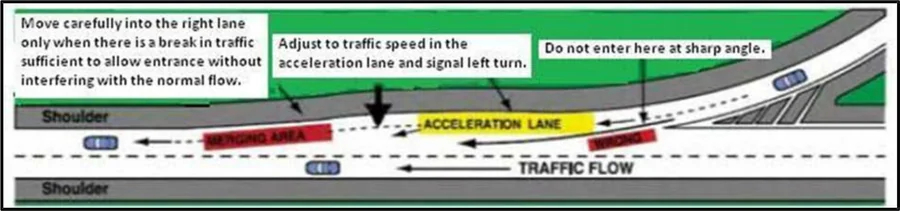
Enter at or near the speed of traffic; the maximum is 70 mph unless posted. Signal, find a gap, and adjust your speed to it. Don't stop at the end of the ramp unless absolutely necessary; interstate traffic has the right-of-way.

Handbook p. 107 ↗
4 seconds

Gap you need to merge, giving you and the car behind two seconds each

Handbook p. 108 ↗
Highway entrance ramp merging (labeled diagram)
Merging from an acceleration lane

Know the rule

At a short acceleration lane in heavy traffic, cars may be stopped waiting. From a full stop you need about a full block to reach interstate speed, and you risk being rear-ended.

Handbook p. 108 ↗

Know the rule

Stay in the right lane unless passing, exiting left, or letting another vehicle enter. With three or more lanes each way: right lane for entering and exiting, middle for travel, far left for passing.

Handbook p. 108 ↗

Know the rule

At a 'merge' sign near an entrance, be ready to adjust your speed or move left so others can enter smoothly.

Handbook p. 108 ↗
4 seconds

Space cushion to keep behind the vehicle ahead on the interstate; double it in bad weather

Handbook p. 108 ↗

Know the rule

Rear-end collisions are the most frequent interstate crash. If you're tailgated, slow down to encourage the driver to pass; if that fails, pull over and let them by. Keep your doors locked.

Handbook p. 108 ↗

Keep space to your sides:

  • Avoid driving alongside other cars on multilane roads
  • Drive in the center of your lane
  • Move over a lane for entering traffic if no one is next to you
Handbook p. 108 ↗

Exiting:

  • About a mile before your exit, make sure you're in the correct lane, changing one lane at a time
  • Signal for about five seconds
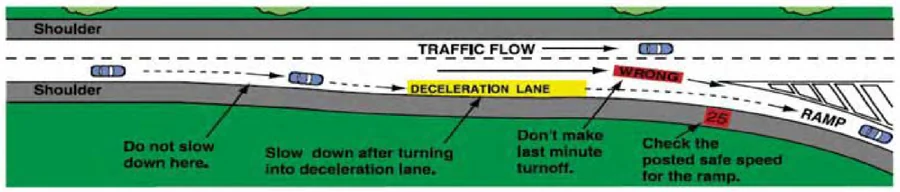
  • Don't slow down on the interstate itself; slow in the deceleration lane to the posted ramp speed
  • Watch for two-way traffic after you exit
Handbook p. 109 ↗

Know the rule

If you miss your exit, don't stop and don't back up; it's illegal and one of the most dangerous things you can do. Go on to the next exit and come back.

Handbook p. 109 ↗
Highway exit ramp deceleration lane (labeled diagram)
Exiting through the deceleration lane

Put it into practice

Traffic on the interstate is moving at 65 mph as you come down the ramp. Signal, look for a gap of about four seconds, match 65 mph in the acceleration lane, and slide in. Don't stop at the end of the ramp.

Check your understanding

Read the question, decide on an answer, then open it to check the explanation. These are Roadwise study questions based on the source handbook.

How should you enter interstate traffic from an on-ramp?
  1. At or near the speed of traffic already on the interstate
  2. Well below the posted speed limit
  3. By stopping at the end of the ramp first
  4. At the posted ramp speed

Answer: At or near the speed of traffic already on the interstate

Matching the speed of interstate traffic makes merging safer and smoother.
Handbook p. 107 ↗
What size gap do you generally need to merge safely into interstate traffic?
  1. 1 second
  2. 4 seconds
  3. 10 seconds
  4. 2 seconds

Answer: 4 seconds

A 4-second gap gives both you and the car you merge in front of adequate following distance.

Handbook p. 108 ↗
On an interstate with two lanes in your direction, which lane should you stay in unless passing, exiting left, or letting a vehicle enter?
  1. The left-hand lane
  2. Whichever lane has less traffic
  3. The right-hand lane
  4. Either lane, at the same speed

Answer: The right-hand lane

The right-hand lane is the default cruising lane unless you're passing, exiting left, or letting someone merge.

Handbook p. 108 ↗
Near interstate exits, where drivers may slow suddenly, the handbook says to always keep at least how many seconds of space ahead?
  1. 2 seconds
  2. 1 second
  3. 8 seconds
  4. 4 seconds

Answer: 4 seconds

Always keep at least a four-second space cushion; double that time when the weather is bad or the pavement is slick.

Handbook p. 108 ↗
For about how long should you signal before leaving the interstate?
  1. About 5 seconds
  2. About 2 seconds
  3. About 10 seconds
  4. About 30 seconds

Answer: About 5 seconds

Signaling for about 5 seconds gives other drivers clear notice before you exit.

Handbook p. 109 ↗
If you miss your exit on the interstate, what should you do?
  1. Stop and back up to the exit
  2. Go on to the next exit and come back
  3. Cross the median to reach the exit
  4. Stop on the shoulder and wait for a gap

Answer: Go on to the next exit and come back

Stopping or backing up on an interstate is illegal and extremely dangerous; continue to the next exit instead.

Handbook p. 109 ↗
Take the lesson checkpoint in the app

More in Night, Weather & Highways