roadwise.Open study app

Louisiana driving lesson · Night, Weather & Highways

Night driving

A 3-minute lesson from the Louisiana course. Read the rules and examples, follow the handbook page references, and check your understanding before you move on.

Read time
3 minutes
Course unit
Night, Weather & Highways
Checkpoint questions
6
Source pages
78, 79, 114

At night you see less, glare can blind you, and others have trouble seeing you. The key rule: drive at a speed that lets you stop within the distance your headlights light up.

Headlight range

Headlight range
BeamSee clearly aboutSpeed that lets you stop
Low beam150-200 feetAbout 45 mph
High beam350-400 feetAbout 65 mph
Handbook p. 79 ↗

Know the rule

Louisiana law requires headlights, not just parking lights, from sunset to sunrise.

Handbook p. 79 ↗

Dim your high beams

Dim your high beams
When you areWithin
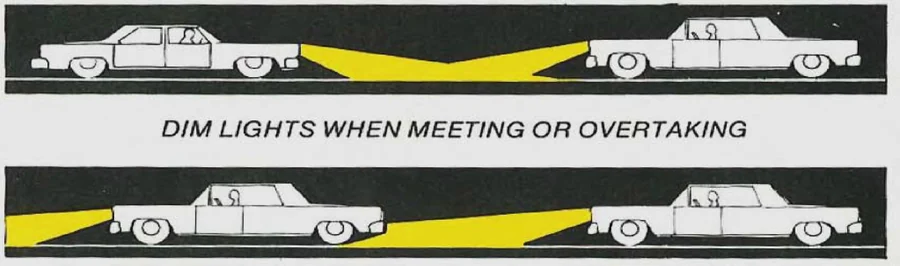
Approaching an oncoming vehicle500 feet
Following another vehicle200 feet
Handbook p. 79 ↗
Dim headlights when meeting or overtaking (diagram)
Dim your lights when meeting or following

Headlights are also required:

  • When rain or moisture requires your windshield wipers
  • When weather conditions are unfavorable
  • When conditions make your vehicle hard to see clearly from 500 feet
Handbook p. 79 ↗

Know the rule

Add at least one extra second of following distance at night, and at least two extra seconds on unfamiliar roads at night.

Handbook p. 79 ↗

Know the rule

Front fog lights may be used in hazardous weather. A red rear fog light is only for dense fog or similar conditions that seriously reduce visibility; switch fog lights off when visibility improves.

Handbook p. 79 ↗

Night driving rules:

  • Keep your windshield and windows clean inside and out; a dirty windshield increases glare
  • Make sure all your lights work
  • Reduce speed so you can stop within the distance you can see
  • Use low beams when approaching other cars
  • If a driver won't dim, look to the right edge of the road and slow down
Handbook p. 79 ↗

Know the rule

Use high beams whenever there are no oncoming vehicles; they let you see twice as far as low beams. If an oncoming driver keeps high beams on, flash yours once quickly, but never keep your brights on to 'get back' at them.

Handbook p. 114 ↗

Know the rule

Don't wear sunglasses or tinted glasses at night or on dark days; colored lenses slow your eyes' adjustment.

Handbook p. 114 ↗

Know the rule

In rural areas it's easy to out-drive your headlights. Increase your following distance to at least four seconds.

Handbook p. 114 ↗

Put it into practice

You're doing 60 mph on a dark highway with low beams on because of oncoming traffic. Low beams show only 150 to 200 feet, about right for 45 mph. Slow down until you can stop within your headlights' reach.

Check your understanding

Read the question, decide on an answer, then open it to check the explanation. These are Roadwise study questions based on the source handbook.

About how far ahead can you see clearly using low-beam headlights?
  1. 150 to 200 feet
  2. 350 to 400 feet
  3. 500 to 600 feet
  4. 50 to 75 feet

Answer: 150 to 200 feet

Low beams let you see clearly about 150 to 200 feet ahead.
Handbook p. 79 ↗
About how far ahead can you see clearly using high-beam headlights?
  1. 150 to 200 feet
  2. 350 to 400 feet
  3. 600 to 700 feet
  4. 50 to 100 feet

Answer: 350 to 400 feet

High beams roughly double the visible distance of low beams, to about 350-400 feet.

Handbook p. 79 ↗
Louisiana law requires headlights to be on:
  1. Only when it's raining
  2. Only on the interstate
  3. Between sunset and sunrise
  4. Only after 9 p.m.

Answer: Between sunset and sunrise

Headlights (not just parking lights) are legally required from sunset to sunrise.

Handbook p. 79 ↗
At what distance must you dim your high beams for an oncoming vehicle?
  1. Within 100 feet
  2. Within 1,000 feet
  3. Within 50 feet
  4. Within 500 feet

Answer: Within 500 feet

Louisiana law requires low beams when approaching within 500 feet of an oncoming vehicle (p.79).

Handbook p. 79 ↗
At what distance must you dim your high beams when following another vehicle?
  1. Within 200 feet
  2. Within 500 feet
  3. Within 50 feet
  4. Within 1,000 feet

Answer: Within 200 feet

Following distance dimming kicks in at 200 feet, closer than the 500-foot oncoming threshold.

Handbook p. 79 ↗
How much extra following distance should you add on unfamiliar roads at night?
  1. At least 1 additional second
  2. At least 3 additional seconds
  3. At least 2 additional seconds
  4. At least 5 additional seconds

Answer: At least 2 additional seconds

Unfamiliar roads at night call for at least 2 extra seconds, more than the 1-second addition for familiar roads.

Handbook p. 79 ↗
Take the lesson checkpoint in the app

More in Night, Weather & Highways