roadwise.Open study app

Kentucky driving lesson · Traffic Control & Signs

Pavement markings & lane controls

A 3-minute lesson from the Kentucky course. Read the rules and examples, follow the handbook page references, and check your understanding before you move on.

Read time
3 minutes
Course unit
Traffic Control & Signs
Checkpoint questions
6
Source pages
44, 45, 53

Pavement markings—lines, arrows, words and symbols painted on the road—divide lanes, show when you may pass or change lanes, mark turn lanes and pedestrian walkways, and show where to stop. Yellow lane markings appear on two-direction roads; white lane markings on one-direction roads.

Center and lane lines

Center and lane lines
MarkingMeaning
Broken yellow center lineTwo-direction road; passing permitted
Double solid yellowTwo-direction road; no passing either direction
Solid and broken yellow, broken on your sideYou may pass (when no one is oncoming)
Solid yellow on your sideYou may not pass
Broken white linesOne-direction road; passing permitted
Handbook p. 45 ↗

Know the rule

You may not pass when there's a solid line on your side of the broken line. You may pass when the solid yellow line is on the left side of the broken yellow line—and only if no vehicles are coming. Signs also mark where passing is legal or illegal.

Handbook p. 53 ↗

Know the rule

When a sign or signal requires you to stop, stop behind the stop line, crosswalk, or sign or signal. If there's a stop line before the crosswalk, obey the stop line first.

Handbook p. 45 ↗

Know the rule

Yield to pedestrians entering or in a crosswalk. Not all crosswalks are marked; if no crosswalk is apparent, stop before entering the intersection.

Handbook p. 45 ↗

Common crosswalk markings shown:

  • Two parallel white lines
  • Unmarked crosswalk (no painted lines)
  • Wide white stripes across the road
Handbook p. 45 ↗
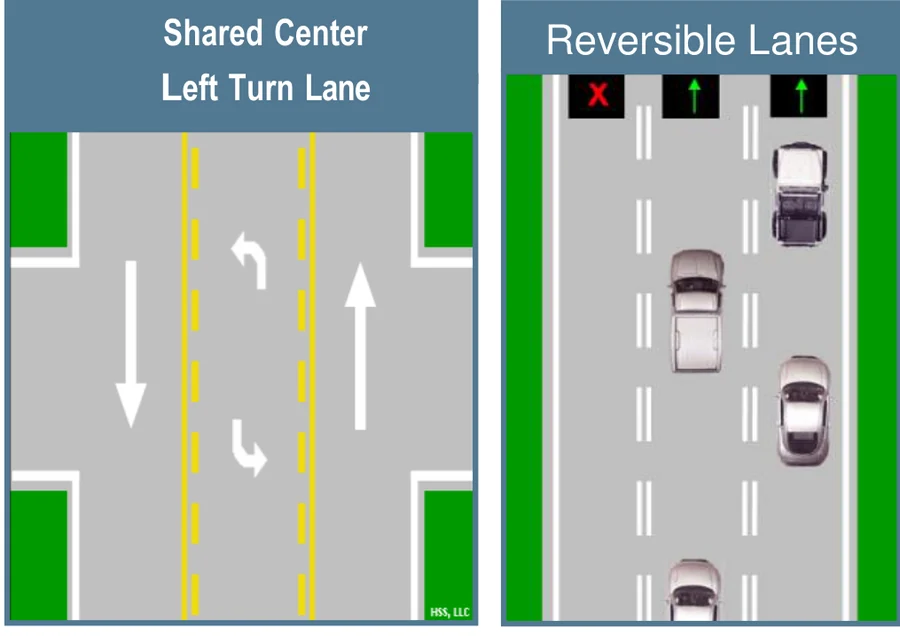
Shared center turn lane and reversible lanes (composite)
Shared center left turn lane and reversible lanes

Shared center left-turn lane

A center lane reserved for left-turning vehicles from either direction. It is not to be used for through traffic or for passing other vehicles.

Handbook p. 44 ↗

Reversible lanes

Lanes whose direction of travel changes, controlled by signals over each lane—the handbook shows a red X over a lane closed to you and green arrows over open lanes.

Handbook p. 45 ↗

Put it into practice

On a two-lane road you see a solid yellow line on your side and a broken yellow line beside it on the other side. You may not pass—though drivers coming the other way may.

Check your understanding

Read the question, decide on an answer, then open it to check the explanation. These are Roadwise study questions based on the source handbook.

A lane marked with a 'Shared Center Lane Left Turn Only' sign is reserved for:
  1. Rush-hour traffic in the peak direction
  2. Left turns from either direction
  3. Passing slower vehicles
  4. Buses and emergency vehicles

Answer: Left turns from either direction

This lane is reserved for left-turning vehicles from either direction and is not to be used for through traffic or passing.
Handbook p. 44 ↗
When you see a solid line on your side of a broken center line, you:
  1. May pass if the way is clear
  2. May not pass
  3. May pass only on multi-lane roads
  4. May pass only if the road is straight

Answer: May not pass

You may not pass when there is a solid line on your side of the broken line.

Handbook p. 53 ↗
On a two-lane road with a solid yellow line and a broken yellow line side by side, you may pass when:
  1. The solid line is on your side
  2. The broken line is on your side
  3. Either line is on your side
  4. Traffic ahead is below the limit

Answer: The broken line is on your side

You may not pass with a solid line on your side; you may pass when the solid line is on the left of the broken line and no vehicles are oncoming.

Handbook p. 53 ↗
Not all crosswalks are marked with painted lines; if a crosswalk is not apparent at an intersection, you must:
  1. Stop before entering the intersection
  2. Proceed at normal speed since none is marked
  3. Only slow down for children
  4. Sound your horn before proceeding

Answer: Stop before entering the intersection

If crosswalks are not apparent, you must stop before entering the intersection and watch for pedestrians.

Handbook p. 45 ↗
If a stop line is painted before a crosswalk, you should pull past it and stop at the edge of the crosswalk instead.
  1. True
  2. False

Answer: False

False. The manual says that if there is a stop line before the crosswalk, the stop line must be obeyed first.

Handbook p. 45 ↗
Broken white lines separating lanes of traffic indicate:
  1. Two-direction traffic; passing permitted
  2. One-direction traffic; passing permitted
  3. Two-direction traffic; no passing
  4. One-direction traffic; no lane changes

Answer: One-direction traffic; passing permitted

The manual's lane-marking chart shows broken white lines on a one-direction roadway where passing is permitted.

Handbook p. 45 ↗
Take the lesson checkpoint in the app

More in Traffic Control & Signs