Vehicles going the same direction at the same speed with good spacing can't hit each other. Trouble starts when someone is much faster or slower than the flow, or merges and exits clumsily.
Know the rule
Keep pace with traffic within the legal limit. Speeding saves only a few minutes an hour, and every pass is a chance for a collision.
Handbook p. 60 ↗Driving this much slower than the traffic flow can be as dangerous as speeding
Handbook p. 60 ↗Know the rule
If vehicles bunch up behind your slow vehicle, pull over when safe and let them pass.
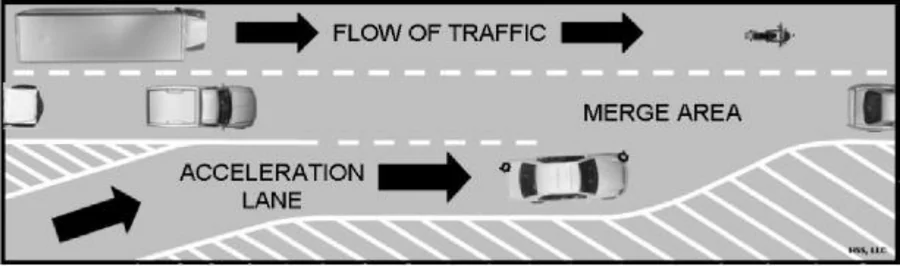
Handbook p. 60 ↗Entering a highway from an acceleration lane:
- Check guide signs for the right route, direction or destination, and the ramp speed sign
- Use the acceleration lane to reach the speed of traffic
- Don't drive to the end of the acceleration lane and stop
- If you must wait for a gap, slow down in the acceleration lane; don't cross the solid white line
- Look over your shoulder and check mirrors; when you find a gap, signal and move in
Know the rule
Exiting: in heavy traffic, get into the proper lane about one-half mile before the exit. Keep your speed on the main road and don't slow down until you're in the deceleration lane.
Handbook p. 60 ↗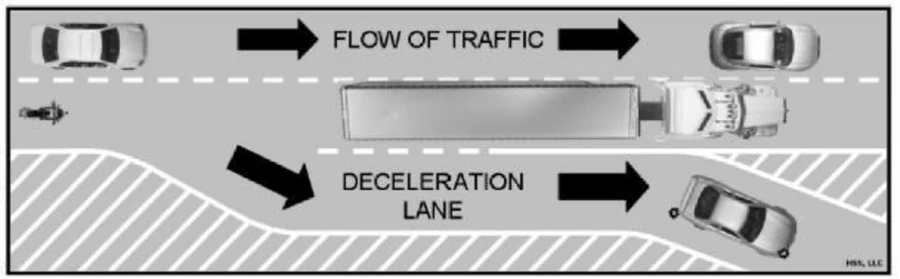
Slow down in crowded places:
- Shopping centers, parking lots and downtown areas
- Rush hours
- Narrow bridges and tunnels
- Toll plazas, where lanes change and vehicles stop and start
- Schools, playgrounds and residential streets with children
- Highway-railroad grade crossings
Excessive speed:
- Reduces your ability to take curves or steer around obstacles
- Increases the distance you travel while reacting
- Makes guardrails and barriers less able to protect you
- Increases tire and brake wear
- Makes it hard for others to judge your distance
- Increases driver fatigue
- Makes crash forces more severe
Know the rule
Unless posted: 30 mph in urban districts; 75 mph on designated separated multilane highways; 65 mph on State or Federal highways; 55 mph on county or township roads.
Handbook p. 61 ↗Know the rule
Limits are for ideal conditions. Driving 55 mph in a snowstorm is not acceptable even where 55 is posted, and you may be cited for driving too fast for conditions.
Handbook p. 62 ↗Know the rule
Check your speedometer often, especially after moving from a high-speed multi-lane road to a slower one, when you're likely going faster than you think.
Handbook p. 62 ↗Know the rule
SUVs, vans, pickups and moving trucks have a higher center of gravity and are more prone to rollovers. Drive slower, avoid sudden direction changes and slow before curves.
Handbook p. 62 ↗Put it into practice
You're merging onto I-35 and traffic is heavy. Speed up in the acceleration lane to match traffic. If no gap appears, slow down in the lane rather than stopping at its end, and don't cross the solid white line.