roadwise.Open study app

District of Columbia driving lesson · Signs, Signals & Pavement Markings

Special lanes: center turn lanes, HOV & yield lines

A 3-minute lesson from the District of Columbia course. Read the rules and examples, follow the handbook page references, and check your understanding before you move on.

Read time
3 minutes
Course unit
Signs, Signals & Pavement Markings
Checkpoint questions
5
Source pages
58

Some lanes have special jobs: shared center lanes on three-lane roads, HOV lanes for carpools and buses, and yield lines at merge points like roundabouts.

Know the rule

On three-lane roads with traffic in both directions, markings show whether the center lane is for passing or for left turns.

Handbook p. 58 ↗

Three-lane road center lane

Three-lane road center lane
Center lane markingUse
Single broken yellow line each sidePassing, by either direction
Solid + broken yellow each sideLeft turns, by either direction
Handbook p. 58 ↗
150 feet

Farthest you may travel in a two-way center left-turn lane

Handbook p. 58 ↗

Yield line

A line of triangles across the roadway, used with a yield sign, marking where you must yield or stop if necessary. Often at the entrance to a roundabout.

Handbook p. 58 ↗

Know the rule

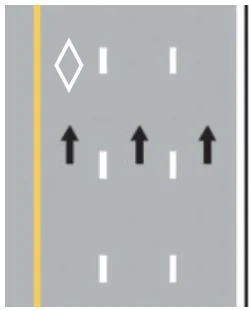
HOV lanes are marked by a diamond shape in the center of the lane. They may also be separated by a barrier or by solid double white lines.

Handbook p. 58 ↗
HOV diamond
Diamond marking: HOV lane

Know the rule

During heavy traffic, HOV lanes are reserved for buses, vanpools, carpools, other high occupancy vehicles, motorcycles and certain clean special fuel vehicles.

Handbook p. 58 ↗

Know the rule

Road signs show the minimum number of passengers required (not counting motorcycles and clean fuel vehicles) and the times HOV restrictions apply.

Handbook p. 58 ↗

Know the rule

Barrier-separated HOV lanes are reversible: traffic flows one way at certain times of day and the opposite way at others. A diamond marking may also mean the lane is a bus lane.

Handbook p. 58 ↗

Put it into practice

You're in a two-way center left-turn lane waiting for a gap to turn into a store. You may use it to line up your turn, but don't drive more than 150 feet in it.

Check your understanding

Read the question, decide on an answer, then open it to check the explanation. These are Roadwise study questions based on the source handbook.

What do double solid white lines typically separate?
  1. A special lane, like an HOV lane
  2. Two-way opposing traffic
  3. A bike lane from a bus lane
  4. Parking spaces from the travel lane

Answer: A special lane, like an HOV lane

Double solid white lines usually separate a special-use lane, like an HOV lane, from ordinary lanes.
Handbook p. 58 ↗
On a three-lane road, if the center lane is marked with a solid yellow line on one side and a broken yellow line on the other, what is it used for?
  1. Passing only, with no distance limit
  2. Left turns, limited to 150 feet
  3. Parking temporarily
  4. Bicycle traffic only

Answer: Left turns, limited to 150 feet

That marking pattern designates the center lane for left turns, limited to 150 feet of travel in it.

Handbook p. 58 ↗
What shape marks the center of an HOV (High Occupancy Vehicle) lane on DC highways?
  1. A diamond
  2. A circle
  3. A triangle
  4. A square

Answer: A diamond

HOV lanes are marked on highways by a diamond shape in the center of the lane.

Handbook p. 58 ↗
What does it mean when HOV lanes are separated by a barrier and described as 'reversible'?
  1. Traffic may use either direction at any time
  2. Flow direction changes by time of day
  3. The lane alternates between HOV and truck use
  4. The lane closes completely each night

Answer: Flow direction changes by time of day

Reversible HOV lanes separated by a barrier flow one way during part of the day and the other way later.

Handbook p. 58 ↗
You may cross double solid white lines at any time as long as no other vehicle is nearby.
  1. True
  2. False

Answer: False

You may not cross double solid white lines except where signs and markings specifically allow entry.

Handbook p. 58 ↗
Take the lesson checkpoint in the app

More in Signs, Signals & Pavement Markings