District of Columbia driving lesson · Signs, Signals & Pavement Markings
Pavement markings: lines & arrows
A 3-minute lesson from the District of Columbia course. Read the rules and examples, follow the handbook page references, and check your understanding before you move on.
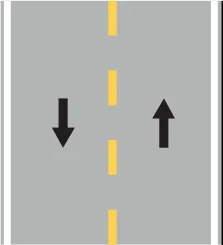
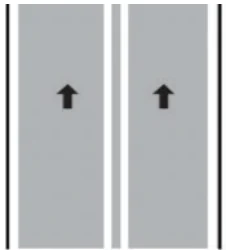
Lines on the road guide, warn and regulate. Yellow lines separate traffic going in opposite directions; white lines separate lanes going the same way and mark the right edge.
Know the rule
Markings may be red, blue, yellow or white. Red is generally not used, though some communities use red curbs for no parking; red reflectors mark areas not to be entered, visible only to wrong-way traffic. Blue marks parking for persons with disabilities.
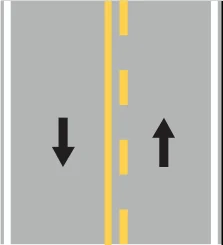
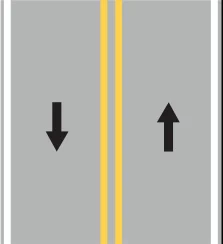
Broken yellow center lineSolid and broken yellow linesDouble solid yellow lines
Know the rule
You may cross a double solid yellow line only to turn left, or to pass pedestrians, bicyclists, or riders of scooters or skateboards when the opposite lane is clear and it is safe. The same exception applies on the solid side of a solid/broken pair.
Solid white lines discourage lane changes near intersections, on- and off-ramps and other risky spots. Stop lines, crosswalks and parking spaces are also marked in white.
White lane arrows: a curved arrow, or a curved arrow with ONLY, means you must turn that way. A curved and a straight arrow together mean you may turn or go straight.
On a two-lane road with double solid yellow lines, a cyclist is riding slowly ahead and the oncoming lane is empty. You may cross the lines to pass the cyclist with at least three feet of room, but you may not cross them to pass a slow car.
Check your understanding
Read the question, decide on an answer, then open it to check the explanation. These are Roadwise study questions based on the source handbook.
Yellow center lines on a roadway generally indicate what kind of traffic flow?
One-way traffic only
A reversible lane
A bicycle-only lane
Two-way traffic flowing in opposite directions
Answer: Two-way traffic flowing in opposite directions
Yellow center lines mean two-way traffic is flowing in opposite directions on either side.