roadwise.Open study app

District of Columbia driving lesson · Sharing the Road

Buses, bus lanes & streetcars

A 3-minute lesson from the District of Columbia course. Read the rules and examples, follow the handbook page references, and check your understanding before you move on.

Read time
3 minutes
Course unit
Sharing the Road
Checkpoint questions
6
Source pages
39, 40

DC streets carry buses, dedicated bus lanes and streetcars. Buses are big and have blind spots all around, and streetcars run on fixed rails. Both get special protections.

Know the rule

Leave greater following distance behind a bus. Buses block your view and have blind spots to the front, back, and both sides.

Handbook p. 39 ↗

Know the rule

Passing a stopped transit bus with its indicator lights flashing, keep a safe speed and watch for pedestrians. Where possible, change lanes to give the bus more space.

Handbook p. 39 ↗

Know the rule

Always give buses the right-of-way when they are entering and exiting traffic.

Handbook p. 39 ↗

Know the rule

It is illegal to make a right turn in front of a bus stopped at an intersection to take on or let off passengers. Stay or merge behind the bus.

Handbook p. 39 ↗
At least $200

Fine for turning right in front of a bus stopped at an intersection for passengers

Handbook p. 39 ↗

Know the rule

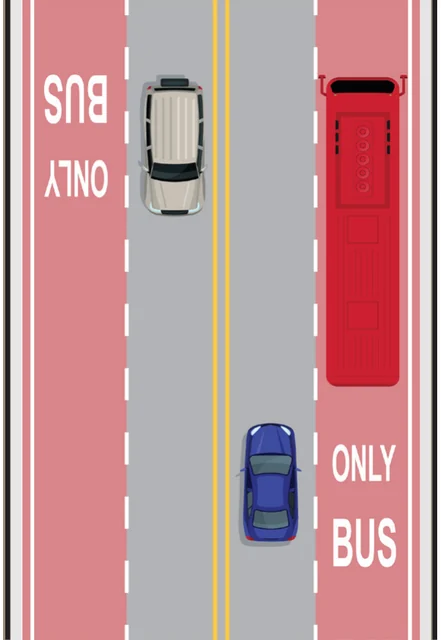
Bus lanes are marked by solid red pavement and Bus Only markings. Some run 24/7; posted signs show the days and times a bus lane is in effect.

Handbook p. 39 ↗

Vehicles allowed in a bus lane:

  • Transit buses
  • Tour buses
  • Charter buses
  • School buses
  • Bicycles
  • Paratransit vehicles
  • Emergency vehicles
Handbook p. 39 ↗

Know the rule

You may cross a bus lane to turn right where an official sign allows it. With no sign, you may turn within 40 feet of an intersection. Check mirrors and yield to bicycles and buses in the lane first.

Handbook p. 39 ↗
Bus-only lane
Bus lanes: solid red pavement marked BUS ONLY

Know the rule

"Bus Only" signals give buses a head start: a vertical bar means the bus may go; after three seconds a flashing triangle shows priority is ending; a horizontal bar means buses must obey normal signals.

Handbook p. 39 ↗

Know the rule

Streetcars run on fixed rails at average speeds of 25 to 35 miles per hour. Pass a stopped streetcar going your direction only with extreme caution, when safe, on its left side; passengers may be getting on or off.

Handbook p. 40 ↗

Parking along a streetcar route:

  • Do not park on the tracks
  • Park within the solid white line
  • Check for an approaching streetcar before opening doors
  • Double parking is illegal
Handbook p. 40 ↗

Know the rule

Parking, stopping or standing on or within a streetcar guideway or next to a streetcar platform is prohibited. Violators face a fine and removal or impounding.

Handbook p. 40 ↗

Put it into practice

A bus is stopped at the corner loading passengers and you want to turn right. Don't swing around in front of it. That's illegal, with a fine of at least $200. Wait or merge behind the bus.

Check your understanding

Read the question, decide on an answer, then open it to check the explanation. These are Roadwise study questions based on the source handbook.

What is illegal for a driver to do when a bus is stopped at an intersection to load or unload passengers?
  1. Change lanes well ahead of the bus
  2. Signal a lane change near the bus stop
  3. Merge behind the bus
  4. Turn right in front of the stopped bus

Answer: Turn right in front of the stopped bus

District law bars making a right turn in front of a stopped bus receiving or discharging passengers.
Handbook p. 39 ↗
What is the minimum fine for illegally turning right in front of a stopped bus loading passengers in DC?
  1. At least $200
  2. At least $25
  3. At least $50
  4. At least $500

Answer: At least $200

Violators of this bus right-of-way law are subject to a fine of at least $200.

Handbook p. 39 ↗
How are DC bus lanes typically marked?
  1. Solid blue pavement with white stripes
  2. Solid red pavement with Bus Only markings
  3. Green pavement with dashed white lines
  4. Standard white lane markings only

Answer: Solid red pavement with Bus Only markings

Bus lanes are indicated by solid red pavement along with Bus Only markings.

Handbook p. 39 ↗
If no official sign is posted, within how many feet of an intersection may you cross a bus lane to make a right turn?
  1. 10 feet
  2. 100 feet
  3. 200 feet
  4. 40 feet

Answer: 40 feet

Absent a sign, you may cross a bus lane to turn right within 40 feet of the intersection.

Handbook p. 39 ↗
When passing a stopped streetcar traveling in the same direction, what should you do?
  1. Pass quickly on the right without stopping
  2. Use extreme caution, passing on the left
  3. Honk before passing on either side
  4. Stop completely and wait for it to move first

Answer: Use extreme caution, passing on the left

Passengers may be entering or exiting a stopped streetcar, so pass with extreme caution on the left when safe.

Handbook p. 40 ↗
Parking on or within a streetcar guideway in DC is:
  1. Allowed for up to 15 minutes
  2. Allowed if hazards are flashing
  3. Prohibited, with fines and towing
  4. Allowed only during off-peak hours

Answer: Prohibited, with fines and towing

District law prohibits parking, stopping, or standing on or within a streetcar guideway; violators may be fined and towed.

Handbook p. 40 ↗
Take the lesson checkpoint in the app

More in Sharing the Road