roadwise.Open study app

District of Columbia driving lesson · Sharing the Road

Bicyclists on the road

A 3-minute lesson from the District of Columbia course. Read the rules and examples, follow the handbook page references, and check your understanding before you move on.

Read time
3 minutes
Course unit
Sharing the Road
Checkpoint questions
6
Source pages
38, 58

In DC, bicycles are vehicles. Bicyclists have the same kinds of rights and duties as drivers, and they're easy to startle and easy to hit, so give them room and time.

Know the rule

Bicycles are treated as vehicles in DC. Bicyclists have rights and duties like those of a motor vehicle driver.

Handbook p. 38 ↗

Know the rule

Motorists must yield the right-of-way to bicyclists at intersections, when passing, and when turning. Most bikes have no turn signals, so cyclists use hand and arm signals.

Handbook p. 38 ↗

Know the rule

As you approach a bicyclist, slow down and avoid using your horn. Loud noises can startle the rider and cause a crash.

Handbook p. 38 ↗

Know the rule

Don't follow a bicycle closely. Bikes stop and maneuver quickly, and young bicyclists especially may change direction suddenly.

Handbook p. 38 ↗

Know the rule

When passing, wait until it's safe and allow about three feet of clearance. Return to your lane when you can clearly see the bicyclist in your rear-view mirror. If you can't pass safely, slow down and follow.

Handbook p. 38 ↗
20-30 mph

Speed an experienced cyclist commonly reaches, closer than you think

Handbook p. 38 ↗

Know the rule

A bicycle should be ridden as close to the right side of the road as possible, but cyclists are expected to use turn lanes. Merge safely with bike traffic when turning, and don't turn right across the path of bicycle traffic.

Handbook p. 38 ↗

Know the rule

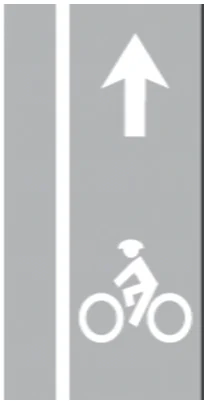
Bicycle lanes are marked by a solid or dashed white line or green pavement plus a bicyclist symbol. Don't drive in one except to turn left or right; check mirrors and yield to bicycles in the lane first.

Handbook p. 58 ↗
Bike lane
Bicycle lane with bicyclist symbol

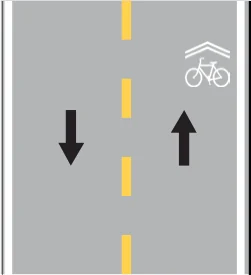
Sharrow

A shared lane marking: a bicycle symbol with a double chevron above it, used on lanes too narrow to share side-by-side. It shows where cyclists should ride and reminds drivers to expect them.

Handbook p. 58 ↗
Shared lane marking (sharrow)

Put it into practice

You're turning right and a cyclist is riding in the bike lane beside you. Don't cut across them. Check your mirror, let the cyclist pass, then merge into the bike lane and make your turn.

Check your understanding

Read the question, decide on an answer, then open it to check the explanation. These are Roadwise study questions based on the source handbook.

Bicycles in DC are legally treated as:
  1. Pedestrians
  2. Vehicles, with a vehicle's duties
  3. Exempt from most traffic laws
  4. Recreational equipment, not vehicles

Answer: Vehicles, with a vehicle's duties

DC law treats bicycles as vehicles, giving bicyclists both rights and duties on the road.
Handbook p. 38 ↗
How much clearance should a driver give when passing a bicyclist?
  1. About six inches
  2. About one foot
  3. About three feet
  4. No specific clearance is required

Answer: About three feet

The handbook specifies allowing about three feet of clearance when passing a bicyclist.

Handbook p. 38 ↗
May a driver use their horn to alert a bicyclist before passing?
  1. Yes, it's required before every pass
  2. Yes, but only a light tap
  3. Only if the cyclist is riding erratically
  4. No, it can startle and unbalance them

Answer: No, it can startle and unbalance them

The horn should not be used to alert or alarm a bicyclist; it can startle them and cause a crash.

Handbook p. 38 ↗
At what typical speed can an experienced cyclist travel, per the handbook?
  1. 20-30 mph
  2. 5-10 mph
  3. 40-50 mph
  4. 60+ mph

Answer: 20-30 mph

The handbook notes experienced cyclists can commonly reach 20-30 mph, often closer than a driver expects.

Handbook p. 38 ↗
What does a shared lane marking, or 'sharrow,' indicate?
  1. A dedicated, car-free bicycle lane
  2. A lane reserved exclusively for buses
  3. Where cyclists share a narrow lane
  4. A crosswalk for pedestrians

Answer: Where cyclists share a narrow lane

A sharrow marks where bicyclists should position themselves in a shared, narrow travel lane.

Handbook p. 58 ↗
How are dedicated DC bicycle lanes typically marked?
  1. A double yellow line only
  2. A diamond symbol in the lane
  3. Red pavement with white lettering
  4. A white line or green pavement, with a bike symbol

Answer: A white line or green pavement, with a bike symbol

Bicycle lanes use a white line (solid or dashed) or green pavement plus a bicycle symbol.

Handbook p. 58 ↗
Take the lesson checkpoint in the app

More in Sharing the Road