A 3-minute lesson from the Delaware course. Read the rules and examples, follow the handbook page references, and check your understanding before you move on.
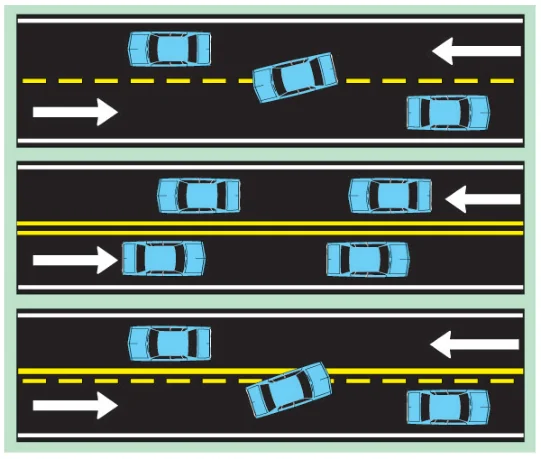
Lines on the road tell you where you may change lanes and pass. Color tells you direction: white lines separate traffic moving the same way, and yellow lines separate traffic moving in opposite directions.
When a sign or signal requires you to stop, stop before the stop line or, if there is one, the crosswalk. Yield to pedestrians in crosswalks—and remember that not all crosswalks are marked.
A lane that carries traffic one direction at some times and the opposite direction at others, usually marked by double broken yellow lines. Check signs or signals before using it.
On a two-lane road there's a solid yellow line on your side and a broken line on the other. You may not pass—but you may still cross the line to turn left into a driveway when it's safe.
Check your understanding
Read the question, decide on an answer, then open it to check the explanation. These are Roadwise study questions based on the source handbook.
A broken white line between lanes traveling the same direction means you
may change lanes if it is safe
are discouraged from changing lanes
may not change lanes at all
may cross it only to exit the road
Answer: may change lanes if it is safe
A broken white line means you may cross it to change lanes if it is safe to do so.