A 3-minute lesson from the Delaware course. Read the rules and examples, follow the handbook page references, and check your understanding before you move on.
Many intersections give pedestrians their own signals. You obey the vehicle signals—but you need to know what walkers see, because you must yield to them. Some newer signals light up only when someone pushes a button.
A device that gives WALK information in non-visual ways—audible tones, verbal messages and/or vibrating surfaces—for pedestrians who are blind or visually impaired.
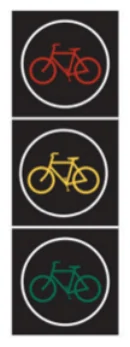
Bicycle signals—circular, arrow or bicycle-shaped—mean the same as regular signals but apply only to bicyclists in designated bike lanes or paths. Cyclists in general travel lanes obey the regular signals.
You're turning right on a green light. A pedestrian with a WALK signal is stepping into the crosswalk you're about to cross. Stop and let them cross before completing your turn.
Check your understanding
Read the question, decide on an answer, then open it to check the explanation. These are Roadwise study questions based on the source handbook.
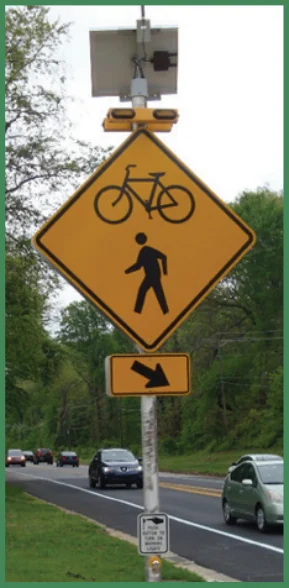
A crosswalk beacon, activated by a pedestrian's push button, that flashes rapidly in a 'stutter' pattern is called a
Standard Advance Warning Beacon
HAWK signal
Rectangular Rapid Flashing Beacon
Reversible Lane Beacon
Answer: Rectangular Rapid Flashing Beacon
Rectangular Rapid Flashing Beacons flash rapidly in a stutter pattern when activated by pedestrians or bicyclists to improve yielding.
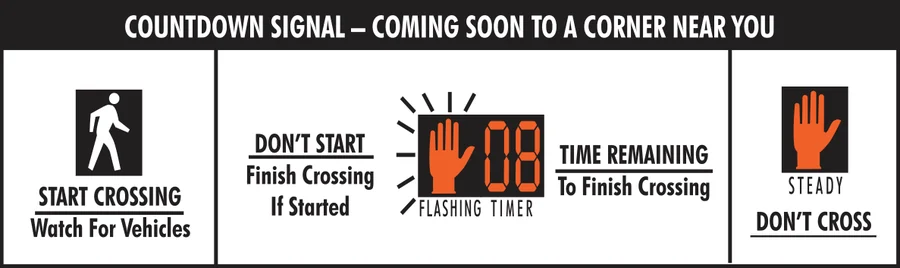
A flashing 'Don't Walk' signal means a pedestrian who has already started crossing should
return to the curb they started from
stop on the center line and wait
finish crossing only if past halfway
finish crossing as quickly as possible
Answer: finish crossing as quickly as possible
A pedestrian who has begun crossing during a flashing Don't Walk should finish crossing as rapidly as possible; if not yet started, they should not begin.