roadwise.Open study app

Delaware driving lesson · Signs, Signals & Markings

Roundabouts, DDIs & shared center lanes

A 3-minute lesson from the Delaware course. Read the rules and examples, follow the handbook page references, and check your understanding before you move on.

Read time
3 minutes
Course unit
Signs, Signals & Markings
Checkpoint questions
5
Source pages
83, 84, 85

Modern roundabouts slow traffic and eliminate direct left turns—a major cause of intersection crashes. Traffic moves counterclockwise, and drivers already in the circle have the right-of-way over entering traffic.

Roundabout

A circular intersection that moves traffic counterclockwise around a central island, with traffic-calming design that encourages lower speeds.

Handbook p. 83 ↗

Using a roundabout:

  • Lanes: right lane to turn right, left lane for a left or U-turn, any approach lane to go straight
  • Stay right of the splitter island and slow to 10–15 mph
  • Watch for bicyclists and let them merge into the entry lane
  • Yield to pedestrians in the crosswalk
  • Yield to traffic already in the roundabout
  • Inside: keep right of the central island, go counterclockwise, keep slow, don't pass
  • Exit at your street, watching for and yielding to pedestrians and bicyclists
Handbook p. 84 ↗
10–15 mph

Speed to slow to as you approach a roundabout

Handbook p. 84 ↗

Know the rule

Once in the roundabout, don't stop except to avoid a collision—you have the right-of-way over entering traffic.

Handbook p. 84 ↗

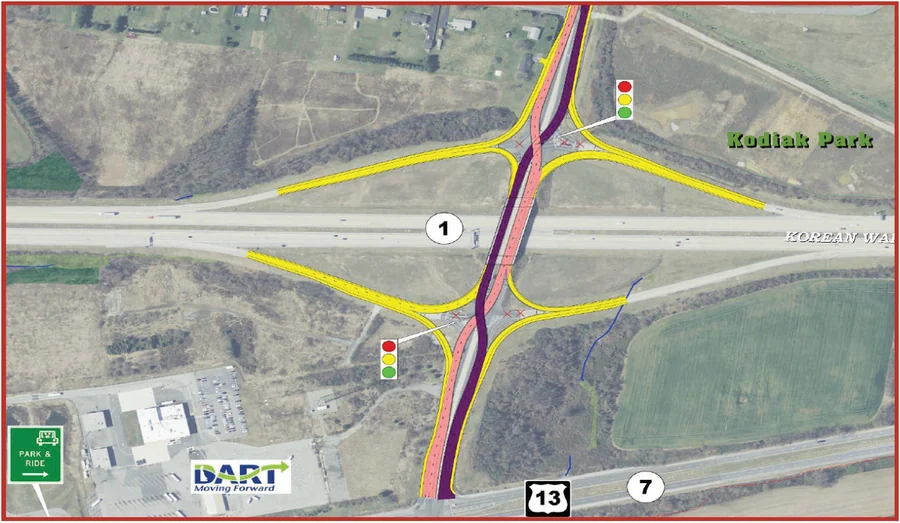
Diverging Diamond Intersection (DDI)

An interchange where traffic briefly drives on the left side of the road so left turns can be made without crossing oncoming traffic or stopping.

Handbook p. 84 ↗
Diverging diamond interchange (aerial view)
A diverging diamond interchange

Shared center lane

A center lane for left turns (or U-turns where allowed) used by both directions, marked with solid and broken yellow lines and alternating left-turn arrows.

Handbook p. 85 ↗

Know the rule

Enter a shared center lane only when you can do so safely. In some areas it becomes a reversible lane during rush hours.

Handbook p. 85 ↗

Put it into practice

You want to turn left at a two-lane roundabout. Use the left approach lane, slow to 10–15 mph, yield to cars already circling, then travel counterclockwise and exit at your street.

Check your understanding

Read the question, decide on an answer, then open it to check the explanation. These are Roadwise study questions based on the source handbook.

When approaching a modern roundabout, you should slow down to about
  1. 25 to 30 mph
  2. 35 to 40 mph
  3. 10 to 15 mph
  4. 45 to 50 mph

Answer: 10 to 15 mph

As you approach a roundabout, stay right of the splitter island and slow to 10-15 mph.
Handbook p. 84 ↗
Inside a Delaware roundabout, you travel
  1. clockwise, keeping to the right of the central island
  2. counterclockwise, keeping to the right of the central island
  3. counterclockwise, keeping to the left of the central island
  4. clockwise, keeping to the left of the central island

Answer: counterclockwise, keeping to the right of the central island

In a roundabout, always keep to the right of the central island and travel counterclockwise.

Handbook p. 84 ↗
When entering a roundabout, you must
  1. yield to traffic already in the circle
  2. have the right-of-way over circulating traffic
  3. stop completely regardless of traffic
  4. always use the innermost lane

Answer: yield to traffic already in the circle

Drivers entering a roundabout must yield to traffic already in the circle before entering.

Handbook p. 84 ↗
A shared center lane with alternating turn arrows on the pavement is reserved for
  1. through traffic in either direction
  2. passing slower vehicles
  3. left turns from either direction
  4. parking and loading

Answer: left turns from either direction

Shared center lanes are reserved for left turns (or U-turns where permitted) and can be used by vehicles traveling in both directions.

Handbook p. 85 ↗
Once inside a roundabout, you generally should not stop except to avoid a collision.
  1. True
  2. False

Answer: True

Drivers in a roundabout have the right-of-way over entering traffic and should keep moving except to avoid a crash.

Handbook p. 84 ↗
Take the lesson checkpoint in the app

More in Signs, Signals & Markings