Roadwise States Arkansas Driving lessons Passing safely & the left-lane law Arkansas driving lesson · See and Be Seen
Passing safely & the left-lane law A 3-minute lesson from the Arkansas course. Read the rules and examples, follow the handbook page references, and check your understanding before you move on.
Read time 3 minutes
Course unit See and Be Seen
Checkpoint questions 6
Source pages 73, 74, 75 Passing on a two-lane road puts you head-on with oncoming traffic, so it takes far more space and time than most drivers guess. When in doubt, don't pass.
Know the rule
Even where signs and markings allow passing, judge whether you have enough space and time. As a rule, pass only one vehicle at a time.
Handbook p. 73 ↗ 10 seconds Time needed to pass at 55 mph, so you need a 10-second gap in oncoming traffic and sight distance
Handbook p. 74 ↗ 1,600+ feet (⅓ mile) Space needed to pass at 55 mph; you and the oncoming car each cover over 800 feet in 10 seconds
Handbook p. 74 ↗ Know the rule
A far-away vehicle can look like it's standing still. If you can see it getting closer, it may be too close to pass. If you're not sure, wait.
Handbook p. 74 ↗ Know the rule
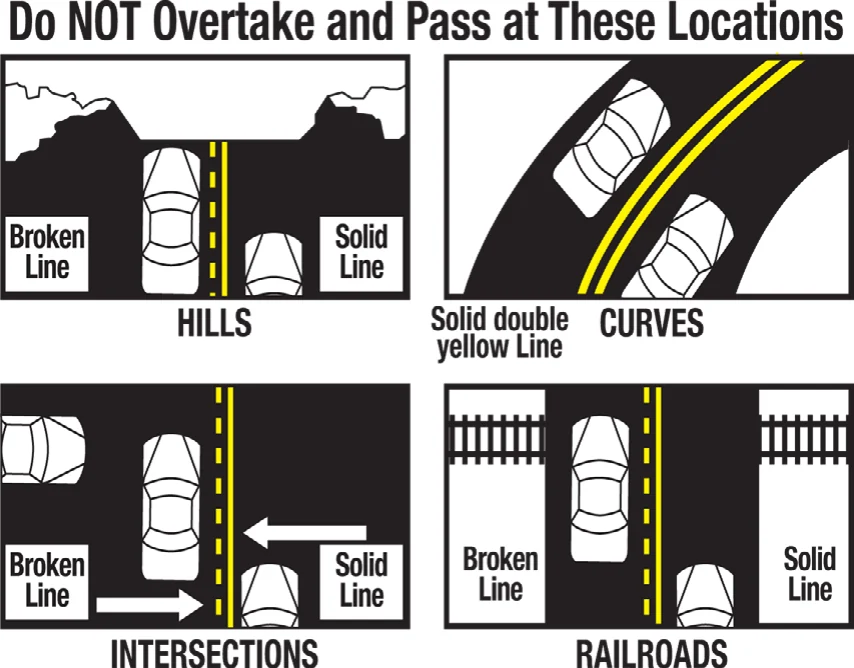
Don't pass where vehicles may enter or cross the road, such as intersections, railroad crossings and shopping center entrances.
Handbook p. 74 ↗ Know the rule
Whenever a hill or curve blocks your view, assume an oncoming vehicle is coming.
Handbook p. 74 ↗ Do not pass at hills, curves, intersections or railroads Know the rule
Never pass unless you have enough space to return to your lane; don't count on others making room.
Handbook p. 75 ↗ You might lose your passing space because of: People or bicyclists near the road A narrow bridge or anything else that narrows the lane A patch of ice, a pothole or an object on the road Handbook p. 75 ↗ Know the rule
Leave room before returning to your lane. At night, it's safe to return when you can see both headlights of the passed vehicle in your rearview mirror.
Handbook p. 75 ↗ Left lane of a multilane highway: use it only when (A.C.A. 27-51-301) Overtaking and passing a vehicle going the same way All other lanes your way are closed for construction or repair All other lanes your way are in disrepair or unsafe to drive Preparing to exit the highway on the left Handbook p. 75 ↗ Put it into practice
On a two-lane road at 55 mph, a slow truck is ahead and the road curves out of sight a quarter mile away. Don't pass: you need about ⅓ mile clear, and you may not pass within ⅓ mile of a curve.
A useful reminder At 55 mph: 10 seconds and about 1,600 feet (⅓ mile) to pass.
Check your understanding Read the question, decide on an answer, then open it to check the explanation. These are Roadwise study questions based on the source handbook.
At 55 mph, about how many seconds of gap do you need in oncoming traffic to pass safely? About 4 seconds About 6 seconds About 10 seconds About 15 seconds Answer: About 10 seconds
At 55 mph, you need roughly a ten-second gap in oncoming traffic to complete a safe pass.
Handbook p. 74 ↗ At 55 mph, about how much distance do you need to safely complete a pass? About 800 feet About 500 feet About 2,500 feet Over 1,600 feet (about 1/3 mile) Answer: Over 1,600 feet (about 1/3 mile)
At 55 mph you and the oncoming vehicle cover over 800 feet each in ten seconds, so you need over 1,600 feet total.
Handbook p. 74 ↗ How many vehicles should you plan to pass at once? Only one at a time Up to two, if both are slow Up to three on a straight road As many as fit before oncoming traffic arrives Answer: Only one at a time
As a rule, only pass one vehicle at a time; don't count on time to pass several cars at once.
Handbook p. 73 ↗ You should not pass within about how far of a hill or curve that blocks your view? 100 feet 1/3 of a mile 1/10 of a mile 1 mile Answer: 1/3 of a mile
Never pass within about a third of a mile of a hill or curve, since an oncoming vehicle could be hidden.
Handbook p. 74 ↗ When is it safe to return to your lane after passing at night? As soon as you clear the front bumper After exactly five seconds When you can see both headlights of the passed vehicle in your rearview mirror When the passed driver flashes their lights Answer: When you can see both headlights of the passed vehicle in your rearview mirror
At night, seeing both headlights of the passed vehicle in your mirror signals it's safe to return to your lane.
Handbook p. 75 ↗ Under Arkansas law, when may a vehicle use the left lane of a multilane highway besides passing? Whenever traffic is light Whenever the driver prefers a smoother lane At any time after dark When all other lanes are closed, unsafe, or the driver is preparing to exit left Answer: When all other lanes are closed, unsafe, or the driver is preparing to exit left
Arkansas Code 27-51-301 limits left-lane use to passing, closed or unsafe other lanes, or preparing to exit left.
Handbook p. 75 ↗ Previous lesson Space to the side, merging & crossing traffic Next lesson Tractor-trailers & the No-Zone About the source Roadwise’s Arkansas course uses the driver handbook edition supplied with this study pack. This lesson cites source pages 73, 74, 75. The linked PDF is a third-party mirror of the handbook, rather than a government-hosted page.
Open the handbook source PDF · View the source edition
For current application requirements, fees, appointments, and the format that applies to your age or license type, check Arkansas’s DFA. Roadwise provides study material and does not issue permits or licenses.