Roadwise States Arkansas Driving lessons Following distance & traffic behind you Arkansas driving lesson · See and Be Seen
Following distance & traffic behind you A 3-minute lesson from the Arkansas course. Read the rules and examples, follow the handbook page references, and check your understanding before you move on.
Read time 3 minutes
Course unit See and Be Seen
Checkpoint questions 6
Source pages 71, 72 Rear-end crashes are very common, and they're caused by following too closely. The more space you keep, the more time you have to react. Keep a cushion ahead, and help the driver behind you keep one too.
Know the rule
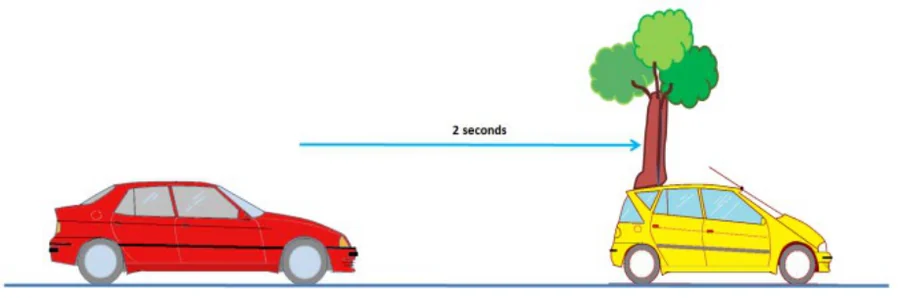
Use the two-second rule to check whether you're following too closely.
Handbook p. 71 ↗ How to use the two-second rule: When the rear of the vehicle ahead passes a fixed point, start counting Count "one-thousand-one, one-thousand-two" If you reach the point before you finish counting, you're too close Drop back and count again until you're no closer than two seconds Handbook p. 71 ↗ Two seconds behind the car ahead Know the rule
Some situations need more space in front of you; you may need a four-second rule to be safe.
Handbook p. 71 ↗ Leave extra space when: Roads are slippery The driver behind wants to pass: slow down to leave room to merge in front of you Following a motorcycle, especially on wet, icy or gravel roads or metal surfaces Following trucks, buses, vans or trailers whose drivers can't see you Towing, since extra weight increases stopping distance Bad weather makes it hard to see Following emergency vehicles, which need room to work Approaching railroad crossings behind buses or hazmat vehicles that must stop Stopped on a hill, where the vehicle ahead could roll back Handbook p. 71 ↗ Know the rule
Help the driver behind you by keeping a steady speed and signaling well before you slow or stop.
Handbook p. 72 ↗ Protecting the space behind you: Picking up or dropping off passengers: find a safe place away from traffic Parallel parking with traffic behind: signal, pull next to the space, let traffic pass, then park Driving slower than others: pull to the side and let them pass; use turnouts where provided Handbook p. 72 ↗ Know the rule
If you're being tailgated, move into the right lane if possible. If not, wait for a clear path ahead, then reduce speed so the tailgater can go around. Never slow down suddenly to discourage a tailgater.
Handbook p. 72 ↗ Put it into practice
A pickup is riding your bumper on a two-lane road. Don't brake-check him. Wait for a clear stretch, ease off the gas gently so he can pass, and keep extra space ahead of you in the meantime.
Check your understanding Read the question, decide on an answer, then open it to check the explanation. These are Roadwise study questions based on the source handbook.
What is the standard following-distance rule for normal conditions? The one-second rule The two-second rule The four-second rule The ten-second rule Answer: The two-second rule
The two-second rule is the standard guideline for checking your following distance in normal conditions.
Handbook p. 71 ↗ If you're being tailgated, what should you avoid doing? Moving into the right lane whenever it is possible Maintaining a steady speed Leaving extra room ahead of you Slowing down suddenly to discourage the tailgater Answer: Slowing down suddenly to discourage the tailgater
Never slow down suddenly to discourage a tailgater; it increases the risk of being hit from behind.
Handbook p. 72 ↗ How do you apply the two-second rule to check your following distance? Count the seconds it takes to fully stop Count the seconds from when the vehicle ahead passes a fixed point until you reach it Count the seconds your turn signal blinks Count the car lengths between vehicles Answer: Count the seconds from when the vehicle ahead passes a fixed point until you reach it
Pick a stationary point, then count the seconds between the vehicle ahead passing it and you reaching it.
Handbook p. 71 ↗ Why should you increase your following distance when towing a trailer? A trailer makes your brake lights harder to see A trailer blocks your view of the road ahead The extra weight increases your stopping distance A trailer sways more at short distances Answer: The extra weight increases your stopping distance
Towing adds weight that increases the distance needed to stop, so more following distance is needed.
Handbook p. 71 ↗ Why should you leave extra space when stopped on an incline behind another vehicle? Your own brakes are weaker on a hill The driver ahead cannot see you on a hill Your engine may stall on the hill The vehicle ahead could roll back when starting Answer: The vehicle ahead could roll back when starting
A vehicle stopped on an incline can roll backward when it starts moving, so extra space is needed.
Handbook p. 71 ↗ You should slow down suddenly if a driver is tailgating you, to encourage them to back off. True False Answer: False
Slowing down suddenly to discourage a tailgater increases the risk of being hit from behind.
Handbook p. 72 ↗ Previous lesson Stopping distance & sight distance Next lesson Space to the side, merging & crossing traffic About the source Roadwise’s Arkansas course uses the driver handbook edition supplied with this study pack. This lesson cites source pages 71, 72. The linked PDF is a third-party mirror of the handbook, rather than a government-hosted page.
Open the handbook source PDF · View the source edition
For current application requirements, fees, appointments, and the format that applies to your age or license type, check Arkansas’s DFA. Roadwise provides study material and does not issue permits or licenses.