roadwise.Open study app

Arkansas driving lesson · Sharing the Road

Tractor-trailers & the No-Zone

A 3-minute lesson from the Arkansas course. Read the rules and examples, follow the handbook page references, and check your understanding before you move on.

Read time
3 minutes
Course unit
Sharing the Road
Checkpoint questions
6
Source pages
76, 77, 78

Tractor-trailers are not large cars. They stop slower, turn wider and see less around them than you'd think. In most fatal car–truck crashes the car driver is blamed, so knowing how trucks move protects you.

72%

Share of fatal multi-vehicle crashes involving a tractor-trailer in which the cause is usually attributed to the car (NHTSA)

Handbook p. 76 ↗

Stopping from 55 mph

Stopping from 55 mph
VehicleStopping distance
Average passenger carAbout 225 feet
Fully loaded tractor-trailerMore than 335 feet (a football field)
Handbook p. 76 ↗

Know the rule

A turning vehicle's rear wheels follow a shorter path than the front wheels, so truck drivers often swing out to the left as the first step of a right turn. Check the truck's turn signal before trying to pass on the right.

Handbook p. 76 ↗

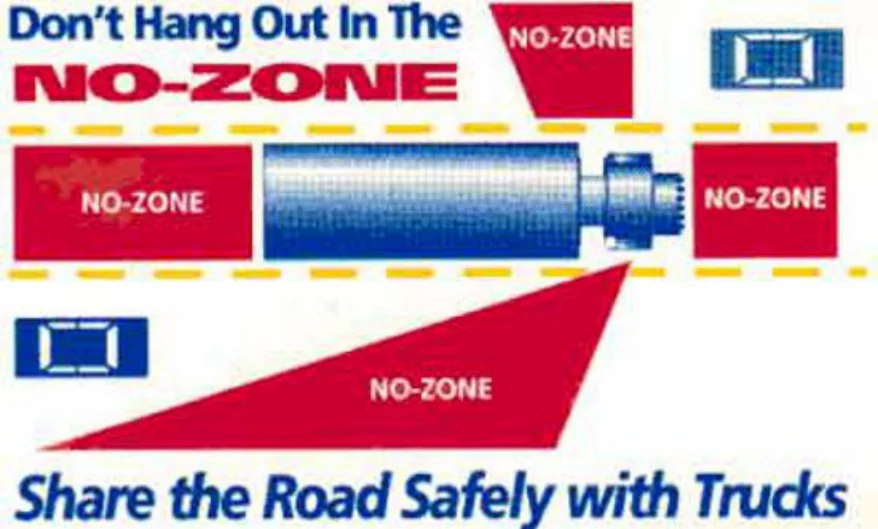
No-Zone

A truck's serious blind spots, where a car can disappear from the driver's view even with big mirrors and a high seat.

Handbook p. 77 ↗

Where cars disappear around a truck

Where cars disappear around a truck
AreaNo-Zone
In front of the cabUp to 20 feet
SidesEither side, particularly alongside the cab
Behind the trailerUp to 200 feet
Handbook p. 77 ↗
Truck no-zone blind spots
Don't hang out in the No-Zone

Know the rule

If you can't see the truck driver in the tractor's side mirror, the driver can't see you.

Handbook p. 78 ↗

Know the rule

Trucks have longer stopping and acceleration distances, need wider areas to turn, and weigh much more than cars.

Handbook p. 78 ↗

Mistakes to avoid around trucks:

  • Cutting in front of a truck to reach an exit or turn; slow down and exit behind it instead
  • Racing a truck to a single-lane construction zone
  • Lingering alongside when passing; pass completely, and on the left side
  • Tailgating: if you can't see the truck's mirrors, the driver can't see you
  • Underestimating an approaching truck's size and speed, especially at intersections
Handbook p. 78 ↗

Put it into practice

A tractor-trailer ahead of you signals right but drifts left first. Don't squeeze into the gap on its right. It's swinging wide to make the turn, so stay back until it finishes.

Check your understanding

Read the question, decide on an answer, then open it to check the explanation. These are Roadwise study questions based on the source handbook.

At 55 mph, about what total stopping distance does a fully loaded tractor-trailer need?
  1. More than 335 feet
  2. About 225 feet
  3. About 150 feet
  4. About 275 feet

Answer: More than 335 feet

A fully loaded tractor-trailer traveling 55 mph may take more than 335 feet to stop completely.
Handbook p. 76 ↗
Why must a tractor-trailer driver often swing left before making a right turn?
  1. To signal the turn more clearly
  2. To give cars room to pass on the right
  3. Its rear wheels follow a shorter path than the front wheels
  4. To avoid oncoming traffic

Answer: Its rear wheels follow a shorter path than the front wheels

A longer vehicle's rear wheels cut the corner more, so drivers swing wide left before turning right.

Handbook p. 76 ↗
A car can disappear into a truck's blind spot up to how many feet in front of the cab?
  1. 5 feet
  2. 50 feet
  3. 100 feet
  4. 20 feet

Answer: 20 feet

A car can vanish into the truck's blind spot up to twenty (20) feet in front of the cab.

Handbook p. 77 ↗
A car can disappear into a truck's blind spot up to how many feet behind the truck?
  1. 200 feet
  2. 20 feet
  3. 50 feet
  4. 500 feet

Answer: 200 feet

The rear blind spot of a tractor-trailer can extend up to two hundred (200) feet behind the truck.

Handbook p. 77 ↗
What is a simple rule of thumb for knowing if a truck driver can see you?
  1. If you can see the truck's taillights, you're visible
  2. If you can't see the truck driver in the side mirror, they can't see you
  3. If you're within one car length, you're visible
  4. If your headlights are on, you're always visible

Answer: If you can't see the truck driver in the side mirror, they can't see you

This mirror rule helps drivers judge whether they are inside a truck's blind spot.

Handbook p. 78 ↗
When passing a tractor-trailer, what should you avoid doing?
  1. Lingering alongside it
  2. Passing on the left side
  3. Signaling before you pass
  4. Completing the pass fully

Answer: Lingering alongside it

Lingering beside a truck while passing removes the driver's ability to react to a road hazard.

Handbook p. 78 ↗
Take the lesson checkpoint in the app

More in Sharing the Road