roadwise.Open study app

Arkansas driving lesson · Sharing the Road

Sharing the road with bicycles

A 4-minute lesson from the Arkansas course. Read the rules and examples, follow the handbook page references, and check your understanding before you move on.

Read time
4 minutes
Course unit
Sharing the Road
Checkpoint questions
6
Source pages
79, 80

Bicycles have the same rights and responsibilities as other vehicles. They're hard to see and riders are easily hurt, so expect sudden moves and give them room.

Know the rule

Bicycles must travel on the right-hand side of the road with other traffic, never facing oncoming traffic, and should ride as close to the right as is safe.

Handbook p. 79 ↗

Know the rule

Expect riders to swerve suddenly because of trash, oil slicks, potholes, cracks, barking dogs, parked cars or opening doors.

Handbook p. 79 ↗

Know the rule

Cyclists passing parked cars move toward the center of the lane; that's proper riding. Give the cyclist the entire lane if possible; if not, pass with extreme caution.

Handbook p. 79 ↗

Where car–bike crashes come from:

  • Most common: a driver turning left in front of an oncoming bike, or right across its path
  • Drivers fail to notice cyclists or misjudge their speed
  • Passing a cyclist, then turning right in front of them
  • Young riders turning in front of you without looking or signaling
Handbook p. 79 ↗

Safety tips for drivers:

  • Look left, right, then left again so you see the cyclist and know their speed before turning
  • Merge with bicycle traffic before a right turn; don't cut across a cyclist's path
  • Try to make and keep eye contact with a cyclist before turning
  • Never pass between a bicyclist and an oncoming vehicle on a two-lane road
  • Don't pass if the street is too narrow or you'd force the rider toward parked cars
  • If a rider may not know you're there, tap your horn gently; never blast it
Handbook p. 79 ↗

Know the rule

In residential areas, bicyclists may ride in the middle of the street and ignore stop signs and signals. Children lack judgment about traffic; watch for bikes from driveways and behind parked cars.

Handbook p. 80 ↗

Know the rule

At night, bicyclists are required to have a front light and a rear reflector, but they're still hard to see, especially in oncoming headlights.

Handbook p. 80 ↗

Know the rule

A red or orange pennant flag on a bicycle means the rider has impaired hearing; slow down.

Handbook p. 80 ↗

A bicyclist may take the full lane when:

  • Overtaking and passing another vehicle going the same way
  • Getting ready to turn left at an intersection or into a driveway
  • Avoiding parked cars, moving vehicles, obstacles, pedestrians, animals, potholes or debris
  • The lane is too narrow for a car and a bike to share safely
Handbook p. 80 ↗

Know the rule

Never use a lane marked and signed for bicycles only as a turning lane, passing lane or for parking.

Handbook p. 80 ↗
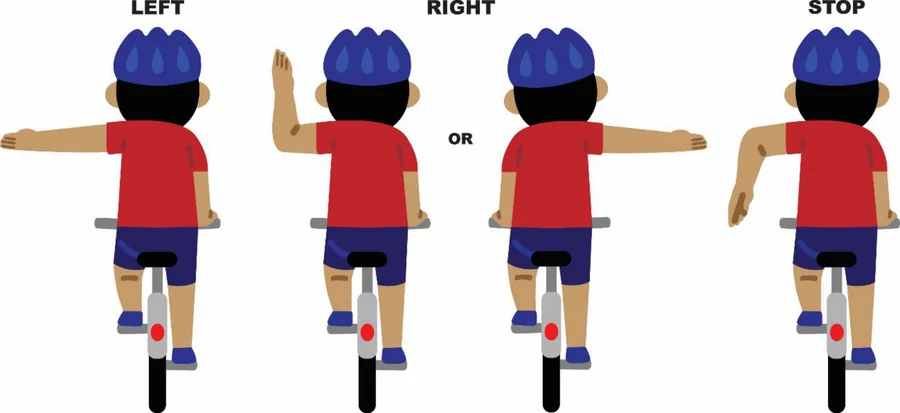
Bicycle hand signals (left, right, stop)
Bicycle hand signals: left, right and stop

Put it into practice

On a narrow two-lane road you come up behind a cyclist while a car approaches from the other way. Slow down and stay behind the bike until the oncoming car passes, then pass the cyclist with plenty of room.

Check your understanding

Read the question, decide on an answer, then open it to check the explanation. These are Roadwise study questions based on the source handbook.

Which side of the road should bicycles generally travel on?
  1. The left-hand side, facing traffic
  2. Either side, at the rider's choice
  3. The center of the lane at all times
  4. The right-hand side, with traffic

Answer: The right-hand side, with traffic

Bicycles are required to travel on the right-hand side of the road with the flow of traffic.
Handbook p. 79 ↗
What is the most common cause of a car-bicycle collision?
  1. A driver turning left in front of, or right across the path of, a bicyclist
  2. A cyclist running a stop sign
  3. A cyclist riding at night without lights
  4. A cyclist riding two abreast

Answer: A driver turning left in front of, or right across the path of, a bicyclist

The handbook identifies drivers turning left in front of, or right across, a cyclist's path as the most common cause.

Handbook p. 79 ↗
When should a cyclist be given full use of a traffic lane?
  1. Never; cyclists must always ride right at the road's edge
  2. When the lane is too narrow to safely share with a car
  3. Only on specially designated bike routes
  4. Only when traffic is light

Answer: When the lane is too narrow to safely share with a car

A cyclist may take the full lane when it's too narrow for a car and bicycle to share safely.

Handbook p. 80 ↗
A red or orange pennant flag attached to a bicycle indicates what?
  1. The rider has impaired hearing
  2. The rider is a delivery courier
  3. The rider is on a group ride
  4. The rider is a minor

Answer: The rider has impaired hearing

A red or orange pennant flag is a symbol that the cyclist has impaired hearing, so drivers should slow down.

Handbook p. 80 ↗
On a two-lane road, you are overtaking a bicycle while an oncoming car approaches. What should you do?
  1. Speed up and pass before the car arrives
  2. Slow down and let the car pass, then pass the bike
  3. Pass while hugging the center line
  4. Honk so the cyclist moves onto the shoulder

Answer: Slow down and let the car pass, then pass the bike

Never pass between a bicyclist and oncoming vehicles; slow down and let the vehicle pass before you pass the bicycle.

Handbook p. 79 ↗
Bicyclists are allowed to ride facing oncoming traffic if there is no bike lane available.
  1. True
  2. False

Answer: False

Bicyclists must ride with the flow of traffic and are not allowed to face oncoming traffic.

Handbook p. 79 ↗
Take the lesson checkpoint in the app

More in Sharing the Road