roadwise.Open study app

Washington driving lesson · Lane Markings and Special Zones

Reading lane lines

A 3-minute lesson from the Washington course. Read the rules and examples, follow the handbook page references, and check your understanding before you move on.

Read time
3 minutes
Course unit
Lane Markings and Special Zones
Checkpoint questions
6
Source pages
130, 131, 132, 133

Road markings are lines, arrows, words, and symbols painted on the road. They divide lanes, show when you may pass or change lanes, mark turn lanes and walkways, and show where to stop. The two colors tell you the most: yellow is about opposite directions, white is about the same direction.

Know the rule

Solid white lines mark the edge of the road and separate bicycle lanes from other traffic.

Handbook p. 130 ↗

Know the rule

If there are no markings on the road, stay as close to the right side as safely possible.

Handbook p. 130 ↗

Line colors

Line colors
ColorWhat it separates
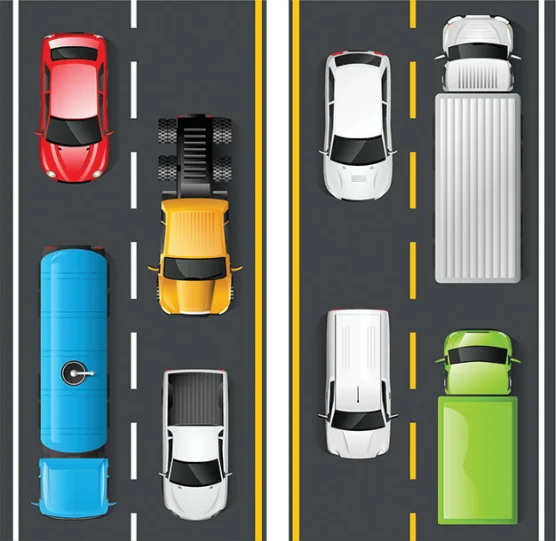
YellowTraffic moving in opposite directions
WhiteTraffic lanes moving in the same direction
Handbook p. 131 ↗
Vehicles sharing a lane (traffic mix)
Yellow center line on a two-way road; white lines between same-direction lanes

Know the rule

Shorter dashed white lines mean your lane is ending: you'll need to merge or exit. You can cross dashed lines if it's safe.

Handbook p. 131 ↗

Know the rule

Medians divide two or more roadways. They can be open spaces, cement dividers, or 18-inch solid yellow pavement markings with stripes. It's illegal to drive within, over, or across a median.

Handbook p. 131 ↗

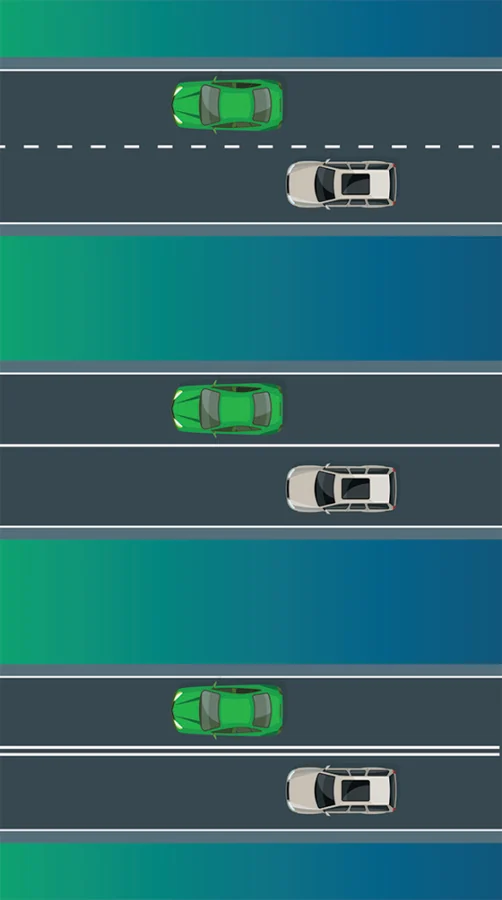
White lines between lanes

White lines between lanes
MarkingMeaning
Dashed whiteYou may cross to change lanes if it's safe
Solid whiteStay in your lane unless a special situation requires it
Double solid whiteA barrier; it's illegal to cross
Handbook p. 132 ↗
Dashed line lane changes
Dashed, solid, and double solid white lines

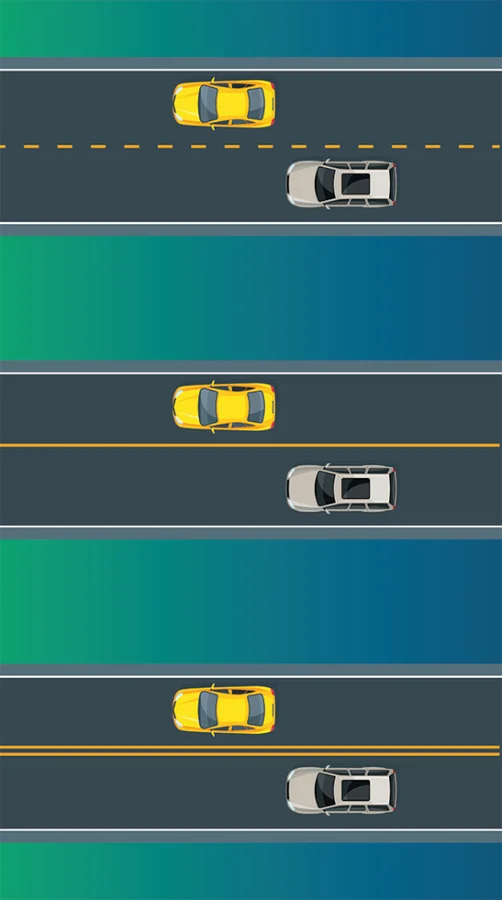
Yellow center lines

Yellow center lines
MarkingPassing
Dashed yellowYou may use the oncoming lane to pass if it's safe
Solid yellowDon't cross it to pass (edge of road or no-passing zone)
Double solid yellowNo passing in either direction
Solid + dashed yellowPass only if the dashed line is on your side
Handbook p. 132 ↗
Dashed yellow center line (two-way road)
Dashed, solid, and double solid yellow center lines

Know the rule

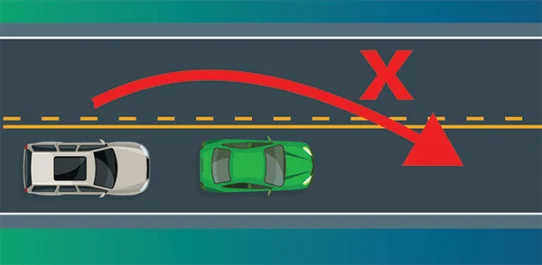
With a solid and a dashed yellow line together, you may not pass when the solid line is on your side. If the dashed line is on your side, you may pass when it's safe.

Handbook p. 133 ↗
Illegal passing across solid yellow line
No passing when the solid yellow line is on your side

Put it into practice

You're on a two-lane highway behind a slow truck. Your side of the center has a dashed yellow line and the other side has a solid one. You may pass if the oncoming lane is clear. If the solid line were on your side, you'd have to stay behind the truck.

Check your understanding

Read the question, decide on an answer, then open it to check the explanation. These are Roadwise study questions based on the source handbook.

What do yellow lines on a roadway separate?
  1. Traffic moving in the same direction
  2. Bike lanes from bus lanes
  3. Parking spaces from travel lanes
  4. Traffic going opposite directions

Answer: Traffic going opposite directions

Yellow lines separate traffic traveling in opposite directions.
Handbook p. 131 ↗
What do white lines on a roadway separate?
  1. Only bicycle lanes
  2. Only HOV lanes
  3. Traffic moving in the same direction
  4. Traffic moving in opposite directions

Answer: Traffic moving in the same direction

White lines separate traffic lanes moving in the same direction.

Handbook p. 131 ↗
Can you legally cross a double solid white line to change lanes?
  1. Yes, if the lane ahead is ending
  2. No, it's a barrier
  3. Yes, if no traffic is nearby
  4. Yes, if you signal first

Answer: No, it's a barrier

Double solid white lines are a barrier between lanes; crossing them is illegal.

Handbook p. 132 ↗
What do double solid yellow centerlines mean for passing?
  1. Passing allowed when clear
  2. Passing allowed on straight stretches only
  3. No passing in either direction
  4. Passing allowed on your side only

Answer: No passing in either direction

Double solid yellow centerlines mean you're not allowed to pass in either direction.

Handbook p. 132 ↗
A road has a solid yellow line paired with a dashed yellow line, and the dashed line is on your side. Can you pass?
  1. Only if the solid line is on your side
  2. Yes, if it's safe to do so
  3. No, the solid line always controls
  4. No, this marking pair never allows passing

Answer: Yes, if it's safe to do so

With this pairing, you may pass if the dashed line is on your side of the road.

Handbook p. 133 ↗
Shorter dashed white lines mean a lane is ending and you'll need to merge or exit.
  1. True
  2. False

Answer: True

Shorter dashed white lines mean the lane is ending, requiring you to merge or exit.

Handbook p. 131 ↗
Take the lesson checkpoint in the app

More in Lane Markings and Special Zones