roadwise.Open study app

Washington driving lesson · Lane Markings and Special Zones

Turn lanes, HOV, reversible, and toll lanes

A 3-minute lesson from the Washington course. Read the rules and examples, follow the handbook page references, and check your understanding before you move on.

Read time
3 minutes
Course unit
Lane Markings and Special Zones
Checkpoint questions
6
Source pages
133, 134, 135, 136, 186

Some lanes have a special job: turning, carrying carpools and buses, changing direction with rush hour, or charging a toll. Each is marked with its own signs and pavement markings, and each has rules about who may use it and how far.

Know the rule

Turn lanes are usually at major intersections, marked by signs and road markings, sometimes with an arrow signal. Once you're in a turn lane, you must follow through with the turn.

Handbook p. 133 ↗

Know the rule

You may cross a solid yellow line on your side of the road to get into a center lane marked with left turn arrows.

Handbook p. 133 ↗

Know the rule

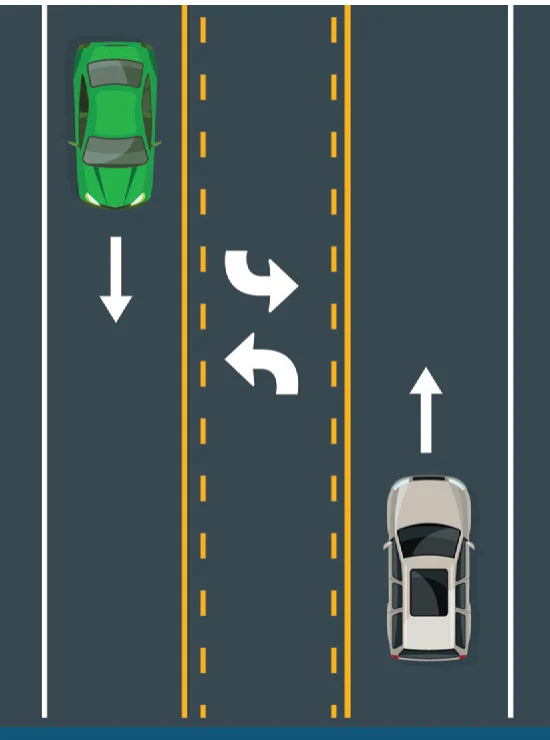
Shared center lanes are reserved for left turns in either direction, from or into the roadway (or U-turns where permitted). Watch oncoming cars: they can use the same lane.

Handbook p. 133 ↗
Center turn lane access
Shared center left turn lane

Know the rule

Never use a shared center lane for passing.

Handbook p. 134 ↗
300 feet

The farthest you should travel in a shared center lane

Handbook p. 134 ↗

Know the rule

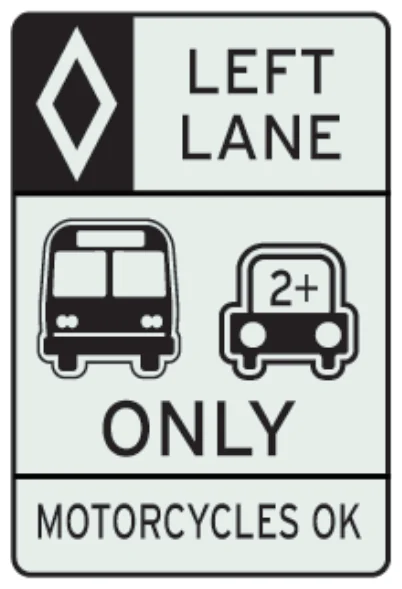
HOV lanes are for carpools, vanpools, and buses. They're marked with a diamond symbol on signs and pavement and separated from other lanes by a solid white line.

Handbook p. 134 ↗

Know the rule

To use an HOV lane, your vehicle must meet the occupancy posted on the signs. Motorcycles are also allowed.

Handbook p. 134 ↗
HOV lane (left lane only, motorcycles OK)
HOV lane sign: 2+ occupants, motorcycles OK

High occupancy vehicle (HOV)

A lane reserved for carpooling vehicles with 2 or more people inside.

Handbook p. 186 ↗

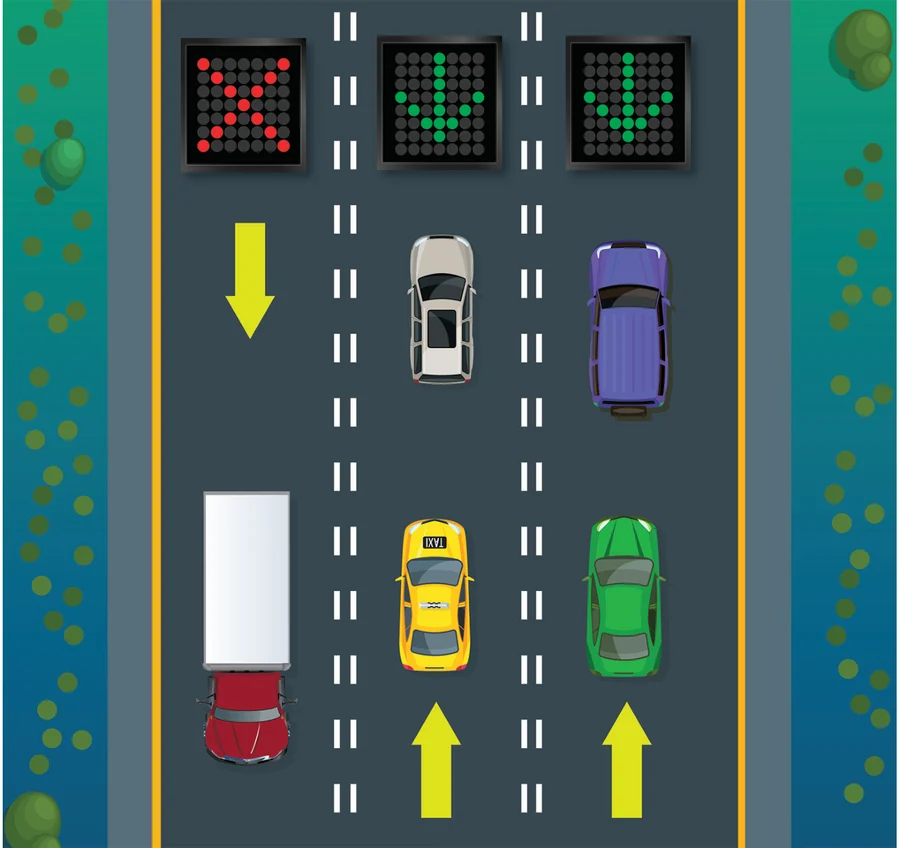
Reversible lane signals (overhead)

Reversible lane signals (overhead)
SignalMeaning
Green arrowYou can use the lane
Red XYou can't use the lane
Steady yellow XLane is changing direction; move out as soon as it's safe
Handbook p. 135 ↗

Know the rule

Reversible lanes, like express lanes, switch direction on regular schedules that follow commuting patterns, or for major events or incidents. They're usually marked by double-dashed white lines; check the overhead signs before entering.

Handbook p. 135 ↗
Lane use control signals
Reversible lane signals over each lane

Know the rule

Reserved lanes are marked by signs or pavement markings for special uses. For example, transit lanes are for buses only.

Handbook p. 136 ↗

Know the rule

Express toll and high occupancy toll lanes are toll-free for buses, vanpools, carpools, and motorcycles. Solo drivers can pay the toll for a faster trip. A Good To Go! account is the best way to pay tolls in Washington.

Handbook p. 136 ↗

Put it into practice

You're alone in your car on a freeway with an HOV lane posted "2+". You may not use it. Later you see an express toll lane: driving alone, you can use it only by paying the toll.

Check your understanding

Read the question, decide on an answer, then open it to check the explanation. These are Roadwise study questions based on the source handbook.

What symbol identifies an HOV lane?
  1. A star symbol
  2. A circle with a checkmark
  3. A triangle emblem
  4. A diamond symbol on signs and pavement

Answer: A diamond symbol on signs and pavement

HOV lanes are identified by a diamond symbol on both signs and the pavement.
Handbook p. 134 ↗
What is the farthest you should travel within a shared center turn lane?
  1. 1,000 feet
  2. 300 feet
  3. 100 feet
  4. 500 feet

Answer: 300 feet

You shouldn't travel farther than 300 feet in a shared center turn lane.

Handbook p. 134 ↗
Can you use a shared center turn lane to pass a slower vehicle?
  1. No, it's only for left turns
  2. Yes, briefly
  3. Yes, if traffic allows
  4. Yes, if you signal first

Answer: No, it's only for left turns

Shared center turn lanes must not be used for passing, only for left turns from either direction.

Handbook p. 134 ↗
In a reversible lane, what does a steady yellow X mean?
  1. The lane is closed permanently
  2. Only buses may use the lane
  3. The lane is changing direction; move out as soon as safe
  4. You may proceed immediately

Answer: The lane is changing direction; move out as soon as safe

A steady yellow X means the lane is changing direction, so move out as soon as it's safe.

Handbook p. 135 ↗
What is a transit lane an example of?
  1. An HOV lane requiring 2+ occupants
  2. A shared center turn lane
  3. A reserved lane for bus use only
  4. A toll lane open to all traffic

Answer: A reserved lane for bus use only

Reserved lanes like transit lanes are marked for special uses, such as buses only.

Handbook p. 136 ↗
What's the best way to pay tolls on Washington's toll roads?
  1. Paying online after each trip
  2. Using a Good To Go! account
  3. Paying cash at a tollbooth
  4. Mailing a check after each trip

Answer: Using a Good To Go! account

A Good To Go! account is the best way to pay tolls, saving money and enabling automatic payments.

Handbook p. 136 ↗
Take the lesson checkpoint in the app

More in Lane Markings and Special Zones