roadwise.Open study app

Washington driving lesson · Lane Markings and Special Zones

Crosswalks, bike lanes, and other markings

A 3-minute lesson from the Washington course. Read the rules and examples, follow the handbook page references, and check your understanding before you move on.

Read time
3 minutes
Course unit
Lane Markings and Special Zones
Checkpoint questions
6
Source pages
137, 138, 139, 140

Paint on the road also protects people outside cars. Crosswalks, bike lanes, sharrows, and bicycle boxes all tell you where walkers and riders will be and what you must do around them. Other markings show where to stop and where you can never drive or park.

Know the rule

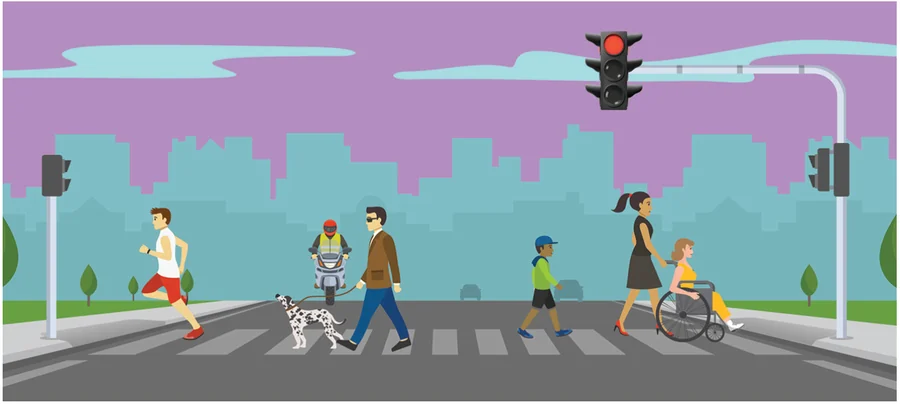
You must yield to people in or about to enter a crosswalk. Stay alert for pedestrians and bicyclists whenever you cross an intersection or turn.

Handbook p. 137 ↗

Know the rule

Some crosswalks have in-pavement lights activated by crossing pedestrians. You must yield when these lights are flashing.

Handbook p. 137 ↗

Know the rule

Not all crosswalks are marked. Every intersection is legally a crosswalk, whether or not there's a crosswalk marking.

Handbook p. 137 ↗
Crosswalk
Pedestrians in a marked crosswalk

Know the rule

Bike lanes are marked with solid white lines and bike symbols. Some are physically separated from traffic by bollards, posts, or planters.

Handbook p. 138 ↗

Know the rule

A buffer of two solid white lines with diagonal crosshatching is part of the bike lane. Don't enter it unless you're making a legal turn after checking that it's safe.

Handbook p. 138 ↗

Know the rule

Stop lines appear at stop signs and signals. Stop before your vehicle reaches the stop line, or the crosswalk if there is one.

Handbook p. 138 ↗

Know the rule

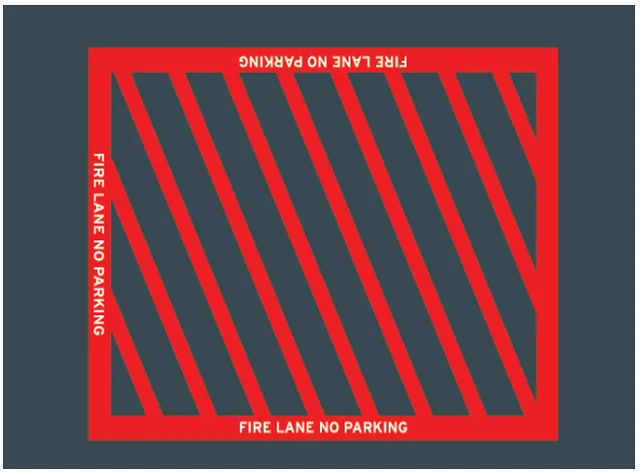
Fire lanes are usually marked with red stripes or a red curb. Don't park or stop in them. Some communities mark the road in front of a fire station as a fire lane.

Handbook p. 138 ↗
Fire lane marking
Fire lane marking

Know the rule

Yellow stripes show where you're not allowed to drive.

Handbook p. 139 ↗

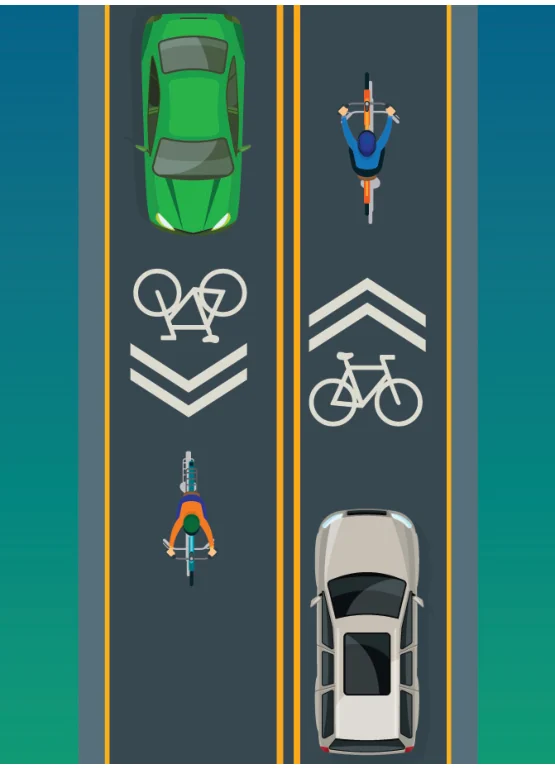
Sharrow

A road marking showing that a vehicle lane is shared with bicycles. Bicyclists line up with the sharrows and ride in the direction the arrow points.

Handbook p. 139 ↗

Know the rule

Where you see sharrows, watch for bicyclists, drive slowly, and give at least 3 feet when passing.

Handbook p. 139 ↗
Shared lane marking (sharrow)
Sharrow markings in a shared lane

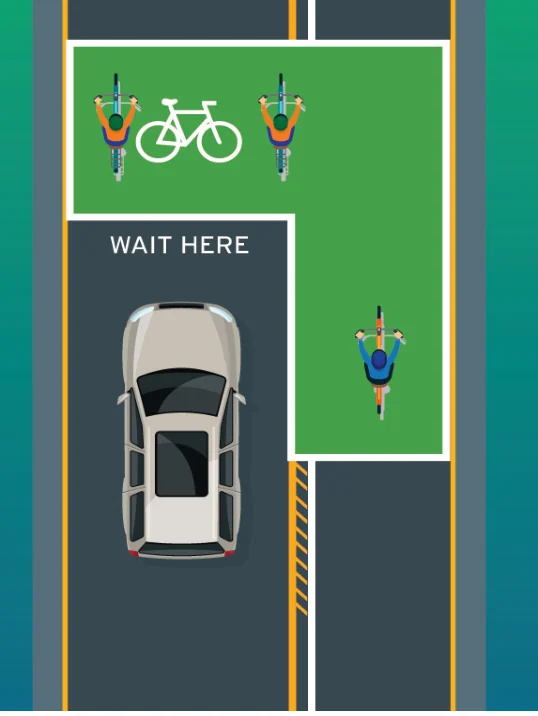
Bicycle box

A marked area at an intersection where bicyclists wait in front of vehicles. On green, bicyclists cross first into the bike lane on the other side.

Handbook p. 140 ↗

Know the rule

You can't turn right on red near a bicycle box. Stay behind the white line until the bicycle box is clear.

Handbook p. 140 ↗
Bicycle box (wait here)
Bicycle box: cars wait behind the white line

Put it into practice

You're first at a red light with a green bicycle box ahead and want to turn right. You can't turn on red here. Wait behind the white line; when the light turns green, let the bicyclists in the box go first, then turn.

Check your understanding

Read the question, decide on an answer, then open it to check the explanation. These are Roadwise study questions based on the source handbook.

You see sharrow markings in a lane ahead. What should you do?
  1. Drive slowly and give at least 3 feet of space to bicyclists
  2. Pass cyclists within the same lane
  3. Treat it as a bike-only lane
  4. Ignore it if no cyclist is visible

Answer: Drive slowly and give at least 3 feet of space to bicyclists

Sharrow markings mean the lane is shared with bicycle traffic; drive slowly and leave 3 feet of space.
Handbook p. 139 ↗
Can you turn right on red near a bicycle box?
  1. Yes, if no cyclist is present
  2. Yes, after a full stop
  3. Yes, if you signal first
  4. No, stay behind the white line until it's clear

Answer: No, stay behind the white line until it's clear

You can't turn right on red near a bicycle box; stay behind the white line until the box is clear.

Handbook p. 140 ↗
When must you yield for in-pavement crosswalk lights?
  1. Only during school hours
  2. Only if a sign is also posted
  3. Whenever they're flashing
  4. Only if a pedestrian is already in the crosswalk

Answer: Whenever they're flashing

You must yield when in-pavement crosswalk lights are flashing, since they're activated by crossing pedestrians.

Handbook p. 137 ↗
Every intersection is legally a crosswalk, even if no crosswalk is painted.
  1. True
  2. False

Answer: True

Every intersection is legally defined as a crosswalk, regardless of whether it's painted.

Handbook p. 137 ↗
A bike lane buffer marked with crosshatching between two solid white lines is considered part of the bike lane.
  1. True
  2. False

Answer: True

The crosshatched buffer is considered part of the bike lane and shouldn't be entered except for a legal turn.

Handbook p. 138 ↗
What does a fire lane marked with red stripes or a red curb mean?
  1. Parking is allowed for up to 5 minutes
  2. Only emergency vehicles may drive there
  3. It's reserved for delivery trucks
  4. Don't park or stop there

Answer: Don't park or stop there

Fire lanes, marked with red stripes or a red curb, must be kept clear — don't park or stop there.

Handbook p. 138 ↗
Take the lesson checkpoint in the app

More in Lane Markings and Special Zones