roadwise.Open study app

Washington driving lesson · Lane Markings and Special Zones

School, work, and emergency zones

A 3-minute lesson from the Washington course. Read the rules and examples, follow the handbook page references, and check your understanding before you move on.

Read time
3 minutes
Course unit
Lane Markings and Special Zones
Checkpoint questions
4
Source pages
140, 141, 142, 143

Three kinds of zones call for extra care: school zones where children may appear, work zones where crews stand feet from traffic, and emergency zones where responders are helping someone at the roadside. Each comes with its own speed rules.

Know the rule

A school zone is the roads around a school building or playground. It can be marked with signs, pavement markings, and flashing lights.

Handbook p. 140 ↗
20 mph

School zone speed limit

Handbook p. 140 ↗

Know the rule

Signs may clarify when the 20 mph limit applies. Students may be around after school for activities, sports, or the playground, so slow down near schools.

Handbook p. 140 ↗
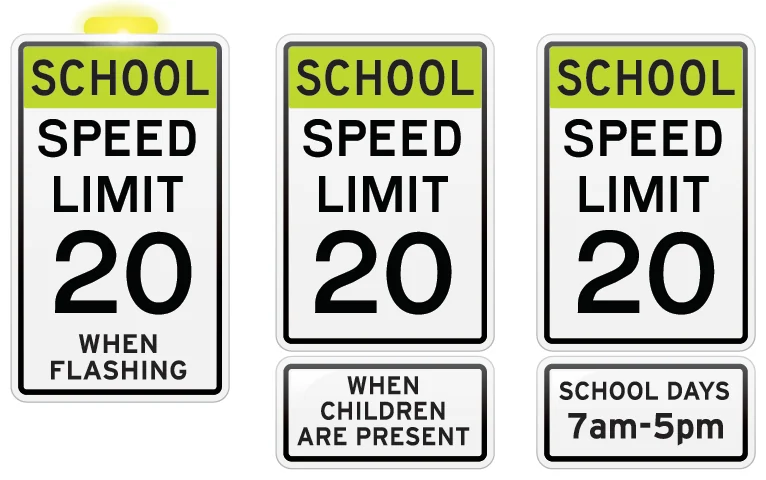
School speed limit signs (variants)
School speed limit 20 signs: when flashing, when children are present, school days

In a work zone:

  • Watch for signs, cones, barrels, large vehicles, and workers
  • Eliminate distractions: turn down music and pause conversations
  • Always reduce your speed, even with no workers present
  • Increase following distance and be prepared to stop
  • Use extreme caution at night, whether or not you see workers
  • Move over when possible to give workers and equipment space
Handbook p. 141 ↗

Know the rule

Observe work zone signs until you see the End Road Work sign. Expect delays, leave early, and use a different route when possible.

Handbook p. 142 ↗
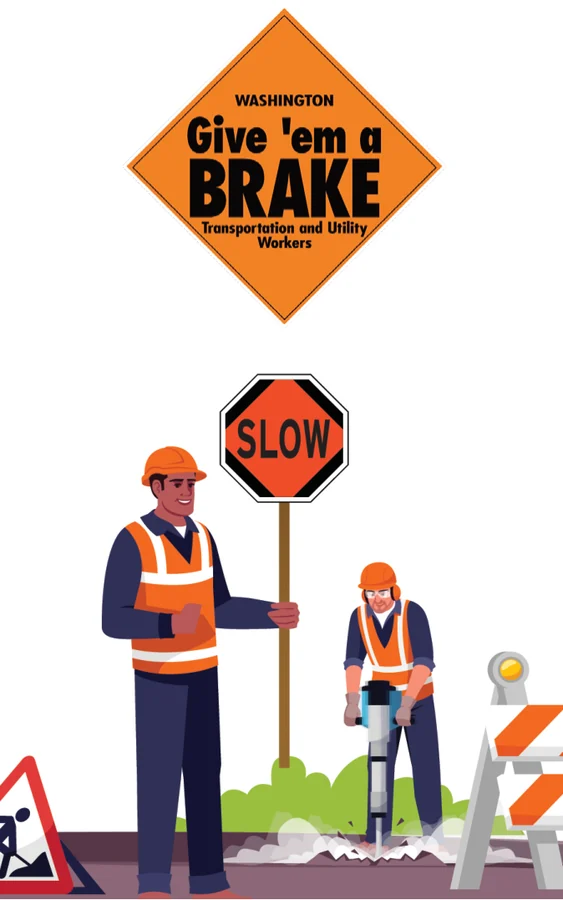
Work zone safety campaign (Give 'em a Brake)
Work zone flagger and crew

Know the rule

An emergency zone is created for a roadside situation needing immediate attention, such as a crash, a broken-down vehicle, or a person in distress.

Handbook p. 142 ↗

When you see a roadside response vehicle with flashing lights, you must either:

  • Move over into a farther lane
  • Slow down to at least 10 mph below the posted speed limit
Handbook p. 143 ↗
50 mph

Never drive faster than this in an emergency zone

Handbook p. 143 ↗

Roadside response vehicles include:

  • Tow trucks and solid waste trucks
  • Incident response and highway maintenance vehicles
  • Utility vehicles
  • Law enforcement, fire trucks, and ambulances
Handbook p. 143 ↗
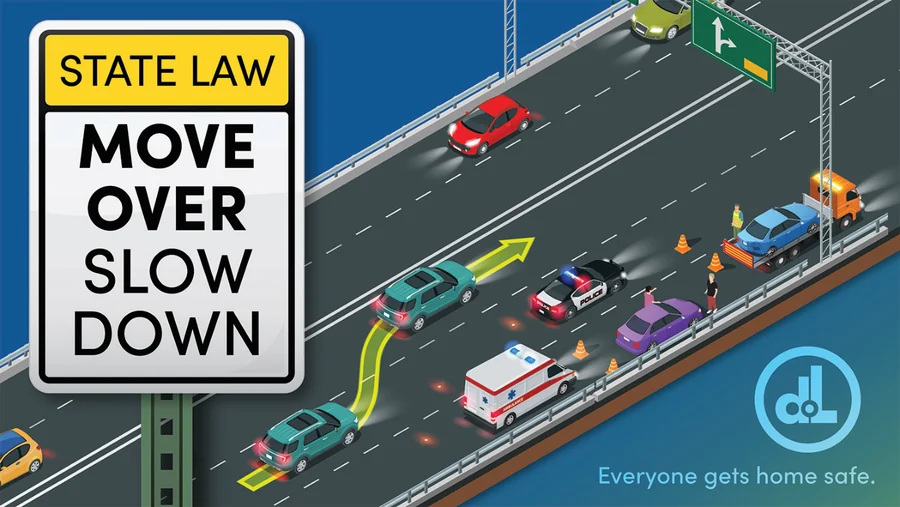
Move over law
State law: Move Over, Slow Down

Put it into practice

On a 60 mph freeway, a tow truck with flashing lights is on the right shoulder. Move into a farther lane if you can. If you can't, slow to 50 mph or less: at least 10 mph under the limit, and never over 50 in an emergency zone.

Check your understanding

Read the question, decide on an answer, then open it to check the explanation. These are Roadwise study questions based on the source handbook.

What is Washington's speed limit in a school zone?
  1. 30 mph
  2. 20 mph
  3. 15 mph
  4. 25 mph

Answer: 20 mph

The school zone speed limit is 20 mph because higher speeds increase the risk of fatal crashes.
Handbook p. 140 ↗
In an emergency zone where you can't move over into a farther lane, how much must you slow down?
  1. Down to a complete stop
  2. At least 10 mph below the posted limit
  3. At least 5 mph below the posted limit
  4. At least 20 mph below the posted limit

Answer: At least 10 mph below the posted limit

In an emergency zone, slow to at least 10 mph below the posted speed limit, or move over a lane.

Handbook p. 143 ↗
What is the fastest you may ever drive through an emergency zone, regardless of the posted limit?
  1. 50 mph
  2. 45 mph
  3. 60 mph
  4. 65 mph

Answer: 50 mph

You should never drive faster than 50 mph in an emergency zone, even if the posted limit is higher.

Handbook p. 143 ↗
You're driving through a work zone and no workers are visible. What should you do?
  1. Drive at the normal posted limit
  2. Still reduce your speed
  3. Slow down only at night
  4. Keep speed but use your hazards

Answer: Still reduce your speed

Always reduce your speed in a work zone, even with no workers; narrow lanes and rough pavement are hazards.

Handbook p. 141 ↗
Take the lesson checkpoint in the app

More in Lane Markings and Special Zones