roadwise.Open study app

Virginia driving lesson · Safe Driving Basics

Turning, U-Turns, Signals & Over-Correcting

A 3-minute lesson from the Virginia course. Read the rules and examples, follow the handbook page references, and check your understanding before you move on.

Read time
3 minutes
Course unit
Safe Driving Basics
Checkpoint questions
6
Source pages
20

A good turn starts well before the intersection: right lane, early signal, a look both ways and smooth braking. Virginia also limits where U-turns are legal and warns about over-correcting, which causes many single-vehicle crashes.

100 feet

Signal at least three to four seconds (100 feet) before a turn

Handbook p. 20 ↗

Know the rule

Signal whenever you change lanes, turn, or enter or exit a highway. It's required by law; signal even if no other traffic is around. After the turn, make sure the signal stops flashing.

Handbook p. 20 ↗

Know the rule

Right turn: be in the lane furthest right, signal, check for pedestrians and traffic, brake smoothly, and stop fully first if there's a red light or stop sign. Turn into the lane closest to the curb unless markings direct otherwise.

Handbook p. 20 ↗

Know the rule

Left turn: use the furthest left lane possible and turn into the leftmost lane of the new road, unless markings direct otherwise. With multiple left-turn lanes, pick the one that best serves your next move.

Handbook p. 20 ↗

Know the rule

While waiting to turn left, keep your front wheels pointed straight ahead, so a rear-end crash won't push you into oncoming traffic. Yield to oncoming vehicles, bicycles and pedestrians.

Handbook p. 20 ↗

Know the rule

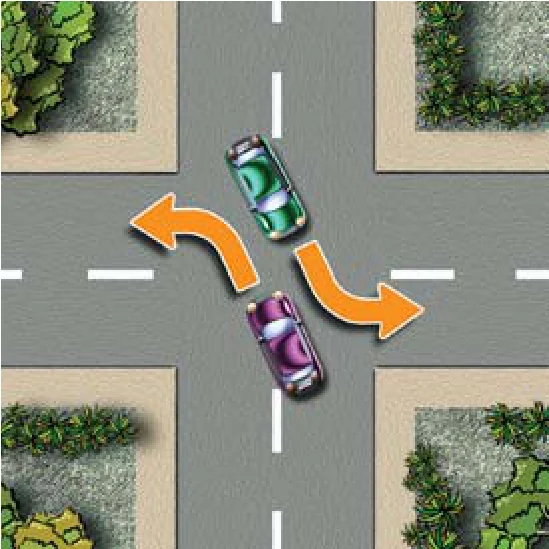
When two vehicles facing each other both turn left, they turn in front of each other, so their passenger sides pass beside each other.

Handbook p. 20 ↗
Left-turn path (opposing vehicles)
Opposing left turns pass in front of each other

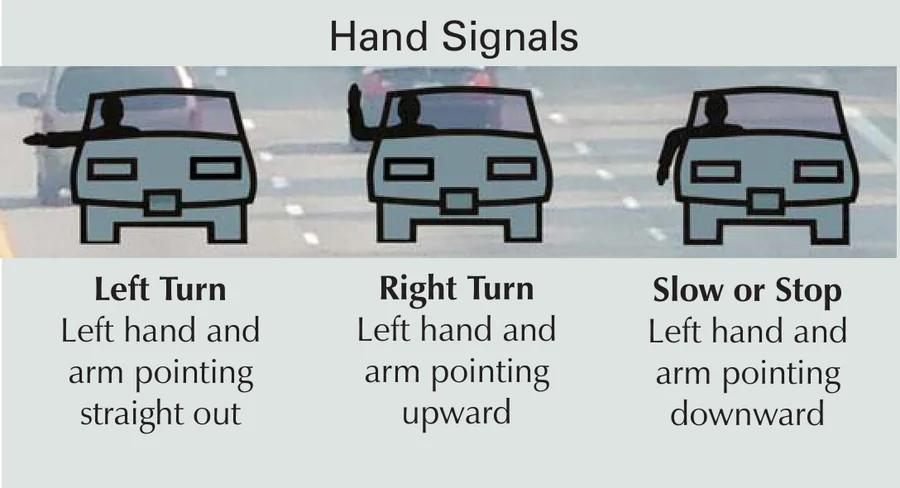
Hand signals (left hand and arm)

Hand signals (left hand and arm)
SignalArm position
Left turnPointing straight out
Right turnPointing upward
Slow or stopPointing downward
Handbook p. 20 ↗
Hand signals (turn and stop)
Hand signals

Know the rule

U-turns: check for No U-Turn or No Left Turn signs. In business districts, cities and towns, U-turns are allowed only at intersections. Never make a U-turn on a highway.

Handbook p. 20 ↗

Know the rule

To make a U-turn, turn on your left signal, stop, and yield to approaching traffic. When clear, turn into the outside (right-hand) lane going the other way.

Handbook p. 20 ↗

Over-correcting

Turning the steering wheel more sharply than expected, so the rear wheels slide toward the outside of the turn; it may cause loss of control.

Handbook p. 20 ↗

Know the rule

Most over-correction crashes are single-vehicle and preventable. If you veer off the road, don't panic: gradually slow down, look where you want to go, and slowly steer back.

Handbook p. 20 ↗

Put it into practice

Your right wheels drift onto the gravel shoulder. Don't panic or jerk the wheel. Gradually reduce your speed, look where you want to go, and slowly steer back onto the roadway.

Check your understanding

Read the question, decide on an answer, then open it to check the explanation. These are Roadwise study questions based on the source handbook.

How far ahead of a turn should you signal?
  1. One second, about 10 feet
  2. Ten seconds, about 500 feet
  3. About 100 feet (3-4 seconds)
  4. Immediately before turning the wheel

Answer: About 100 feet (3-4 seconds)

Signal three or four seconds, about 100 feet, ahead of your turn.
Handbook p. 20 ↗
What is the correct hand signal for a left turn?
  1. Left hand and arm pointing upward
  2. Left hand and arm pointing downward
  3. Right hand and arm pointing straight out
  4. Left hand and arm pointing straight out

Answer: Left hand and arm pointing straight out

The hand signal for a left turn is the left hand and arm pointing straight out.

Handbook p. 20 ↗
In business districts, cities, and towns, where are U-turns generally allowed?
  1. Anywhere without a No U-Turn sign
  2. Only on one-way streets
  3. Only at intersections
  4. Only from marked turn lanes

Answer: Only at intersections

In business districts, cities, and towns, U-turns are allowed only at intersections.

Handbook p. 20 ↗
What causes an over-correction crash?
  1. Steering too sharply, making the rear wheels slide out
  2. Braking hard while going straight
  3. Steering too little in a sharp curve
  4. Accelerating hard out of a turn

Answer: Steering too sharply, making the rear wheels slide out

Over-correcting happens when the driver turns the wheel too sharply, causing the rear wheels to slide toward the outside of the turn.

Handbook p. 20 ↗
If you veer off the road, what is the correct response?
  1. Brake hard immediately and turn the wheel sharply back
  2. Gradually reduce speed, look where you want to go, and steer back slowly
  3. Accelerate to regain control quickly
  4. Steer back sharply at your current speed

Answer: Gradually reduce speed, look where you want to go, and steer back slowly

If you veer off the road, don't panic; gradually reduce speed, look where you want to go, and slowly steer back onto the roadway.

Handbook p. 20 ↗
When making a left turn, why should you keep your front wheels pointed straight ahead until you actually turn?
  1. So oncoming drivers can see your turn signal better
  2. So you can accelerate faster once clear
  3. So a rear-end hit won't push you into traffic
  4. So you can finish the turn in a tighter arc

Answer: So a rear-end hit won't push you into traffic

Keeping your wheels straight prevents you from being pushed into oncoming traffic if another vehicle hits you from behind.

Handbook p. 20 ↗
Take the lesson checkpoint in the app

More in Safe Driving Basics