Roadwise States Virginia Driving lessons Stopping Distance & Antilock Brakes Virginia driving lesson · Safe Driving Basics
Stopping Distance & Antilock Brakes A 2-minute lesson from the Virginia course. Read the rules and examples, follow the handbook page references, and check your understanding before you move on.
Read time 2 minutes
Course unit Safe Driving Basics
Checkpoint questions 3
Source pages 17 A car can't stop instantly. First you have to notice the danger, then move your foot, then the brakes have to bring you to a halt. Every one of those stages grows with speed and bad conditions, which is why distances add up so fast.
Three factors determine stopping distance: Perception time: the time it takes you to recognize a hazard Reaction distance: how far you travel between recognizing a problem and applying the brakes Braking distance: how far your car travels after you apply the brakes Handbook p. 17 ↗ Know the rule
Perception time, reaction distance and braking distance are affected by weather, visibility, and your mental and physical condition.
Handbook p. 17 ↗ Know the rule
Braking distance is also affected by your speed, the condition of your brakes and tires, and the pavement. Wet pavement can double your braking distance.
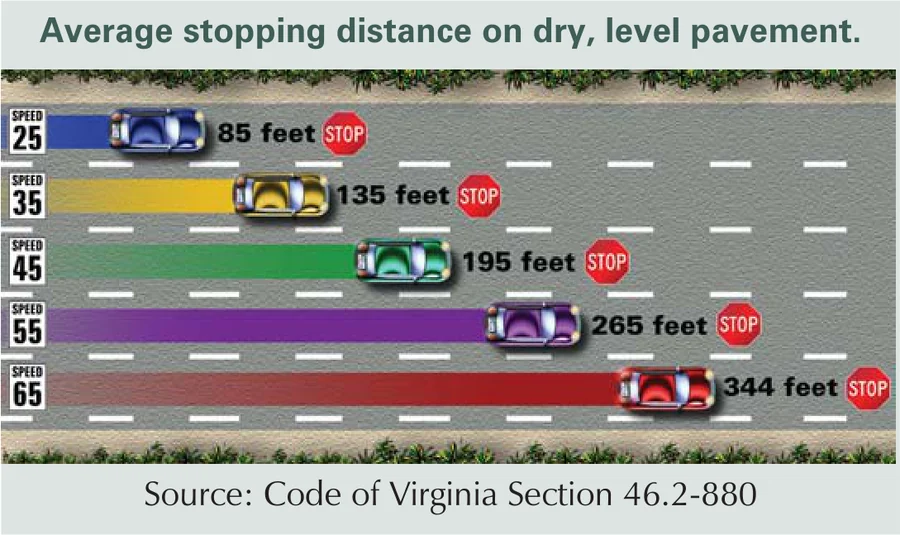
Handbook p. 17 ↗ Average stopping distance chart (Code of Virginia 46.2-880) Know the rule
If your vehicle has antilock brakes, learn how they work from the owner's manual and practice before driving on the road. Never pump antilock brakes.
Handbook p. 17 ↗ Put it into practice
At 55 MPH on dry pavement you need about 265 feet to stop. On wet pavement, braking distance can double, so leave much more room.
Check your understanding Read the question, decide on an answer, then open it to check the explanation. These are Roadwise study questions based on the source handbook.
What three factors determine your vehicle's total stopping distance? Speed, vehicle weight, and road surface Perception time, reaction time, and tire grip Following distance, speed, and visibility Perception time, reaction distance, and braking distance Answer: Perception time, reaction distance, and braking distance
Stopping distance is determined by perception time, reaction distance, and braking distance.
Handbook p. 17 ↗ How does wet pavement typically affect your braking distance? It can double your braking distance It has no measurable effect It slightly shortens it It can triple your braking distance Answer: It can double your braking distance
Wet pavement can double your braking distance compared to dry pavement.
Handbook p. 17 ↗ What should you never do with antilock brakes? Apply them firmly Pump them Use them on wet pavement Use them at highway speeds Answer: Pump them
If your vehicle has antilock brakes, you should never pump them.
Handbook p. 17 ↗ Previous lesson When You Must Stop & School Buses Next lesson Right-of-Way & Roundabouts More in Safe Driving Basics About the source Roadwise’s Virginia course uses the driver handbook edition supplied with this study pack. This lesson cites source pages 17. The linked PDF is a third-party mirror of the handbook, rather than a government-hosted page.
Open the handbook source PDF · View the source edition
For current application requirements, fees, appointments, and the format that applies to your age or license type, check Virginia’s DMV. Roadwise provides study material and does not issue permits or licenses.