roadwise.Open study app

Virginia driving lesson · Safe Driving Basics

Changing Lanes & Passing

A 3-minute lesson from the Virginia course. Read the rules and examples, follow the handbook page references, and check your understanding before you move on.

Read time
3 minutes
Course unit
Safe Driving Basics
Checkpoint questions
6
Source pages
19, 20

Changing lanes and passing put you beside and in front of other vehicles, often at speed. Virginia expects a set routine every time, and bans passing where you can't see far enough or where people may be in the road.

Changing lanes, in order:

  • Check your side and rearview mirrors for traffic approaching from behind
  • Turn on your signal
  • Check for other drivers moving into the same lane
  • Just before moving, quickly glance over your shoulder at your blind spot
Handbook p. 19 ↗

Know the rule

On a multi-lane highway, stay in the right lane if you're slower than traffic around you. The left lane is for passing only, not cruising.

Handbook p. 19 ↗

Know the rule

Before passing, check ahead, behind and your blind spot. Signal, then accelerate. Return to the right lane when you can see the front of the passed vehicle in your rearview mirror.

Handbook p. 19 ↗

Know the rule

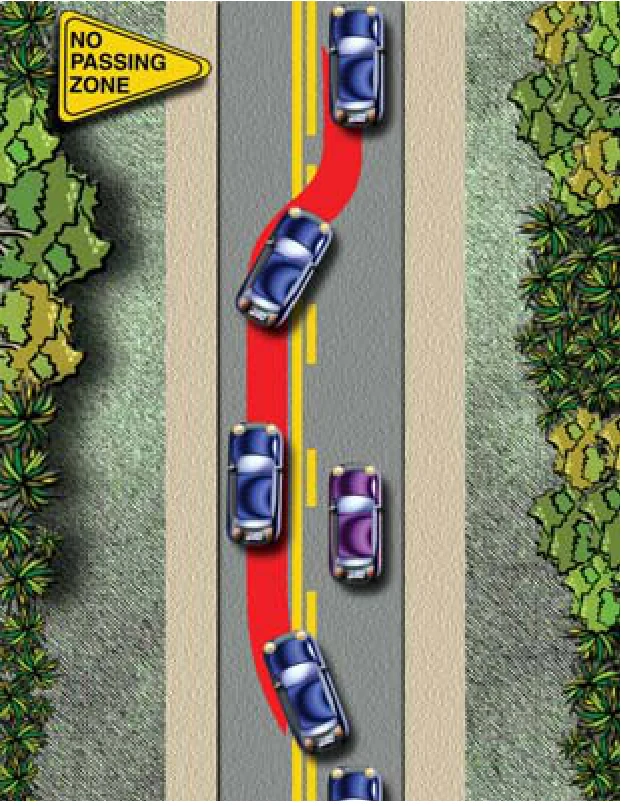
It is against the law to exceed the speed limit while passing. Finish the pass before a No Passing zone; still being in the left lane there is breaking the law.

Handbook p. 19 ↗

Know the rule

You may pass on the right only when the vehicle ahead has signaled and is turning left, and never if you must drive off the pavement or main roadway to do it.

Handbook p. 19 ↗
3 feet

Minimum clearance to the left when passing a bicycle, moped, power-assisted bicycle or other device (reduce speed too)

Handbook p. 19 ↗

Know the rule

When being passed, don't speed up. Keep a steady speed or slow down.

Handbook p. 19 ↗

Passing is unlawful and unsafe:

  • On hills, curves, at intersections or railroad crossings (unless 2+ lanes go your direction)
  • Off the pavement or on the shoulder
  • When a school bus is stopped to load or unload on a public road, unless a barrier or unpaved median divides it
  • When a school bus is loading or unloading on a private road
  • When a solid line marks the left side of your lane
  • Near a crosswalk when the vehicle ahead or in the next lane is stopped
Handbook p. 20 ↗
No-passing zone
Complete the pass before the no passing zone

Put it into practice

A car ahead signals left and slows to turn. You may pass on its right if you can stay on the pavement, but watch carefully: the turning car may block your view of other traffic, and theirs of you.

Check your understanding

Read the question, decide on an answer, then open it to check the explanation. These are Roadwise study questions based on the source handbook.

On a multi-lane highway, the left lane is generally reserved for what?
  1. Slower traffic
  2. Trucks and buses
  3. Cruising at the speed limit
  4. Passing only

Answer: Passing only

The left lane is for passing only, not cruising; stay right if you're driving slower than surrounding traffic.
Handbook p. 19 ↗
When passing another vehicle, when should you return to the right lane?
  1. When you see its front in your rearview mirror
  2. Right after your rear bumper clears its front bumper
  3. After signaling for at least three seconds
  4. When the passed driver flashes their headlights

Answer: When you see its front in your rearview mirror

Return to the right lane as soon as you can see the front of the passed vehicle in your rearview mirror.

Handbook p. 19 ↗
When may you legally pass another vehicle on the right?
  1. Whenever the right lane is open
  2. When the car ahead is turning left
  3. On any two-lane road with light traffic
  4. Whenever you must drive off the pavement to do so

Answer: When the car ahead is turning left

You may pass on the right if the vehicle ahead has signaled and is making a left turn, but be cautious of blocked views.

Handbook p. 19 ↗
How much clearance must you give when passing a bicyclist?
  1. At least one foot to the left
  2. Any distance, as long as you slow down
  3. At least three feet to the left
  4. At least six feet to the left

Answer: At least three feet to the left

When approaching or passing a bicyclist, reduce speed and pass at least three feet to the left.

Handbook p. 19 ↗
Passing is unlawful on hills, curves, or at intersections, except under what condition?
  1. On roads with 2+ lanes moving your direction
  2. When traffic is very light
  3. When no oncoming traffic is in sight
  4. On roads with a posted speed limit above 45 MPH

Answer: On roads with 2+ lanes moving your direction

Passing on hills, curves, or at intersections is unlawful except on roads with two or more same-direction lanes.

Handbook p. 19 ↗
Before changing lanes, what should you do just before moving into the new lane?
  1. Turn on your turn signal
  2. Glance over your shoulder at your blind spot
  3. Check your side and rearview mirrors
  4. Accelerate rapidly to complete the move quickly

Answer: Glance over your shoulder at your blind spot

Just before moving into the other lane, quickly glance over your shoulder to check for vehicles in your blind spot.

Handbook p. 19 ↗
Take the lesson checkpoint in the app

More in Safe Driving Basics