roadwise.Open study app

Virginia driving lesson · Safe Driving Basics

Space Cushion & Following Distance

A 3-minute lesson from the Virginia course. Read the rules and examples, follow the handbook page references, and check your understanding before you move on.

Read time
3 minutes
Course unit
Safe Driving Basics
Checkpoint questions
6
Source pages
21

Space is your reaction time. Staying in the middle of your lane with room ahead and behind gives you time to steer or brake out of trouble. Virginia measures following distance in seconds, and the number of seconds rises with speed.

Know the rule

Create a space cushion by staying in the middle of your lane, with enough room ahead and behind for others to pass or stop safely.

Handbook p. 21 ↗

Following distance on dry surfaces

Following distance on dry surfaces
Your speedFollowing time
Under 35 MPH2 seconds
35–45 MPH3 seconds
46–70 MPH4 seconds
Handbook p. 21 ↗

Know the rule

These space cushions do not work if you're speeding over 70.

Handbook p. 21 ↗

How to count it:

  • Watch the vehicle ahead pass a fixed object (overpass, sign, fence, corner)
  • Count the seconds until you reach the same place
  • Reach it before counting 2, 3 or 4 (by speed)? You're too close; slow down
  • Add extra seconds for bad weather, heavy traffic, poor pavement or a vehicle in poor condition
Handbook p. 21 ↗

Response times

Response times
ResponseTime
Hand responseClose to a half second
Foot responseNormally three-quarters of a second
Handbook p. 21 ↗

Know the rule

These times don't include delays in perception from being tired, on medication or distracted. Road conditions, speed, alertness and vehicle weight all change your ability to stop.

Handbook p. 21 ↗

Increase your following distance:

  • Behind a large vehicle that blocks your vision
  • In bad weather or heavy traffic
  • When exiting an expressway
  • Behind a motorcycle or bicycle
  • When being tailgated
Handbook p. 21 ↗

Know the rule

If you're tailgated, don't brake suddenly. Move to another lane if possible, or gently tap your brakes to flash your brake lights and slow down, encouraging the tailgater to pass or slow.

Handbook p. 21 ↗

Know the rule

Help the driver behind you: keep a safe following distance and steady speed, and tap your brakes to warn them when you plan to slow or stop.

Handbook p. 21 ↗
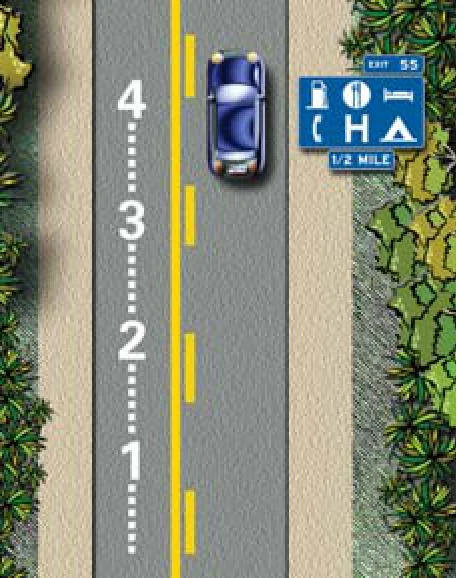
Exit countdown markers with guide sign
Counting following distance from a fixed mark

Put it into practice

At 40 MPH, the car ahead passes a road sign. You count 'one-thousand-one, one-thousand-two' and pass the sign. At 35–45 MPH you need 3 seconds, so drop back.

Check your understanding

Read the question, decide on an answer, then open it to check the explanation. These are Roadwise study questions based on the source handbook.

What following distance is recommended when traveling under 35 MPH on a dry surface?
  1. 2 seconds
  2. 3 seconds
  3. 4 seconds
  4. 1 second

Answer: 2 seconds

At speeds under 35 MPH on dry surfaces, a 2-second following distance is recommended.
Handbook p. 21 ↗
What following distance is recommended when traveling 46 to 70 MPH on a dry surface?
  1. 2 seconds
  2. 4 seconds
  3. 3 seconds
  4. 5 seconds

Answer: 4 seconds

At 46-70 MPH on dry surfaces, a 4-second following distance is recommended.

Handbook p. 21 ↗
According to the manual, the standard following-distance space cushions do not reliably work above what speed?
  1. 55 MPH
  2. 85 MPH
  3. 70 MPH
  4. 100 MPH

Answer: 70 MPH

The manual says the 2-, 3- and 4-second space cushions do not work if you're speeding over 70 MPH.

Handbook p. 21 ↗
When should you add extra seconds to your following distance?
  1. Only above 45 MPH
  2. Only on unpaved roads
  3. When traffic is light and roads are clear
  4. In bad weather, heavy traffic, or poor vehicle condition

Answer: In bad weather, heavy traffic, or poor vehicle condition

For bad weather, heavy traffic, poor pavement, or a vehicle in poor condition, add extra seconds to your following distance.

Handbook p. 21 ↗
If you are being tailgated, what is the recommended response?
  1. Tap your brakes gently to flash your brake lights
  2. Brake suddenly to warn them
  3. Speed up until they fall back
  4. Pull onto the shoulder and stop

Answer: Tap your brakes gently to flash your brake lights

If tailgated, don't brake suddenly; move over if possible, or gently tap your brakes so the tailgater passes or slows down.

Handbook p. 21 ↗
Foot response time is generally faster than hand response time.
  1. True
  2. False

Answer: False

Hand response time is close to a half second, while foot response time is normally three-quarters of a second, so hand response is faster.

Handbook p. 21 ↗
Take the lesson checkpoint in the app

More in Safe Driving Basics