roadwise.Open study app

Virginia driving lesson · Sharing the Road

Bicycles & Motorcycles

A 3-minute lesson from the Virginia course. Read the rules and examples, follow the handbook page references, and check your understanding before you move on.

Read time
3 minutes
Course unit
Sharing the Road
Checkpoint questions
6
Source pages
22

Bicycles and motorcycles are small, easy to miss, and give their riders no protection. Many crashes happen because the driver never saw the motorcycle. Give two-wheelers extra space, extra looks and extra time.

Know the rule

A bicyclist on a roadway generally has the same right-of-way as a motor vehicle driver.

Handbook p. 22 ↗

Know the rule

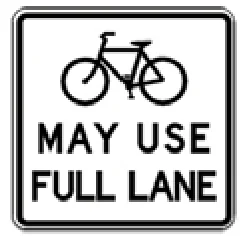
Bicyclists may ride in the center of the lane when necessary, such as when about to turn left or when the lane is too narrow to share side by side with a car.

Handbook p. 22 ↗

Know the rule

Bicyclists may use all public roads except interstates and most freeways (limited access highways). Expect them riding either direction on sidewalks, shared-use paths and two-way separated bike lanes.

Handbook p. 22 ↗
3 feet

Minimum clearance when passing a bicyclist; if the lane is too narrow for that, change lanes to pass

Handbook p. 22 ↗

Know the rule

Motor vehicles may not use marked bicycle lanes, including while passing.

Handbook p. 22 ↗

Know the rule

A bicycle's or motorcycle's small size lets it slip into your blind spot. Check before you pull out, change lanes, turn, back up, open your door, or go through an intersection.

Handbook p. 22 ↗
More than half

Share of fatal motorcycle crashes that involve automobiles

Handbook p. 22 ↗

Motorcycle safety:

  • Look twice: in more than half of car-motorcycle crashes, the driver didn't see the bike in time
  • Never tailgate: add an extra second to the following distance rule
  • In inclement weather, double that distance
  • Expect sudden moves within the lane; riders use the entire lane as conditions change
  • Never drive beside a motorcycle in the same lane
  • Check twice before pulling out; its size can fool you about speed and distance
Handbook p. 22 ↗

Know the rule

Motorcycle permits and licenses are covered in the Virginia Motorcycle Operator Manual (DMV 2).

Handbook p. 22 ↗
Bicycles may use full lane
Bicycles may use full lane sign

Put it into practice

You're following a motorcycle at 50 MPH on a dry road. The 4-second rule plus one extra second gives you 5 seconds. If it starts raining, double that distance.

Check your understanding

Read the question, decide on an answer, then open it to check the explanation. These are Roadwise study questions based on the source handbook.

On what roads are bicyclists generally NOT allowed to ride?
  1. Any two-lane road
  2. Residential streets
  3. Roads with a bike lane
  4. Interstates and most freeways (limited access highways)

Answer: Interstates and most freeways (limited access highways)

Bicyclists are legally allowed on all public roads except interstates and most freeways.
Handbook p. 22 ↗
When is a bicyclist allowed to ride in the center of the travel lane?
  1. When turning left or the lane is too narrow to share
  2. Only when riding as fast as traffic
  3. Never, bicycles must always ride at the edge
  4. Only when there is no other traffic present

Answer: When turning left or the lane is too narrow to share

Bicyclists may ride in the center of the lane when necessary, such as turning left or when the lane is too narrow to share side-by-side.

Handbook p. 22 ↗
How much clearance does Virginia law require when passing a bicyclist?
  1. At least one foot
  2. At least three feet
  3. At least six feet
  4. At least ten feet

Answer: At least three feet

State law requires motorists to pass cyclists with at least three feet of clearance.

Handbook p. 22 ↗
If the travel lane is not wide enough to pass a bicyclist with three feet of clearance, what must a motorist do?
  1. Pass anyway at reduced speed
  2. Pass with at least one foot of clearance
  3. Change lanes to pass safely
  4. Wait for the bicyclist to leave the lane

Answer: Change lanes to pass safely

If the lane is not wide enough for a three-foot clearance, the motorist must change lanes to pass safely.

Handbook p. 22 ↗
How should you adjust your following distance behind a motorcycle?
  1. Add one second to your following distance
  2. Follow exactly as you would a car
  3. Reduce your following distance to see around it
  4. Only adjust it in the rain

Answer: Add one second to your following distance

Never tailgate a motorcycle; add an extra second to the following distance rule, doubling it in bad weather.

Handbook p. 22 ↗
Why should you never drive beside a motorcycle in the same lane?
  1. Motorcycles are legally entitled to the whole road
  2. The rider may use the whole lane and move suddenly
  3. Motorcycles accelerate faster than cars
  4. Motorcycles need extra room to brake

Answer: The rider may use the whole lane and move suddenly

Although not as wide as the lane, a motorcyclist may use the entire lane, so never drive beside one in the same lane.

Handbook p. 22 ↗
Take the lesson checkpoint in the app

More in Sharing the Road