roadwise.Open study app

Virginia driving lesson · Sharing the Road

Backing, Parking & Painted Curbs

A 3-minute lesson from the Virginia course. Read the rules and examples, follow the handbook page references, and check your understanding before you move on.

Read time
3 minutes
Course unit
Sharing the Road
Checkpoint questions
6
Source pages
24, 15

Backing and parking happen at low speed, but people and cars move all around you. Virginia sets exact distances for where you can't park, and the direction you turn your wheels on a hill keeps a parked car from rolling into traffic.

Know the rule

The most common backing mistake is failing to look both ways behind you. Mirrors don't give a full view: turn your body and head right, look through the rear window, back slowly, and glance quickly to either side.

Handbook p. 24 ↗

Know the rule

Park as far from traffic as possible. On a shoulder, pull as far over as possible; beside a curb, pull close to it.

Handbook p. 24 ↗
1 foot

Maximum distance you may park from the curb

Handbook p. 24 ↗

Know the rule

On a two-way street, park on the right side of the road. On a one-way road, you may park on either side.

Handbook p. 24 ↗

Know the rule

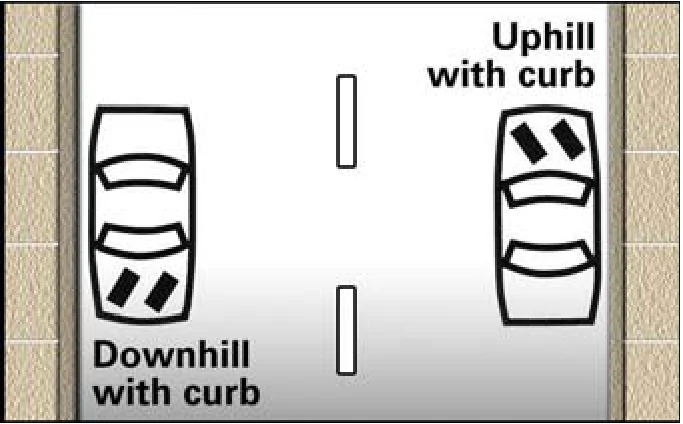
With a curb, turn your front wheels to keep the car from rolling into the street. Without a curb, turn them so the rear of the car would roll away from traffic.

Handbook p. 24 ↗

Parking on a hill

Parking on a hill
SituationFront wheels
Uphill, with curbTurn left
Uphill, no curbTurn right
Downhill, with curbTurn right
Downhill, no curbTurn right
Handbook p. 24 ↗
Parking on a hill (with curb)
Uphill and downhill with a curb

Know the rule

Look for cars, bicyclists and pedestrians before opening your door.

Handbook p. 24 ↗

Never park within…

Never park within…
DistanceOf
15 feetA fire hydrant
15 feetThe entrance to a fire, ambulance or rescue squad station
20 feetAn intersection
50 feetA railroad crossing
500 feetWhere fire trucks or equipment answer an alarm
Handbook p. 24 ↗

You also may not park:

  • Beside another parked vehicle (double parking)
  • On crosswalks or sidewalks, or in front of driveways
  • Where yellow curbs or No Parking signs prohibit it
  • In a disabled parking space or its striped access aisle
  • On the hard surface of a road when no curb is present
  • In a bike lane
  • Where you block or create a hazard for vehicles in a traffic lane
Handbook p. 24 ↗

Painted curbs (check local meanings)

Painted curbs (check local meanings)
ColorMeaning
WhiteStop only to pick up or drop off passengers
YellowStop only to load or unload; stay with your car
RedDo not stop, stand or park
Handbook p. 15 ↗

Put it into practice

You find a spot 18 feet from a corner, on a street with a hydrant 20 feet away. The hydrant distance is fine (15 feet), but you're within 20 feet of the intersection, so you can't park there.

Check your understanding

Read the question, decide on an answer, then open it to check the explanation. These are Roadwise study questions based on the source handbook.

A painted red curb generally means what?
  1. Stop only to load or unload while staying with your car
  2. Parking is allowed for up to 15 minutes
  3. Do not stop, stand, or park
  4. Parking is reserved for disabled permit holders

Answer: Do not stop, stand, or park

A red curb generally means do not stop, stand, or park there.
Handbook p. 15 ↗
When parking next to a curb, how far from the curb can you legally park?
  1. No more than one foot from the curb
  2. No more than three feet from the curb
  3. Exactly against the curb only
  4. No more than six inches from the curb

Answer: No more than one foot from the curb

You may not park more than one foot from the curb.

Handbook p. 24 ↗
How close to a fire hydrant may you legally park?
  1. No closer than 5 feet
  2. No closer than 15 feet
  3. No closer than 25 feet
  4. No closer than 50 feet

Answer: No closer than 15 feet

You may not park within 15 feet of a fire hydrant.

Handbook p. 24 ↗
How close to an intersection is it illegal to park?
  1. Within 10 feet
  2. Within 15 feet
  3. Within 20 feet
  4. Within 50 feet

Answer: Within 20 feet

You may not park within 20 feet of an intersection.

Handbook p. 24 ↗
How close to a railroad crossing is parking prohibited?
  1. Within 15 feet
  2. Within 20 feet
  3. Within 100 feet
  4. Within 50 feet

Answer: Within 50 feet

You may not park within 50 feet of a railroad crossing.

Handbook p. 24 ↗
When parking uphill without a curb, which way should you turn your front wheels?
  1. Straight ahead, regardless of the grade
  2. Left, toward the center of the road
  3. Right, so the rear rolls away from traffic
  4. Left, so the car rolls toward the shoulder

Answer: Right, so the rear rolls away from traffic

Without a curb, turn the front wheels (to the right, per the diagram) so that if the vehicle rolls, the rear rolls away from traffic.

Handbook p. 24 ↗
Take the lesson checkpoint in the app

More in Sharing the Road