roadwise.Open study app

Vermont driving lesson · Hazardous Driving Conditions

Work zones

A 3-minute lesson from the Vermont course. Read the rules and examples, follow the handbook page references, and check your understanding before you move on.

Read time
3 minutes
Course unit
Hazardous Driving Conditions
Checkpoint questions
6
Source pages
36, 37, 38

A work zone is any stretch of highway with construction, maintenance or utility work. It may be stationary, or it may move slowly, as with line striping, mowing and snow removal. Many crashes happen before the work area, where drivers are slowing and merging.

Know the rule

Most work zone crashes are rear-end crashes caused by driving too fast for conditions and not keeping a safe following distance. Stopped traffic may be hidden around a curve or over a hill.

Handbook p. 36 ↗

Safe driving in Vermont work zones:

  • Rules apply 24/7, not just in daylight
  • Slow to the posted limit and adjust for weather
  • Minimize distractions; expect pedestrians and bicyclists too
  • Follow the signs; merge as instructed as soon as it's safe
  • Don't change lanes in the work zone, tailgate or drive aggressively
  • Give roadway workers and their equipment as much space as possible
  • Keep a 4-second following distance
  • Be patient, expect delays, or take another route
Handbook p. 36 ↗

Distance to stop a passenger car on dry pavement

Distance to stop a passenger car on dry pavement
SpeedStopping distance
30 mph75 feet
60 mph240 feet
Handbook p. 36 ↗

Know the rule

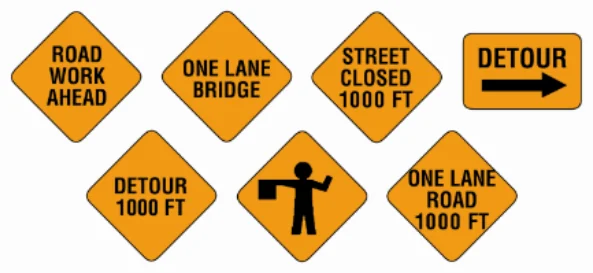
Work zone signs are orange and diamond or rectangular shaped. They warn of hazards such as closed lanes, detours, rough pavement or flaggers.

Handbook p. 37 ↗
Common work-zone signs
Work zone signs

Know the rule

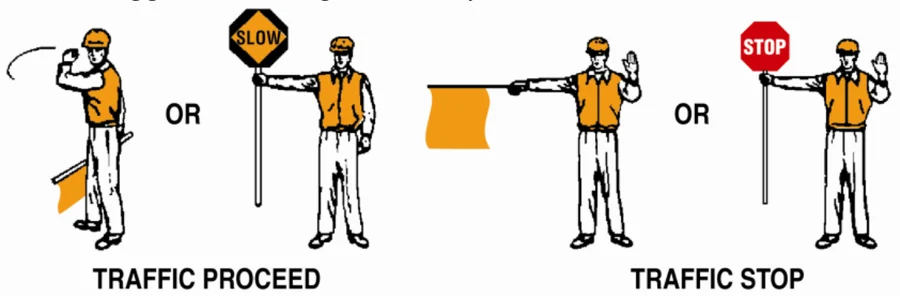
Flaggers use STOP/SLOW paddles or orange flags to guide traffic. A flagger has legal authority to control traffic and must be obeyed.

Handbook p. 37 ↗
Flagger stop/slow paddle
Flagger signals: traffic proceed and traffic stop
Work zone traffic control devices
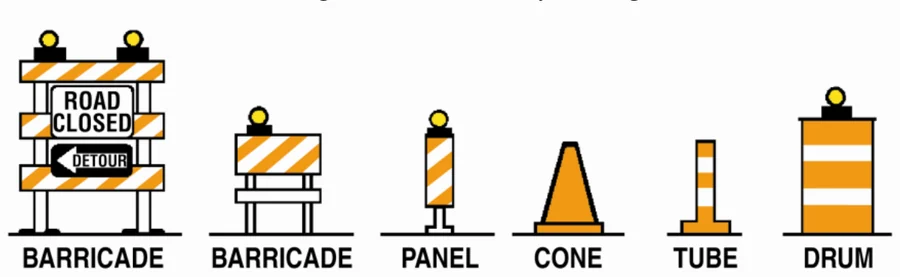
Channeling devices: barricades, panel, cone, tube and drum

Channeling devices

Cones, drums and barricades used to keep traffic out of hazardous work areas and guide it safely through the work zone.

Handbook p. 37 ↗

Know the rule

Flashing arrow panels guide you into the correct lane. In "caution" mode they show a straight line of blinking lights, or blinking corner lights. Slow down when you see caution mode.

Handbook p. 37 ↗
Arrow panel
Flashing arrow panels

Know the rule

Temporary markings: white separates lanes going the same direction, and yellow separates opposite directions. The yellow should be on your left; if it isn't, you're in the wrong lane.

Handbook p. 37 ↗

Know the rule

If your wheels drop onto a low shoulder, reduce speed without braking, then turn back onto the pavement very carefully at a slow speed.

Handbook p. 38 ↗

Put it into practice

At 10 p.m. you reach a lane closure with no workers in sight. The reduced work zone limit still applies, since the rules are 24/7. Merge early when the arrow panel directs you, keep 4 seconds back, and don't change lanes inside the zone.

Check your understanding

Read the question, decide on an answer, then open it to check the explanation. These are Roadwise study questions based on the source handbook.

In a temporary work zone, which color pavement marking should be on your left if you're in the correct lane?
  1. White
  2. Orange
  3. Blue
  4. Yellow

Answer: Yellow

In work zones, yellow markings separate opposite-direction lanes and should be on your left if you're correct.
Handbook p. 37 ↗
About how far does it take a passenger car to stop at 60 mph on dry pavement, compared to 30 mph?
  1. 240 feet at 60 mph, versus 75 feet at 30 mph
  2. 120 feet at 60 mph, versus 60 feet at 30 mph
  3. 500 feet at 60 mph, versus 150 feet at 30 mph
  4. 75 feet at 60 mph, versus 240 feet at 30 mph

Answer: 240 feet at 60 mph, versus 75 feet at 30 mph

It takes about 240 feet to stop at 60 mph, versus about 75 feet at 30 mph, on dry pavement.

Handbook p. 36 ↗
Do Vermont work zone rules apply only during active work hours?
  1. Yes, only 7 a.m. to 5 p.m.
  2. No, they apply 24/7
  3. Yes, only when workers are visible
  4. Yes, only during daylight hours

Answer: No, they apply 24/7

Work zone rules apply around the clock, not just during visible daylight work hours.

Handbook p. 36 ↗
What following distance is recommended when driving through a Vermont work zone?
  1. At least 1 second
  2. There's no specific recommendation
  3. Exactly 2 car lengths
  4. At least 4 seconds

Answer: At least 4 seconds

Maintaining a 4-second following distance is recommended in work zones.

Handbook p. 36 ↗
According to the handbook, what type of crash is most common in work zones?
  1. Rear-end crashes
  2. Head-on crashes
  3. Sideswipe crashes
  4. Crashes into roadside equipment

Answer: Rear-end crashes

Most work zone crashes are rear-end crashes caused by driving too fast for conditions and not keeping a safe following distance.

Handbook p. 36 ↗
What should drivers avoid doing in a work zone, even if traffic seems light?
  1. Reducing speed for the posted limit
  2. Changing lanes within the work zone
  3. Following signs through the zone
  4. Watching for flaggers

Answer: Changing lanes within the work zone

Drivers are advised not to change lanes in the work zone, tailgate, or drive aggressively.

Handbook p. 36 ↗
Take the lesson checkpoint in the app

More in Hazardous Driving Conditions