roadwise.Open study app

Vermont driving lesson · Hazardous Driving Conditions

Interstate driving

A 3-minute lesson from the Vermont course. Read the rules and examples, follow the handbook page references, and check your understanding before you move on.

Read time
3 minutes
Course unit
Hazardous Driving Conditions
Checkpoint questions
6
Source pages
29, 39, 51, 52

Interstates are multi-lane, divided, controlled-access roads built for quicker, safer travel over long distances. They're also called expressways, turnpikes or freeways. High speeds leave little room for error, so merging, lane discipline and emergencies each have their own rules.

65 mph

Maximum speed on a Vermont Interstate, unless another limit is posted

Handbook p. 29 ↗

Speed-change lanes

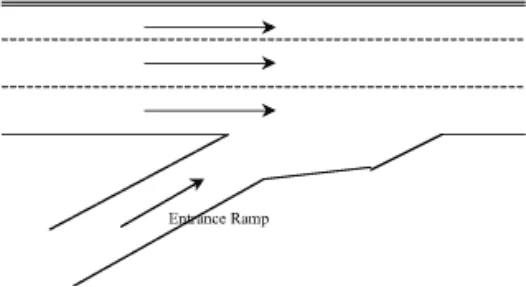
Short lanes beside the Interstate that connect ramps to the main lanes: acceleration lanes for speeding up to enter, deceleration lanes for slowing to exit.

Handbook p. 51 ↗

Entering from the ramp:

  • Stay to the right in the acceleration lane and signal left
  • Speed up toward interstate speed
  • Check your blind spot over your left shoulder
  • Change lanes when the travel lane is safe; you must yield to drivers already on the interstate
Handbook p. 51 ↗
Entrance ramp (acceleration lane)
Entrance ramp and acceleration lane

Know the rule

To exit, signal a lane change, move into the deceleration lane closest to the exit, and slow to the posted exit speed.

Handbook p. 51 ↗

Know the rule

Keep your eyes moving and check your mirrors often. Use the 4-second rule, and add space if the road is wet or slippery. Never slow down or change lanes suddenly, and avoid frequent lane changes.

Handbook p. 51 ↗

Know the rule

Before changing lanes or passing, check your mirrors, signal, and check the blind spot in the direction you're moving.

Handbook p. 51 ↗

Interstate rules:

  • Never stop in a traffic lane; stopping is illegal except in an emergency
  • Emergency: move to the breakdown lane, far right; for help, raise the hood, tie on a white cloth, stay inside
  • Drive in the right lane unless passing or a sign says otherwise
  • Don't drive tired; if you get tired, rest in a safe area as soon as possible
  • Bridges, overpasses and icy ramps can be more slippery than the main road
  • Missed your exit? Never back up or use the emergency turnaround; go on to the next exit
  • Never use cruise control in rain, fog, snow or ice
Handbook p. 52 ↗

Know the rule

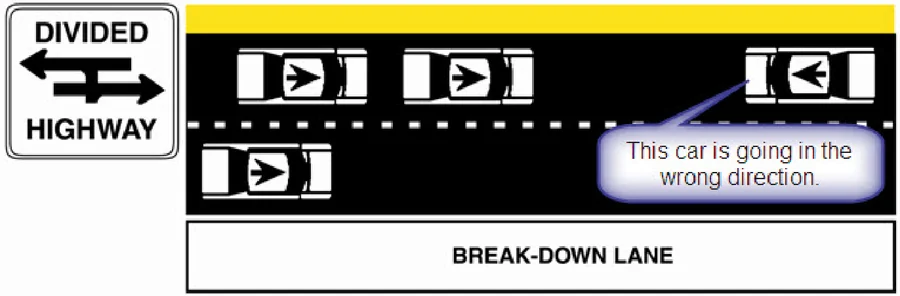
If the edge line on your right is yellow on a divided highway, you are going the WRONG WAY. On a divided highway the line on your right should be white.

Handbook p. 52 ↗
Divided highway wrong-way warning
Wrong-way driver on a divided highway

Know the rule

Don't stop to pick up hitchhikers on the Interstate or its ramps.

Handbook p. 39 ↗

Put it into practice

You miss your exit on I-91. Don't stop, back up or cut through the median crossover, which is for emergency and maintenance vehicles only. Drive to the next exit and turn around there.

Check your understanding

Read the question, decide on an answer, then open it to check the explanation. These are Roadwise study questions based on the source handbook.

When entering an interstate, who must yield the right-of-way?
  1. Drivers already on the interstate must yield to the entering driver
  2. Whoever is driving faster has the right-of-way
  3. No one; entrance ramps have their own right-of-way
  4. The entering driver must yield to traffic already on the interstate

Answer: The entering driver must yield to traffic already on the interstate

The entering driver must yield to drivers already on the interstate.
Handbook p. 51 ↗
When is it legal to stop on an interstate?
  1. Only in an emergency, in the breakdown lane
  2. Anytime, if you use the breakdown lane
  3. Only in an emergency, in the right travel lane
  4. When traffic is light and your hazards are on

Answer: Only in an emergency, in the breakdown lane

It is illegal to stop on an interstate except in an emergency, and then you move into the breakdown lane as far right as possible.

Handbook p. 52 ↗
You miss your intended interstate exit. What should you do?
  1. Stop and carefully back up
  2. Continue to the next exit
  3. Use the emergency turnaround
  4. Make a U-turn across the median

Answer: Continue to the next exit

If you miss your exit, never stop and back up, and never use the emergency turnaround; go to the next exit.

Handbook p. 52 ↗
You're driving on a divided highway and notice the edge line to your right is painted yellow instead of white. What does this mean?
  1. You're in the passing lane
  2. You're approaching a work zone
  3. You are going the wrong way
  4. The shoulder ahead is unpaved

Answer: You are going the wrong way

On a divided highway, a yellow line on your right instead of white means you're going the wrong way.

Handbook p. 52 ↗
What lane should you generally drive in on the interstate, absent a reason to do otherwise?
  1. The left lane
  2. Whichever lane is moving fastest
  3. The center lane on a 3-lane highway
  4. The right lane

Answer: The right lane

Drive in the right lane on the interstate unless passing another vehicle or a sign indicates otherwise.

Handbook p. 52 ↗
What is the correct way to leave the interstate at your exit?
  1. Slow down abruptly in the travel lane first
  2. Cut across from the left lane at the last moment
  3. Signal, move to the deceleration lane, then slow to the exit speed
  4. Coast in neutral until you reach the ramp

Answer: Signal, move to the deceleration lane, then slow to the exit speed

Exiting properly means signaling, moving to the deceleration lane, then slowing to the posted exit speed.

Handbook p. 51 ↗
Take the lesson checkpoint in the app

More in Hazardous Driving Conditions