roadwise.Open study app

Vermont driving lesson · Hazardous Driving Conditions

Skids

A 3-minute lesson from the Vermont course. Read the rules and examples, follow the handbook page references, and check your understanding before you move on.

Read time
3 minutes
Course unit
Hazardous Driving Conditions
Checkpoint questions
6
Source pages
49

Most skids happen because the driver didn't adjust speed to the road and traffic in time. Snow, ice, rain, dirt, gravel and wet leaves all reduce traction. Preventing a skid is easier than recovering from one, and the recovery is the same for every vehicle.

Know the rule

Most skids are caused by failing to adjust speed to conditions such as snow, ice, rain, dirt/gravel and wet leaves. Don't use cruise control in these conditions.

Handbook p. 49 ↗

Know the rule

In a rear-wheel drive vehicle you can usually feel a skid starting. A front-wheel drive may give no warning. It handles better in snow, but its traction isn't flawless, so don't let that confidence make you drive faster.

Handbook p. 49 ↗

How to avoid skidding:

  • Drive slower on roads that may be slippery
  • Make no sudden changes in speed or direction
  • To slow down, first take your foot off the gas
  • To slow more, gently squeeze the brakes with slow, steady pressure and let the wheels keep rolling
  • If the wheels start to lock, ease off the brake; shifting to a lower gear may also help
  • With anti-lock brakes, use steady pressure; don't pump
Handbook p. 49 ↗

How to control a skid (front- or rear-wheel drive):

  • Don't hit the brakes; it makes the skid worse
  • Steer in the direction you want the vehicle to go
  • You may have to steer left and right a few times to get fully under control
Handbook p. 49 ↗
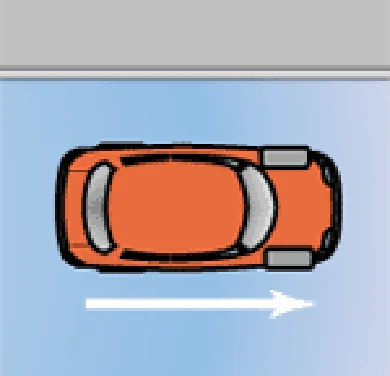
Skid recovery (regaining control)
Steering where you want to go straightens the car out of a skid

Know the rule

Stability control and other improvements help, but they can't replace driver caution.

Handbook p. 49 ↗

Know the rule

Four-wheel and all-wheel drive give better traction in snow but not on ice. Be wary of overconfidence in these vehicles.

Handbook p. 49 ↗

Know the rule

Whatever you drive, practice in an empty parking lot to learn how your vehicle handles on ice and snow.

Handbook p. 49 ↗

Put it into practice

On a curve covered in wet leaves, your rear end slides to the right. Stay off the brake and look and steer toward where you want to go, down your lane. Be ready to correct left and right a few times until the car straightens.

Check your understanding

Read the question, decide on an answer, then open it to check the explanation. These are Roadwise study questions based on the source handbook.

If your vehicle begins to skid, what should you do first?
  1. Hit the brakes hard immediately
  2. Pump the brakes quickly
  3. Turn the wheel opposite the skid direction
  4. Steer where you want the vehicle to go

Answer: Steer where you want the vehicle to go

Don't hit the brakes in a skid; steer in the direction you want the vehicle to go.
Handbook p. 49 ↗
To slow down gradually on a slippery road, what should you do before braking?
  1. Shift into neutral and coast
  2. Pull the parking brake gently
  3. Take your foot off the gas pedal first
  4. Pump the brakes rapidly from the start

Answer: Take your foot off the gas pedal first

To slow down on a slippery road, first take your foot off the gas to lower speed and keep control.

Handbook p. 49 ↗
In a skid, you should steer in the direction you want the vehicle to go rather than braking hard.
  1. True
  2. False

Answer: True

Braking harder worsens a skid; steering toward your intended path is the correct response.

Handbook p. 49 ↗
You feel your rear-wheel-drive car start to lose traction. Would you expect the same clear warning sign in a front-wheel-drive car?
  1. Yes, all vehicles give identical warning signs
  2. No, front-wheel-drive vehicles never skid
  3. Yes, but only at speeds above 50 mph
  4. No, they may skid with less warning

Answer: No, they may skid with less warning

Rear-wheel-drive often gives a feel of losing traction; front-wheel-drive may skid with less warning.

Handbook p. 49 ↗
You should make sudden changes in speed or direction to correct for slippery road conditions.
  1. True
  2. False

Answer: False

Sudden speed or direction changes on slippery roads increase the risk of a skid.

Handbook p. 49 ↗
What should you avoid doing on a road that may be icy, besides braking hard?
  1. Reducing your overall speed
  2. Sudden speed or direction changes
  3. Increasing your following distance
  4. Turning on your headlights

Answer: Sudden speed or direction changes

On slippery roads, avoid sudden speed or direction changes in addition to braking gently.

Handbook p. 49 ↗
Take the lesson checkpoint in the app

More in Hazardous Driving Conditions