roadwise.Open study app

Texas driving lesson · Right-of-Way

Yielding to emergency vehicles

A 3-minute lesson from the Texas course. Read the rules and examples, follow the handbook page references, and check your understanding before you move on.

Read time
3 minutes
Course unit
Right-of-Way
Checkpoint questions
5
Source pages
28, 29

When a police car, fire truck or ambulance approaches with siren or lights, your job is to get out of the way safely. Texas also sets exact rules for following fire trucks and for passing emergency vehicles stopped on the road.

Know the rule

Yield to police cars, fire trucks, ambulances and other emergency vehicles sounding a siren, bell, or flashing red light. If traffic allows, pull to the right edge of the road and stop. If you can't pull right, slow down and leave a clear path.

Handbook p. 28 ↗
Yielding to emergency vehicles
Pull to the right edge and stop to let an emergency vehicle pass
500 ft

Do not follow within this distance of a fire truck answering an alarm or an ambulance with flashing red lights on

Handbook p. 28 ↗

Know the rule

Do not drive or park on the street where a fire truck has answered an alarm, and don't park where you interfere with an ambulance arriving at or leaving an emergency.

Handbook p. 28 ↗

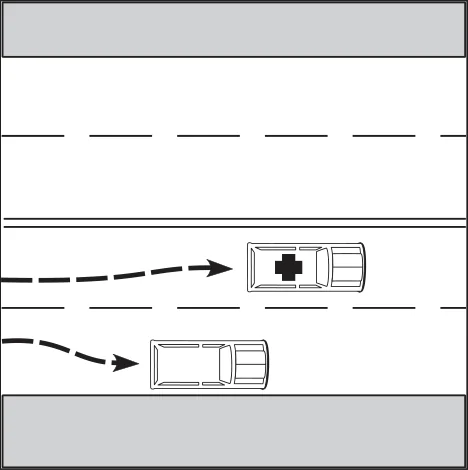
Approaching a stopped emergency vehicle with lights on (unless an officer directs otherwise):

  • Vacate the lane closest to it if there are two or more lanes going its direction; or
  • Slow to 20 mph below the posted limit when the limit is 25 mph or more; or
  • Slow to less than 5 mph when the posted limit is less than 25 mph
Handbook p. 29 ↗
20 mph below

How far under the posted limit you must slow for a stopped emergency vehicle (limit 25 mph or more)

Handbook p. 29 ↗

Put it into practice

You're on a two-lane highway posted at 55 mph and an ambulance is stopped ahead with lights flashing. You can't change lanes, so slow to no more than 35 mph (20 below the limit) as you pass.

Check your understanding

Read the question, decide on an answer, then open it to check the explanation. These are Roadwise study questions based on the source handbook.

How closely may you follow a fire truck answering an alarm with its flashing red lights on?
  1. No closer than 100 feet
  2. No closer than 1,000 feet
  3. No closer than 500 feet
  4. No closer than 200 feet

Answer: No closer than 500 feet

You may not follow within 500 feet of a fire truck or ambulance responding with lights flashing.

Handbook p. 28 ↗
You're on a two-lane highway posted at 55 mph when a stopped emergency vehicle with lights activated is ahead and you can't change lanes. What should you do?
  1. Maintain your current speed
  2. Stop completely in your lane
  3. Slow to no more than 45 mph
  4. Slow to no more than 35 mph

Answer: Slow to no more than 35 mph

When the posted limit is 25 mph or more, slow to a speed not more than 20 mph below the posted limit.
Handbook p. 29 ↗
A fire truck has answered an alarm on a street. What does the handbook say about that street?
  1. Do not drive or park on it
  2. You may drive on it but not park
  3. You may park if 500 feet away
  4. You may drive on it below 20 mph

Answer: Do not drive or park on it

Do not drive or park on the street where a fire truck has answered an alarm.

Handbook p. 28 ↗
You must yield to an emergency vehicle only when it is sounding a siren, not when it shows only a flashing red light.
  1. True
  2. False

Answer: False

You must yield to emergency vehicles sounding a siren, bell, or flashing red light.

Handbook p. 28 ↗
You may follow an ambulance with its flashing red lights on as close as 300 feet.
  1. True
  2. False

Answer: False

You may not follow within 500 feet of a fire truck or ambulance with its flashing red lights on.

Handbook p. 28 ↗
Take the lesson checkpoint in the app

More in Right-of-Way