roadwise.Open study app

Texas driving lesson · Right-of-Way

Railroad crossings

A 4-minute lesson from the Texas course. Read the rules and examples, follow the handbook page references, and check your understanding before you move on.

Read time
4 minutes
Course unit
Right-of-Way
Checkpoint questions
6
Source pages
27, 28, 39, 59

Trains cannot stop quickly and always have the right-of-way. Texas sets an exact stopping zone at crossings and a fine for ignoring crossing laws. Know when you must stop and what to do if you ever stall on the tracks.

Stop between 15 and 50 feet from the nearest rail when:

  • A clearly visible railroad signal warns of an approaching train
  • A crossing gate is lowered, or a flag person warns of a train
  • An official traffic-control device or signal requires you to stop
  • An approaching train is within about 1,500 feet (it will sound an audible signal)
  • An approaching train is visible and in close proximity to the crossing
Handbook p. 27 ↗
15–50 ft

Stopping zone measured from the nearest rail

Handbook p. 27 ↗
$50–$200

Fine for failing to obey railroad grade crossing laws

Handbook p. 28 ↗

Know the rule

Once stopped, remain stopped until you're allowed to proceed or it's safe to proceed.

Handbook p. 28 ↗

Safe procedures at crossings

  • Crossbuck or reduce-speed sign only: look both ways and listen; stop if a train comes, else go with caution
  • Red lights flashing: stop, and stay stopped until the train passes and lights stop flashing
  • Gates lowered: stop and wait until the train passes and the gates are raised
  • There may be two or more tracks; one train can hide another
  • Never stop on the tracks
  • Roll windows down and turn the radio down so you can hear whistles
Handbook p. 28 ↗

Know the rule

Gate and flashing light crossings: stop when the lights begin to flash, before the gate lowers, and stay stopped until the gates are raised and the lights stop flashing.

Handbook p. 39 ↗

Know the rule

If your car stalls on the tracks and won't restart, get out and try to push it off; if you can't, get help. If a train is coming, get out quickly and move away, running toward the approaching train and to the side of the tracks to avoid flying debris.

Handbook p. 28 ↗
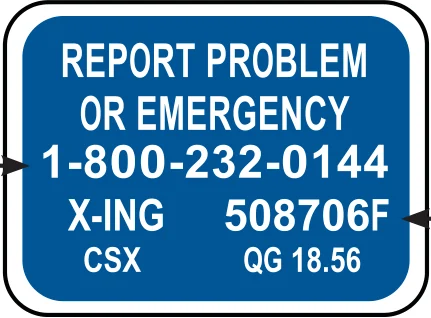
Railroad emergency notification sign
Blue and white Emergency Notification System (ENS) sign

In an emergency at a crossing (ENS sign):

  • Locate the blue and white ENS sign at the crossing
  • Call the railroad's emergency number listed on the sign
  • Give the crossing's USDOT identification number and describe the emergency
Handbook p. 28 ↗

Know the rule

Report a crossing signal problem to the DPS Communications Center at (800) 772-7677 or local police or sheriff, and give the crossing's identifying number.

Handbook p. 28 ↗

Put it into practice

You approach a crossing with only a crossbuck sign. Slow down, lower the radio, look both ways and listen. If a train is coming, stop 15 to 50 feet from the nearest rail. If no train is coming, cross with caution and never stop on the tracks.

Check your understanding

Read the question, decide on an answer, then open it to check the explanation. These are Roadwise study questions based on the source handbook.

How far from the nearest rail must you stop at a railroad crossing when required?
  1. Between 5 and 10 feet
  2. Between 15 and 50 feet
  3. Between 50 and 100 feet
  4. Between 100 and 200 feet

Answer: Between 15 and 50 feet

You must stop between 15 and 50 feet from the nearest rail when required.
Handbook p. 27 ↗
You must stop at a railroad crossing when an approaching train is within about how many feet and gives an audible signal?
  1. 500 feet
  2. 3,000 feet
  3. 1,500 feet
  4. 1,000 feet

Answer: 1,500 feet

A train within about 1,500 feet of the crossing will produce an audible signal.

Handbook p. 27 ↗
What is the fine range for failing to obey the law at a railroad grade crossing?
  1. $500 to $2,000
  2. $10 to $50
  3. $1,000 to $4,000
  4. $50 to $200

Answer: $50 to $200

Failing to obey railroad crossing laws carries a fine of $50 to $200.

Handbook p. 28 ↗
Your car stalls on a railroad crossing and a train is approaching. What should you do?
  1. Get out quickly and move away from the tracks
  2. Stay in the car with the hazard lights on
  3. Keep trying to restart the engine
  4. Stay in the car until the train crew stops

Answer: Get out quickly and move away from the tracks

If a train is approaching a stalled vehicle, get out quickly and move away, off to the side of the tracks.

Handbook p. 28 ↗
What should you do if a railroad crossing has only a cross-buck sign with no train visible or audible?
  1. Always stop regardless of whether a train is present
  2. Look and listen, then proceed carefully if clear
  3. Speed up to clear the crossing quickly
  4. Cross at normal speed without looking

Answer: Look and listen, then proceed carefully if clear

At a cross-buck-only crossing, look and listen; if no train is approaching, proceed with caution.

Handbook p. 28 ↗
You're stopped at a crossing gate that has just lowered with lights flashing. What should you do?
  1. Wait ten seconds, then drive around the gate
  2. Proceed if you don't see a train yet
  3. Wait until the gate rises and lights go off
  4. Back away and take an alternate route immediately

Answer: Wait until the gate rises and lights go off

You must remain stopped until the gates are raised and the lights stop flashing.

Handbook p. 39 ↗
Take the lesson checkpoint in the app

More in Right-of-Way