roadwise.Open study app

Tennessee driving lesson · Signs, Signals & Markings

Traffic signals

A 4-minute lesson from the Tennessee course. Read the rules and examples, follow the handbook page references, and check your understanding before you move on.

Read time
4 minutes
Course unit
Signs, Signals & Markings
Checkpoint questions
6
Source pages
55, 56

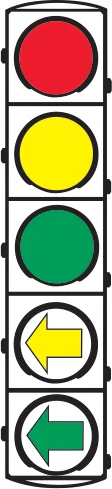
Signals assign the right-of-way at busy intersections, but a green light is permission, not a guarantee. Standard lights are red, yellow and green from top to bottom. Many crashes happen when one driver tries to beat the yellow and another jumps the green.

Traffic signal head (all indications)
Signal with red, yellow, green and turn arrows

What each signal means

What each signal means
SignalWhat you do
Steady redStop behind the crosswalk or stop line
Steady yellowRed is next; stop if you safely can
Steady greenGo if clear; yield to anyone still in it
Flashing redFull stop, same as a stop sign
Flashing yellowSlow down and proceed with caution
Green arrowProtected turn in the arrow's direction
Flashing yellow arrowTurn left after yielding to all oncoming
Red arrow or red lightNo turns from that lane
Handbook p. 55 ↗

Know the rule

Unless a sign says otherwise, you may turn right on red after a complete stop when no pedestrians or cross traffic are present.

Handbook p. 55 ↗
3 seconds

Minimum time Tennessee law requires the yellow light to show before red

Handbook p. 55 ↗

Know the rule

If you're already IN the intersection when the light turns yellow, don't stop — continue cautiously through. Never speed up to beat the light.

Handbook p. 55 ↗

Know the rule

On a green light you must still yield to vehicles and pedestrians in the intersection and, when turning left, to oncoming traffic. Never 'jump the gun' with a quick left in front of oncoming cars.

Handbook p. 55 ↗

Know the rule

With a green protected arrow you have the right-of-way, after yielding to anyone already in the intersection. When the arrow turns yellow, the protected turn is ending — prepare to yield to oncoming traffic.

Handbook p. 55 ↗

Know the rule

Don't pull into an intersection to turn until your path is clear, or you may be stranded blocking it.

Handbook p. 55 ↗

Know the rule

If a signal is out, treat the intersection as an all-way stop. When two vehicles arrive at the same time, the driver on the left yields to the driver on the right.

Handbook p. 56 ↗

Pedestrian

Under Tennessee law, any person on foot or using a motorized or non-motorized wheelchair.

Handbook p. 56 ↗

Know the rule

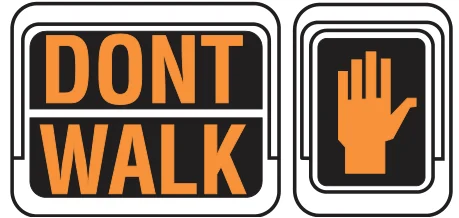
WALK or a walking person means pedestrians may start across; those already crossing continue quickly. DON'T WALK or a raised hand means don't start crossing. Some signals need a push button.

Handbook p. 56 ↗
Pedestrian don't walk signal
DON'T WALK signal and raised-hand symbol

Lane control signals over a lane

Lane control signals over a lane
SignalMeaning
Green arrowYou may drive in this lane
Flashing yellow XLane is for turning only
Steady yellow XLane direction is changing — move out
Red XYou may not drive in this lane
Handbook p. 56 ↗

Put it into practice

You're waiting to turn left on a green ball light when it turns yellow with oncoming cars still passing. Since you're behind the stop line and not yet in the intersection, don't pull in — wait for the next cycle.

Check your understanding

Read the question, decide on an answer, then open it to check the explanation. These are Roadwise study questions based on the source handbook.

Under Tennessee law, the yellow light must be shown for a minimum of how long before the light turns red?
  1. One second
  2. Ten seconds
  3. Five seconds
  4. Three seconds

Answer: Three seconds

Tennessee law only requires the yellow light to be shown for a minimum of three seconds before the red light.
Handbook p. 55 ↗
Unless otherwise posted, when may you turn right on a red light?
  1. After coming to a complete stop, when no pedestrians or cross traffic are present
  2. Any time without stopping
  3. Only between 6 a.m. and 6 p.m.
  4. Never, right turns on red are illegal statewide

Answer: After coming to a complete stop, when no pedestrians or cross traffic are present

You may turn right on red after a complete stop, when no pedestrians or cross traffic are present, unless posted otherwise.

Handbook p. 55 ↗
A green protected turn arrow means:
  1. You must wait for a gap in oncoming traffic
  2. You may turn, yielding to anyone already in it
  3. You may turn without watching for pedestrians
  4. You may turn only after a complete stop

Answer: You may turn, yielding to anyone already in it

A green protected arrow gives you the right-of-way to turn, after yielding to anyone already in the intersection.

Handbook p. 55 ↗
A flashing yellow arrow allows a driver to:
  1. Turn left without yielding to oncoming traffic
  2. Turn left only after a complete stop
  3. Turn left after yielding to oncoming traffic and pedestrians
  4. Go straight only; left turns are closed

Answer: Turn left after yielding to oncoming traffic and pedestrians

A flashing yellow arrow is a permissive arrow allowing a left turn after yielding to oncoming traffic, bicyclists, and pedestrians.

Handbook p. 55 ↗
If you are already in the intersection when the light turns yellow, you should:
  1. Stop immediately, even in the intersection
  2. Speed up to clear it before the red
  3. Stop and yield to the cross traffic
  4. Continue cautiously through the intersection

Answer: Continue cautiously through the intersection

If you are already in the intersection when the yellow light appears, do not stop; continue cautiously through.

Handbook p. 55 ↗
If a traffic signal is not working (dark) at an intersection, drivers must treat the intersection as:
  1. An all-way stop
  2. A yield-only intersection
  3. An uncontrolled intersection
  4. A green light for the main road

Answer: An all-way stop

Tennessee law requires treating a malfunctioning signal as an all-way stop intersection.

Handbook p. 55 ↗
Take the lesson checkpoint in the app

More in Signs, Signals & Markings