roadwise.Open study app

Tennessee driving lesson · Signs, Signals & Markings

Lane markings & crosswalks

A 4-minute lesson from the Tennessee course. Read the rules and examples, follow the handbook page references, and check your understanding before you move on.

Read time
4 minutes
Course unit
Signs, Signals & Markings
Checkpoint questions
6
Source pages
56, 57

Lines on the pavement tell you where you may drive, pass, turn and stop. Their color tells you traffic direction: yellow separates opposite directions, white separates lanes going the same way. States follow the federal Manual on Uniform Traffic Control Devices.

Pavement lines and symbols:

  • Divide the road into lanes
  • Tell you when you may pass or change lanes
  • Show which lanes to use for turns
  • Mark pedestrian walkways
  • Show where to stop for signs or signals
Handbook p. 56 ↗

Know the rule

A solid white line marks the right edge of the road. Yellow marks the left edge of lanes going your way. If you have yellow on your right and white on your left, you're going the wrong way.

Handbook p. 56 ↗

Know the rule

On a divided highway, the line on your left next to the median is always yellow and the right edge is always white.

Handbook p. 56 ↗

Yellow center lines

Yellow center lines
MarkingMeaning
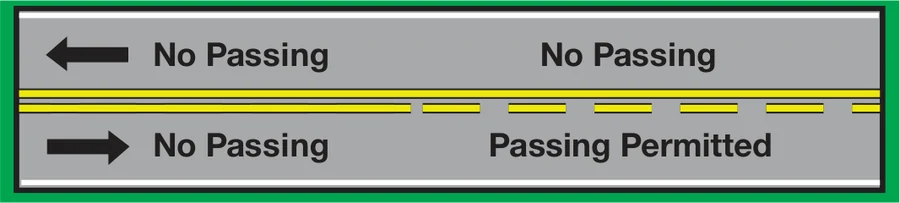
Broken yellowMay cross to pass if clear and safe
Two solid yellowNo passing from either direction
Solid + brokenMay pass only if broken line is on your side
Handbook p. 57 ↗
Solid and broken yellow lines
No-passing and passing-permitted markings

Know the rule

You may cross solid yellow lines to turn into a driveway or side road if it's safe. In a passing zone, you must be back on your side before the zone ends. Yellow also marks hazards like bridge supports.

Handbook p. 56 ↗

White lane lines

White lane lines
MarkingMeaning
Broken whiteMay change lanes or pass when safe
Single solid whiteStay in your lane (emergency excepted)
Double solid whiteDo not cross
Handbook p. 57 ↗

Crosswalk

White lines marking where pedestrians cross, at intersections or mid-block. Not every crosswalk is painted. Yield to pedestrians in or about to enter one.

Handbook p. 57 ↗

Know the rule

Stop behind a white stop line. With no stop line, stop before the first line of a marked crosswalk; with neither, stop before your front bumper crosses the white edge line of the cross street.

Handbook p. 57 ↗

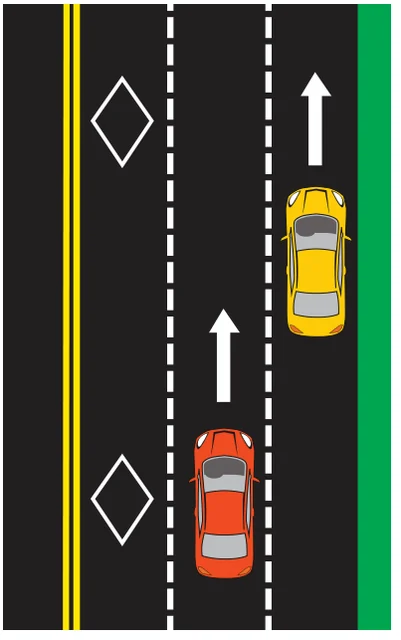
HOV lane

A lane marked with a white diamond, reserved in heavy traffic for buses, vanpools, motorcycles and carpools. Signs show the minimum riders and hours.

Handbook p. 57 ↗
HOV diamond
Diamond-marked HOV lane

Know the rule

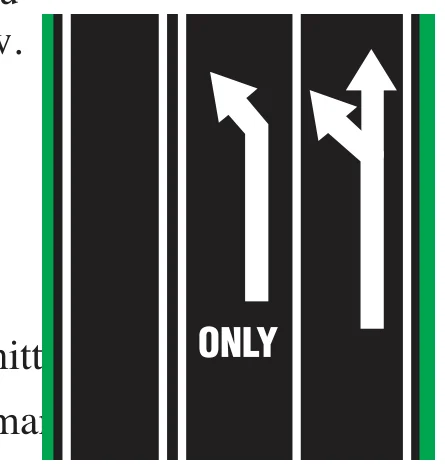
A curved arrow with ONLY means you must turn that way. A curved plus straight arrow lets you turn or go straight. Double or triple arrows allow more than one move; a single arrow allows only that one.

Handbook p. 57 ↗
Lane use arrows
Turn-only and turn-or-straight lane arrows

Know the rule

A white X with the letters RR painted on the pavement warns of a railroad crossing ahead.

Handbook p. 57 ↗

Put it into practice

On a two-lane road you see a solid yellow line next to your lane and a broken yellow line beyond it. The solid line is on your side, so you may not pass — even with no one coming. The driver going the other way may pass.

Check your understanding

Read the question, decide on an answer, then open it to check the explanation. These are Roadwise study questions based on the source handbook.

If you notice a yellow line to your right and a white line to your left, what does this mean?
  1. You are in a passing zone
  2. You are driving the wrong way
  3. You are in a two-way left-turn lane
  4. You are on a one-way street correctly

Answer: You are driving the wrong way

If yellow is to your right and white is to your left, you are traveling the wrong direction on the roadway.
Handbook p. 56 ↗
A broken yellow center line means you may cross it to pass when:
  1. Never, broken yellow always prohibits passing
  2. Only on divided highways
  3. No traffic is oncoming and it's safe
  4. Only during daylight hours

Answer: No traffic is oncoming and it's safe

A broken yellow line means you may cross to pass if there is no oncoming traffic and it is safe.

Handbook p. 56 ↗
Two solid yellow lines between opposing lanes of traffic mean:
  1. You may pass if no one is oncoming
  2. Only left turns are prohibited
  3. Only the lane with the solid line may not pass
  4. Neither direction may cross to pass

Answer: Neither direction may cross to pass

Two solid yellow lines mean neither direction may cross to pass, even if no oncoming traffic is visible.

Handbook p. 56 ↗
With one solid yellow line and one broken yellow line between lanes, when may you pass?
  1. Only when the broken line is on your side
  2. Only when the solid yellow line is on your side
  3. At any time regardless of which line is on your side
  4. Never, this marking always prohibits passing

Answer: Only when the broken line is on your side

If the broken yellow line is on your side, you are in a legal passing zone; if the solid line is on your side, you may not pass.

Handbook p. 57 ↗
Broken white lines between lanes traveling the same direction mean:
  1. You may never cross these lines
  2. You may cross when safe
  3. You must be in a designated turn lane
  4. The lane is reserved for buses only

Answer: You may cross when safe

Broken white lines mean you may cross to pass or change lanes if it is safe to do so.

Handbook p. 57 ↗
A pavement lane marked with a curved arrow and the word 'ONLY' means:
  1. You may go straight or turn
  2. You must turn that way
  3. The lane is for passing only
  4. The lane is closed ahead

Answer: You must turn that way

A lane marked with a curved arrow and the word ONLY requires you to turn in the direction shown.

Handbook p. 57 ↗
Take the lesson checkpoint in the app

More in Signs, Signals & Markings