Regulatory signs, usually white rectangles, tell you the law: speed limits, turns you can't make, lanes you must use. Warning signs, usually yellow diamonds, alert you to a condition ahead that may call for slowing down.
Know the rule
A white sign with a red circle and diagonal slash means NO — whatever is shown under the slash is forbidden (no trucks, no bicycles, no left turn, no U-turn, no parking).
Handbook p. 51 ↗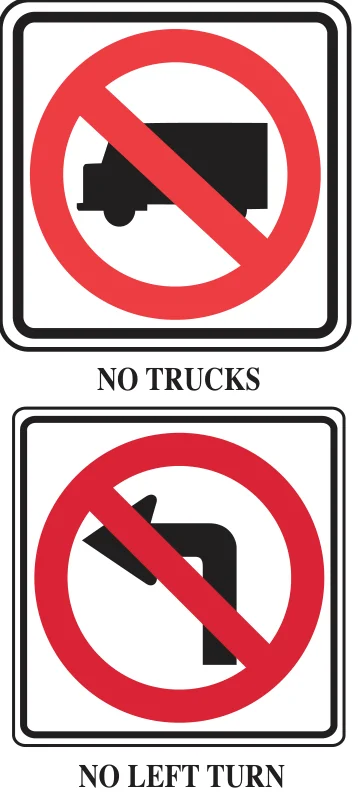
Other regulatory signs
- Lane control signs: some lanes for trucks, some must go straight or turn
- HOV signs: lanes for buses and vehicles with the minimum occupants shown
- Speed signs: maximum, minimum, or a change in the limit
- DO NOT ENTER: a one-way street you may not enter from your direction
Know the rule
The school speed sign is used when children are within walking distance of a school. It runs on a time clock and flashes yellow lights while showing the school speed limit.
Handbook p. 51 ↗Know the rule
SLOWER TRAFFIC KEEP RIGHT is used where there is more than one lane each way: stay in the far right lane unless passing or turning left, and never straddle lanes.
Handbook p. 51 ↗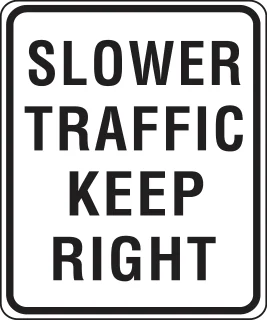
Know the rule
No-passing zones are based on how far ahead you can see. The yellow pennant-shaped NO PASSING ZONE sign is posted on the left side of the road.
Handbook p. 51 ↗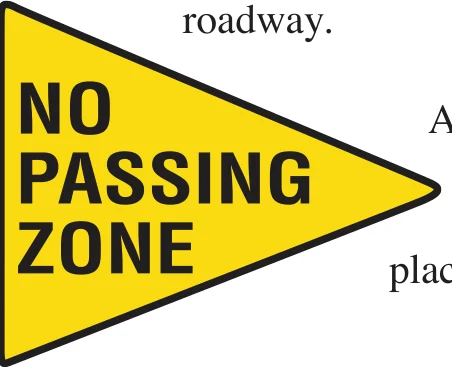
Common warning signs
| Sign | What it tells you |
|---|---|
| Turn sign (sharp arrow) | Sharp turn; recommended speed 30 mph or less |
| Curve sign | Curve; recommended speed 30 to 55 mph |
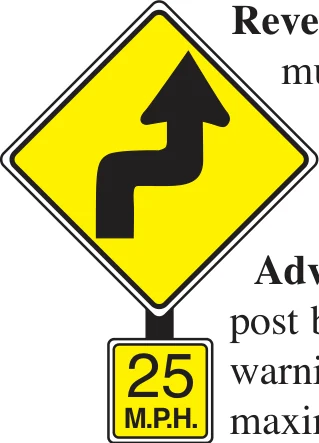
| Reverse turn | Two opposite turns less than 600 feet apart |
| Advisory speed plate | Recommended maximum safe speed |
| Fallen rock | Rocks may be in the road — watch the road |
| Stop ahead / signal ahead | Hidden stop sign or signal; start slowing |
| Narrow bridge | Passing cars may need to slow |
| Merging traffic | Traffic blends in; move over if you can |
Know the rule
A lane-ends sign means your lane is ending: merge left and signal. A yield-ahead sign means a YIELD sign you can't see yet — start slowing.
Handbook p. 52 ↗Know the rule
School signs near school grounds mean slow down and watch for children; the school bus stop ahead sign means buses load and unload there during the school season.
Handbook p. 52 ↗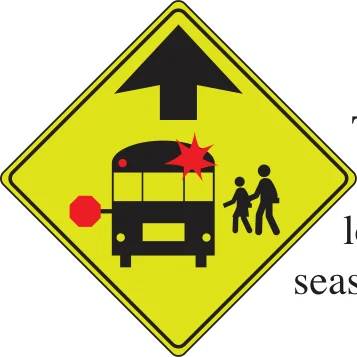
Put it into practice
A yellow diamond with a zigzag arrow and a '25 M.P.H.' plate below it appears. That's a reverse turn — two curves less than 600 feet apart — and 25 mph is the recommended safe speed. Slow down before the first bend.