Tennessee driving lesson · Interstate, Night & Weather Driving
HOV lanes, exits & interchanges
A 4-minute lesson from the Tennessee course. Read the rules and examples, follow the handbook page references, and check your understanding before you move on.
Knowing how HOV lanes, exits and interchanges work keeps you from last-second lane changes — one of the main causes of interstate crashes. The heavier the traffic, the earlier you should be in the right lane.
HOV lane
A specially marked far-inside lane for vehicles with two or more occupants, meant to encourage ridesharing and move more people through rush hour.
Exit signs are usually at least one mile ahead. Signal, move to the lane nearest the exit, keep your speed until the deceleration lane (outlined by white reflectors), then slow to the ramp's posted speed.
Don't drive on the paved shoulder except to decelerate where marked or in an emergency. Parking on any part of a ramp is illegal unless your vehicle is disabled.
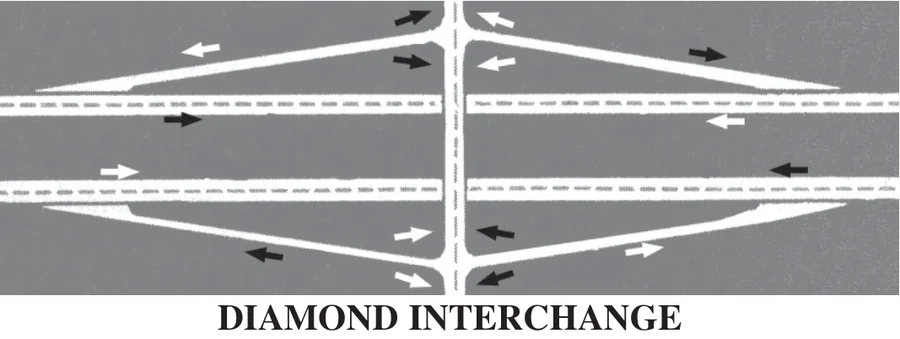
At a diamond interchange you're on the cross street and want to go left onto the interstate. Pass under the interstate first; the left-turn entrance ramp is on the far side. Turning left before crossing would put you on the exit ramp — wrong way.
Check your understanding
Read the question, decide on an answer, then open it to check the explanation. These are Roadwise study questions based on the source handbook.
On a diamond interchange, the entrance ramp for a RIGHT turn onto the interstate is encountered:
Before crossing the interstate
After crossing over or under the interstate
At the same point as the left-turn ramp
After the left-turn entrance ramp
Answer: Before crossing the interstate
On a diamond interchange, the right-turn entrance ramp is always encountered before crossing the interstate.