roadwise.Open study app

Tennessee driving lesson · Interstate, Night & Weather Driving

Entering & driving the interstate

A 4-minute lesson from the Tennessee course. Read the rules and examples, follow the handbook page references, and check your understanding before you move on.

Read time
4 minutes
Course unit
Interstate, Night & Weather Driving
Checkpoint questions
5
Source pages
82, 83

Interstates are usually safer because access is controlled: no stop signs, no railroad crossings, no traffic lights, and medians that all but eliminate head-on crashes. But speeds are higher, so you need constant alertness and good merging skills.

Limited (controlled) access

You enter and leave only at interchanges, never crossing the path of other traffic.

Handbook p. 82 ↗

Before you get on

  • Plan your entrance, direction and exit
  • Make sure your vehicle is in good condition
  • Check your gas — rural exits can be many miles apart
  • If you can't or won't drive the minimum speed, don't use the interstate
Handbook p. 82 ↗

Know the rule

To enter, stay right and use the ramp and acceleration lane to reach interstate speed, signal left, and merge when there's a gap. You must yield to traffic already on the interstate.

Handbook p. 82 ↗

Know the rule

Don't stop at the end of the ramp — you won't have room to reach traffic speed and drivers behind you won't expect it. If you must wait, slow down on the ramp so you still have room to speed up.

Handbook p. 82 ↗
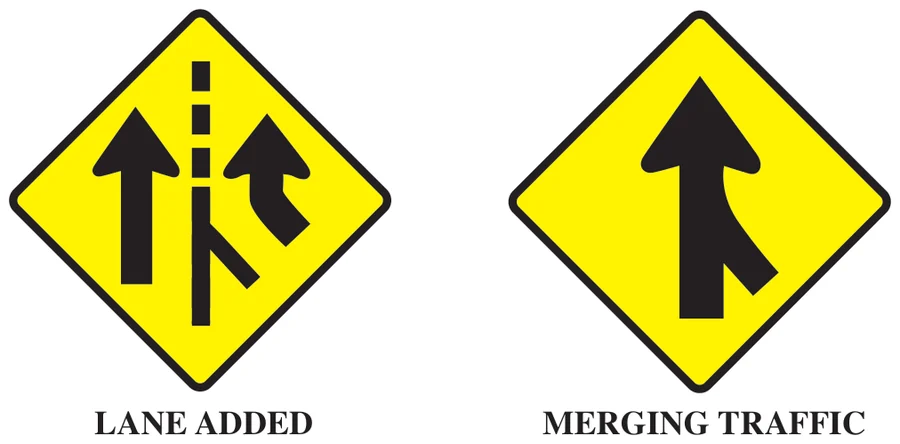
Added lane
Lane added vs. merging traffic signs

Know the rule

A LANE ADDED sign means the ramp becomes a new lane, so entering traffic needn't merge right away — drivers on the interstate should avoid moving right there. A MERGING TRAFFIC sign means entering cars must merge into the existing right lane.

Handbook p. 82 ↗

Know the rule

Leave the far-left lane for faster traffic. Keep to the middle of your lane, drive at an even speed, and don't weave or ride alongside other cars in their blind spots. Avoid packs of cars.

Handbook p. 82 ↗

Know the rule

Stay at least two seconds behind the car ahead — at least four in bad weather, at night and on higher-speed rural sections — and scan 15 to 20 seconds ahead.

Handbook p. 83 ↗

Know the rule

See brake lights ahead or a tie-up? Slow down and tap your brakes several times to warn drivers behind you.

Handbook p. 83 ↗

Traffic flow and speed

  • Keep a constant speed with traffic, but don't speed to 'keep up'
  • Driving too slowly is illegal because it's dangerous
  • Slower than traffic? Use the right lane
  • In the left lane with a faster car behind? Move one lane right
  • The left lane is for passing
  • Give trucks and buses entering the interstate extra time and space
Handbook p. 83 ↗

Know the rule

Planning to exit? Move to the right lane as early as possible to avoid hasty lane changes.

Handbook p. 83 ↗

Put it into practice

Heavy traffic on the on-ramp means you can't merge yet. Instead of stopping at the end of the ramp, slow down early on the ramp itself, watch for a gap, then accelerate hard in the acceleration lane, signal left and merge.

Check your understanding

Read the question, decide on an answer, then open it to check the explanation. These are Roadwise study questions based on the source handbook.

When entering an interstate highway, you should use the acceleration lane to:
  1. Come to a complete stop before merging
  2. Wait until traffic clears completely
  3. Drive slower than surrounding traffic
  4. Match speed and merge smoothly

Answer: Match speed and merge smoothly

You should use the acceleration lane to reach interstate speed so you can merge smoothly when the way is clear.
Handbook p. 82 ↗
According to the handbook, which lane on the interstate should generally be reserved for faster/passing traffic?
  1. The extreme right lane
  2. The center lane only
  3. The lane nearest the exit ramps
  4. The extreme left lane

Answer: The extreme left lane

Leave the extreme left lane for faster traffic; courteous drivers move over to allow faster vehicles to pass.

Handbook p. 82 ↗
On the interstate, how far ahead should you try to watch for cars braking, entering or exiting?
  1. 2 to 4 seconds ahead
  2. 5 to 8 seconds ahead
  3. 15 to 20 seconds ahead
  4. 45 to 60 seconds ahead

Answer: 15 to 20 seconds ahead

On the interstate, scan the roadway ahead and try to watch 15 to 20 seconds in front of your vehicle for cars braking, entering or exiting.

Handbook p. 83 ↗
It's a good habit to check your gas gauge before entering a rural stretch of interstate, since exits may be far apart.
  1. True
  2. False

Answer: True

In rural areas exits can be many miles apart, so check your gas gauge before getting on the interstate.

Handbook p. 82 ↗
When merging onto the interstate, drivers already on the highway are expected to make allowance for vehicles trying to enter.
  1. True
  2. False

Answer: True

Drivers already on the interstate should, for their own safety, make allowance for vehicles attempting to enter.

Handbook p. 82 ↗
Take the lesson checkpoint in the app

More in Interstate, Night & Weather Driving