A 3-minute lesson from the Tennessee course. Read the rules and examples, follow the handbook page references, and check your understanding before you move on.
Backing is harder than driving forward: your car blocks much of your view and speed and direction are harder to control. It's a small part of the road test, but it's the maneuver that most often makes new drivers fail.
Know the rule
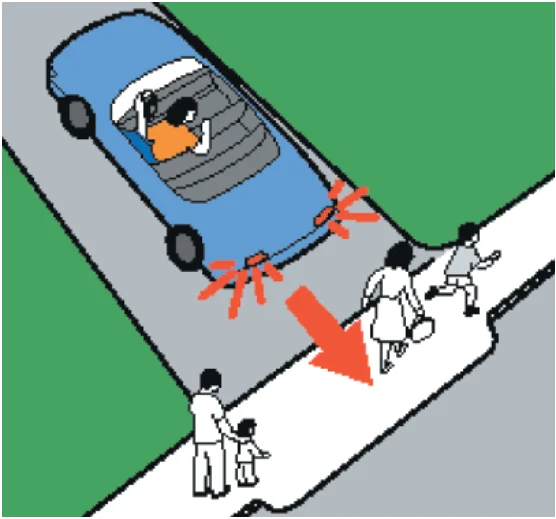
Never back into a travel lane — the only exception is backing into a parallel parking space. Other drivers don't expect a car backing toward them.
Missed your turn or exit? Don't back up — go on to the next turn or exit. Backing up on the interstate is illegal, and you shouldn't stop in a travel lane for any reason.
It's good practice to set the parking brake every time you park a manual-transmission car — especially on steep hills and near crosswalks where children are present.
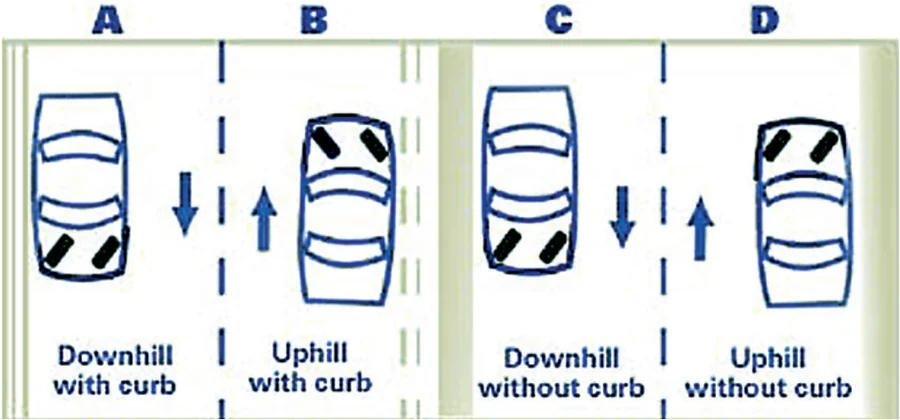
You park facing uphill on a street with a curb. Turn the wheels left, away from the curb, and let the car roll back gently until the tire rests against the curb. If the brakes fail, the curb stops it instead of traffic.
Check your understanding
Read the question, decide on an answer, then open it to check the explanation. These are Roadwise study questions based on the source handbook.
When parking downhill on a street WITH a curb, which way should you turn your front wheels?
Toward the curb (right)
Away from the curb (left)
Straight ahead
It does not matter
Answer: Toward the curb (right)
On a downhill with a curb, turn your front wheels toward the curb so the car rolls into the curb if the brake fails.