roadwise.Open study app

South Carolina driving lesson · General Driving

Zipper merge

A 3-minute lesson from the South Carolina course. Read the rules and examples, follow the handbook page references, and check your understanding before you move on.

Read time
3 minutes
Course unit
General Driving
Checkpoint questions
6
Source pages
92, 93

Many drivers were taught to merge early when a lane ends. In heavy, slow traffic, that causes sudden lane switching, collisions and road rage. The zipper merge fixes it by using both lanes up to the merge point.

Zipper merge (late merge)

Staying in your lane until the merge point, then taking turns with drivers in the other lane to ease into the open lane.

Handbook p. 92 ↗

Know the rule

When you see a "lane closed ahead" sign and traffic is backing up, stay in your current lane until you reach the merge point, then take turns merging safely and smoothly.

Handbook p. 92 ↗

Know the rule

The law doesn't require the zipper merge, but it's a best practice, especially when a lane is closed in a construction zone.

Handbook p. 92 ↗

Zipper merge benefits:

  • Reduces the difference in speeds between the two lanes
  • Reduces the overall length of the backup by as much as 40%
  • Reduces congestion on the interstate
  • Creates a sense of fairness: all lanes move at the same rate
  • Reduces road rage incidents
Handbook p. 92 ↗
40%

How much the zipper merge can shorten a traffic backup

Handbook p. 92 ↗
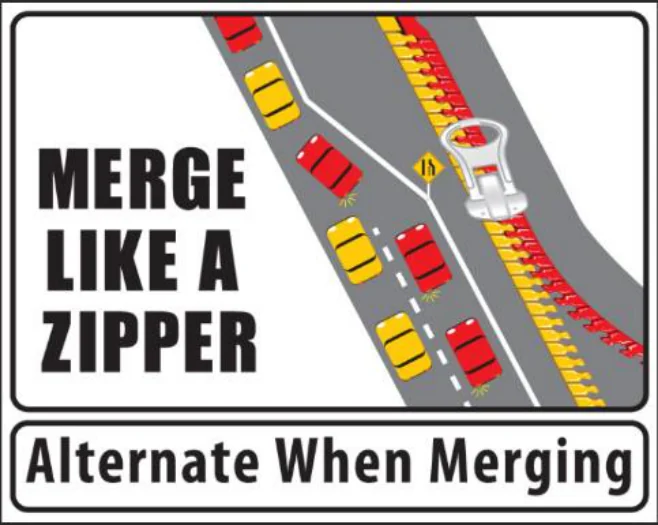
Zipper merge
Merge like a zipper: alternate when merging

Know the rule

When traffic is moving at highway speeds with no backups, move over sooner to the lane that will stay open. The bottom line: merge when it's safe.

Handbook p. 93 ↗

Put it into practice

A construction sign says the right lane closes in one mile, and traffic is crawling. Stay in the right lane to the merge point, then alternate with the left-lane drivers. If traffic were flowing at 65 mph, you'd move left early instead.

Check your understanding

Read the question, decide on an answer, then open it to check the explanation. These are Roadwise study questions based on the source handbook.

The zipper merge strategy asks drivers to:
  1. Merge as early as possible when a lane is closing
  2. Always use the right lane in a work zone
  3. Stay in their lane until the merge point
  4. Stop completely before merging

Answer: Stay in their lane until the merge point

Zipper merging means staying in your current lane until reaching the point of merge, then taking turns easing in.
Handbook p. 92 ↗
Is the zipper merge required by SC law?
  1. Yes, it is mandatory in every work zone
  2. Yes, but only on interstates
  3. No, it is illegal to use
  4. No, it's best practice, not law

Answer: No, it's best practice, not law

Law does not require the zipper merge to be used, but it is a best practice, especially in construction zones.

Handbook p. 92 ↗
The zipper merge can reduce the overall length of traffic backup by as much as:
  1. 40%
  2. 5%
  3. 90%
  4. 15%

Answer: 40%

The zipper merge can reduce the overall length of traffic backup by as much as 40%.

Handbook p. 92 ↗
One benefit of the zipper merge is that it:
  1. Increases the number of lane changes needed
  2. Evens out speeds between lanes
  3. Requires drivers to speed up before merging
  4. Eliminates the need for turn signals

Answer: Evens out speeds between lanes

The zipper merge reduces the difference in speeds between lanes, making changing lanes easier and safer.

Handbook p. 92 ↗
When is it best NOT to use the zipper merge?
  1. When a lane is closed in a construction zone
  2. When traffic is heavy and slow
  3. At highway speeds with no backups
  4. When you see a 'lane closed ahead' sign with backups

Answer: At highway speeds with no backups

When traffic is moving at highway speeds with no backups, it makes more sense to move early to the lane that stays open.

Handbook p. 93 ↗
Merging early instead of using the zipper merge, when traffic is backed up, can lead to:
  1. Faster overall traffic flow
  2. Fewer lane changes for everyone
  3. A guaranteed reduction in congestion
  4. Unexpected lane switching, collisions, and road rage

Answer: Unexpected lane switching, collisions, and road rage

Merging early when traffic is backed up can lead to unexpected and dangerous lane switching, collisions, and road rage.

Handbook p. 92 ↗
Take the lesson checkpoint in the app

More in General Driving