roadwise.Open study app

South Carolina driving lesson · General Driving

Intersections, DDIs & RCUTs

A 3-minute lesson from the South Carolina course. Read the rules and examples, follow the handbook page references, and check your understanding before you move on.

Read time
3 minutes
Course unit
General Driving
Checkpoint questions
6
Source pages
79, 80, 81

Intersections are where paths cross, so they're where collisions happen. Slow down, search, and never count on other drivers to do the right thing. You can only control your own driving.

At all intersections, reduce speed and search for:

  • Traffic control devices
  • Oncoming and cross traffic
  • Pedestrians and bicyclists
  • The roadway condition
  • Areas of limited visibility
Handbook p. 79 ↗

Know the rule

Don't rely on others to obey signals or signs. Some road users won't yield, so be prepared to avoid a collision.

Handbook p. 79 ↗

Know the rule

Before moving again after stopping, take extra time to check for crossing traffic and bicyclists. Look left, then right, then left again before entering the intersection.

Handbook p. 80 ↗

Know the rule

When a light turns green, don't move immediately. Make sure your path is clear and no traffic is crossing.

Handbook p. 80 ↗

Know the rule

You need a gap big enough to cross the roadway, or to turn into the proper lane and reach an appropriate speed.

Handbook p. 80 ↗

Know the rule

Don't turn into a lane just because an approaching vehicle is signaling. The driver may turn after passing you, or may have forgotten to cancel the signal.

Handbook p. 80 ↗

Diverging Diamond Interchange (DDI)

An interchange whose crossovers shift cross-street traffic to the left side between signals, so left turns to or from ramps don't cross oncoming through traffic.

Handbook p. 80 ↗

Know the rule

DDIs improve turning movements to and from the interstate, significantly reduce vehicle conflict points compared to a conventional diamond interchange, and reduce the severity of conflicts.

Handbook p. 81 ↗

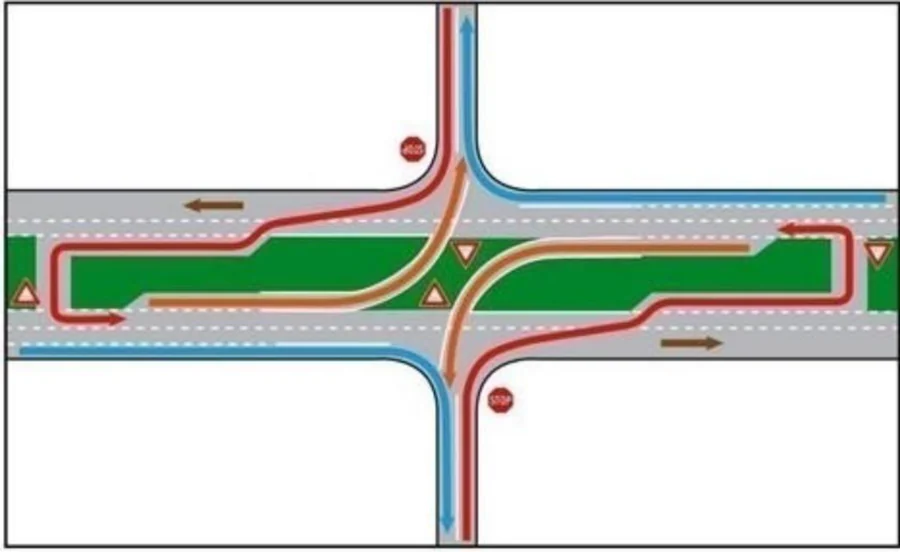
Restricted Crossing U-turn (RCUT)

An intersection that removes left-turn and through movements from the cross street. You turn right onto the main road, then make a U-turn at a one-way median opening.

Handbook p. 81 ↗
Restricted crossing U-turn (RCUT) intersection
RCUT: turn right, then U-turn at the median

Know the rule

RCUTs may be controlled by a traffic signal, stop sign, or merge or yield sign. They reduce potential conflict points and increase safety.

Handbook p. 81 ↗

Put it into practice

You want to go straight across a divided highway at an RCUT. You can't cross directly. Turn right onto the highway, move to the median U-turn opening, make the U-turn, then turn right onto the side road you were heading for.

Check your understanding

Read the question, decide on an answer, then open it to check the explanation. These are Roadwise study questions based on the source handbook.

At all intersections, search for traffic controls, oncoming and cross traffic, pedestrians and bicyclists, the roadway condition, and:
  1. Vehicles in your rearview mirror
  2. Your fuel and gauge readings
  3. Emergency pull-off areas
  4. Areas of limited visibility

Answer: Areas of limited visibility

At all intersections, reduce speed and search for traffic control devices, oncoming and cross traffic, pedestrians, and areas of limited visibility.
Handbook p. 79 ↗
Before moving again after stopping at an intersection, you should look:
  1. Left, then right, then left again
  2. Only straight ahead
  3. Only in your mirrors
  4. Right, then left only

Answer: Left, then right, then left again

You should always look left, then right, then left again before proceeding through the intersection.

Handbook p. 80 ↗
You should not assume another driver will yield space just because:
  1. They have a green light
  2. Their turn signal is active
  3. They are behind you
  4. They are driving a large vehicle

Answer: Their turn signal is active

Do not turn into a lane just because an approaching vehicle has an active turn signal; the driver may not actually turn.

Handbook p. 80 ↗
A Diverging Diamond Interchange (DDI) is designed to:
  1. Increase the number of traffic signals needed
  2. Keep left turns from crossing through traffic
  3. Allow higher speeds through the interchange
  4. Replace the need for on-ramps

Answer: Keep left turns from crossing through traffic

A DDI shifts crossroad traffic so left-turning vehicles don't conflict with vehicles approaching from other directions.

Handbook p. 80 ↗
A Restricted Crossing U-turn (RCUT) requires a driver turning left from the cross street to:
  1. Cross directly through oncoming traffic
  2. Wait for a dedicated left-turn signal only
  3. Turn right, then U-turn at a median
  4. Make the turn from the far right lane

Answer: Turn right, then U-turn at a median

An RCUT eliminates left-turn and through movements, requiring drivers to turn right then make a U-turn at a one-way median opening.

Handbook p. 81 ↗
You should turn into a lane whenever an approaching vehicle has its turn signal on, even before it actually turns.
  1. True
  2. False

Answer: False

The driver with an active signal may turn after passing you or may have forgotten to cancel it from a prior turn.

Handbook p. 80 ↗
Take the lesson checkpoint in the app

More in General Driving