Roadwise States South Carolina Driving lessons Passing South Carolina driving lesson · General Driving
Passing A 3-minute lesson from the South Carolina course. Read the rules and examples, follow the handbook page references, and check your understanding before you move on.
Read time 3 minutes
Course unit General Driving
Checkpoint questions 6
Source pages 90, 91 Passing means spending time in another lane, often facing oncoming traffic or beside another driver's blind spot. Do it only where it's legal and clear, and get it done quickly.
Know the rule
On multi-lane roads, use the left-most lane to pass slower vehicles.
Handbook p. 90 ↗ Know the rule
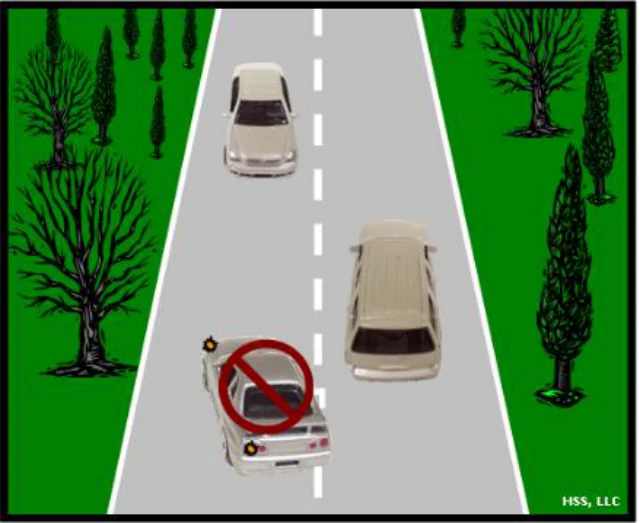
Never pass on the shoulder, paved or not. The shoulder on the right is an emergency stopping lane, not for through traffic.
Handbook p. 90 ↗ Know the rule
Pass as quickly and safely as possible. The longer you stay alongside, the longer you're in the other driver's blind spot.
Handbook p. 90 ↗ To pass: Check for oncoming traffic Check mirrors and over your shoulder for following or passing vehicles When safe, signal 100 feet or more before passing Steer smoothly into the passing lane; maintain or adjust speed Keep going until the whole front of the passed vehicle shows in your rearview mirror Signal to return, check over your shoulder, and steer smoothly back Handbook p. 91 ↗ When you're being passed: Stay in your lane Keep a constant speed so the driver can pass Stay on guard against the other driver's unsafe moves Handbook p. 91 ↗ Don't pass: When an oncoming vehicle is approaching When a curve or hill blocks your view At intersections Before a highway-railroad crossing or a bridge Handbook p. 91 ↗ Know the rule
Passing a bicyclist: slow down, leave as much space as possible, and consider the bicyclist's speed.
Handbook p. 91 ↗ Never pass on the shoulder Put it into practice
On a two-lane road you want to pass a slow truck just before a hill crest. Stay behind it. The hill blocks your view of oncoming traffic, so wait for a clear, legal stretch.
Check your understanding Read the question, decide on an answer, then open it to check the explanation. These are Roadwise study questions based on the source handbook.
On multi-lane roads, which lane is used for passing slower vehicles? The right-most lane The shoulder The left-most lane The center lane Answer: The left-most lane
On multi-lane roads, the left-most lane is to be used for passing slower vehicles.
Handbook p. 90 ↗ Before passing, you should signal your intention how far before passing? 25 feet or more 500 feet or more You are not required to signal 100 feet or more Answer: 100 feet or more
When it is safe to pass, signal your intentions 100 feet or more before passing.
Handbook p. 91 ↗ You should never pass another vehicle: On the shoulder, paved or not On a road with a dashed line on your side When you have signaled 100 feet ahead On a road posted for passing Answer: On the shoulder, paved or not
Never pass on the shoulder, whether it is paved or not; it is meant as an emergency stopping lane, not through traffic.
Handbook p. 90 ↗ When you are being passed, you should: Slow down sharply to let them in Keep a steady speed and your lane Move onto the shoulder Speed up so they can't cut in Answer: Keep a steady speed and your lane
When being passed, stay in your lane and maintain a constant speed to allow the driver to pass.
Handbook p. 91 ↗ You should avoid passing when: You have signaled 100 feet in advance Driving on a straight, open road Your view is blocked by a curve or hill There is a dashed line on your side Answer: Your view is blocked by a curve or hill
Do not attempt to pass when your view is blocked by a curve or hill, at intersections, or before a railroad crossing or bridge.
Handbook p. 91 ↗ When passing, you may return to your lane as soon as your rear bumper clears the passed vehicle's front bumper. True False Answer: False
Continue to pass until the complete front of the passed vehicle is visible in your rearview mirror.
Handbook p. 91 ↗ Previous lesson Changing lanes, entering & exiting highways Next lesson Zipper merge About the source Roadwise’s South Carolina course uses the driver handbook edition supplied with this study pack. This lesson cites source pages 90, 91. The linked PDF is a third-party mirror of the handbook, rather than a government-hosted page.
Open the handbook source PDF · View the source edition
For current application requirements, fees, appointments, and the format that applies to your age or license type, check South Carolina’s DMV. Roadwise provides study material and does not issue permits or licenses.