roadwise.Open study app

South Carolina driving lesson · Signs, Signals & Markings

Pavement markings & crosswalks

A 3-minute lesson from the South Carolina course. Read the rules and examples, follow the handbook page references, and check your understanding before you move on.

Read time
3 minutes
Course unit
Signs, Signals & Markings
Checkpoint questions
6
Source pages
71, 72, 73, 74, 75

Lines, arrows, words and symbols painted on the road give directions and warnings. The color tells you the traffic direction: yellow separates opposite directions, white separates lanes going the same way.

Pavement markings are used to:

  • Divide lanes
  • Show when you may pass or change lanes
  • Show which lanes to use for turns
  • Define pedestrian walkways
  • Show where you must stop for signs or signals
Handbook p. 71 ↗

Yellow center lines (two-direction roads)

Yellow center lines (two-direction roads)
MarkingMeaning
Single dashed yellow linePassing permitted
Solid and dashed yellow linesPass only if the dashed line is on your side
Double solid yellow linesPassing prohibited in both directions
Handbook p. 72 ↗
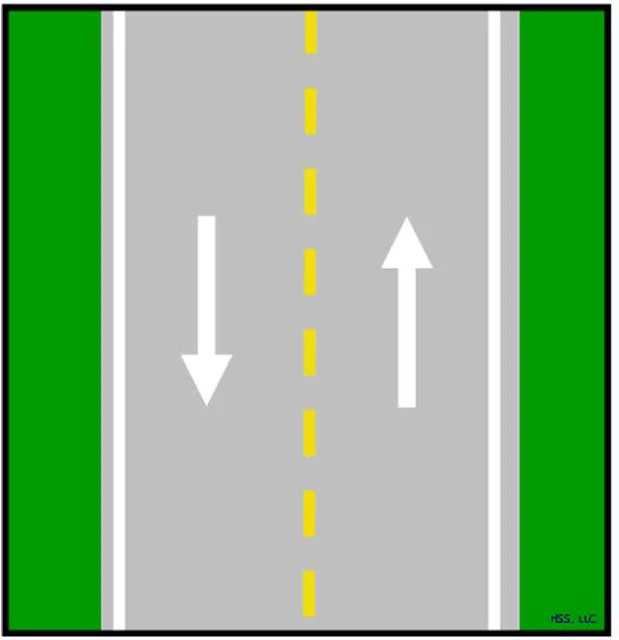
Broken yellow center line
Solid and dashed yellow: passing allowed from the dashed side
Broken yellow center line
Double solid yellow: no passing either way

Know the rule

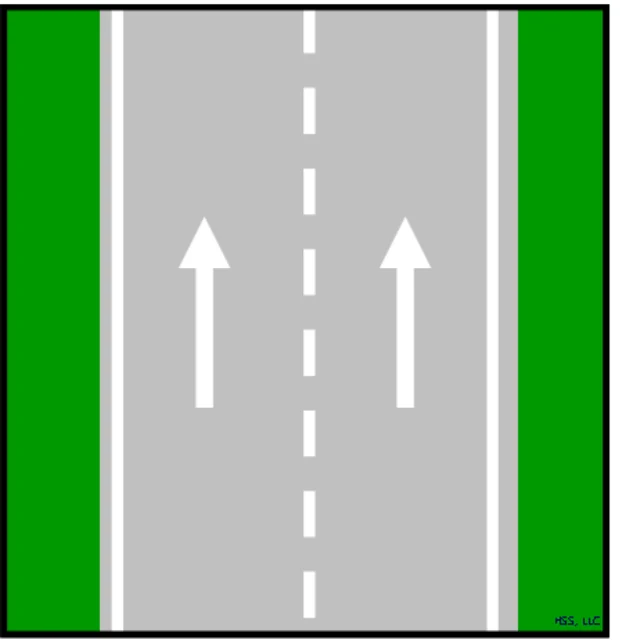
White lane markings are used on one-direction roadways. A dashed white line between lanes means passing is permitted.

Handbook p. 73 ↗
Broken white line
Dashed white line on a one-direction roadway
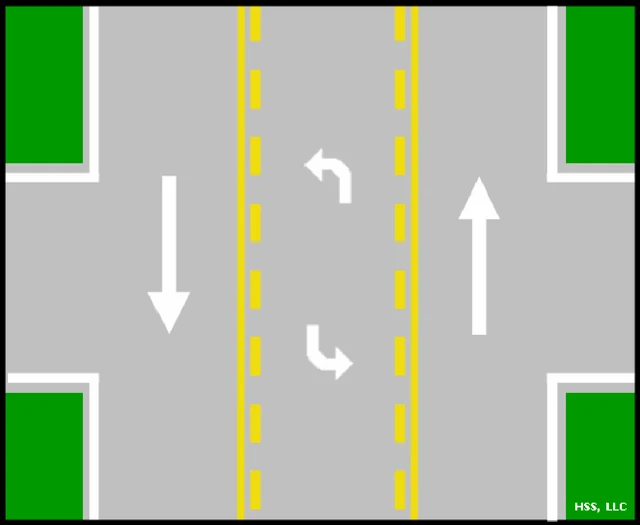
Two-way left turn lane markings
Shared center left-turn lane

Know the rule

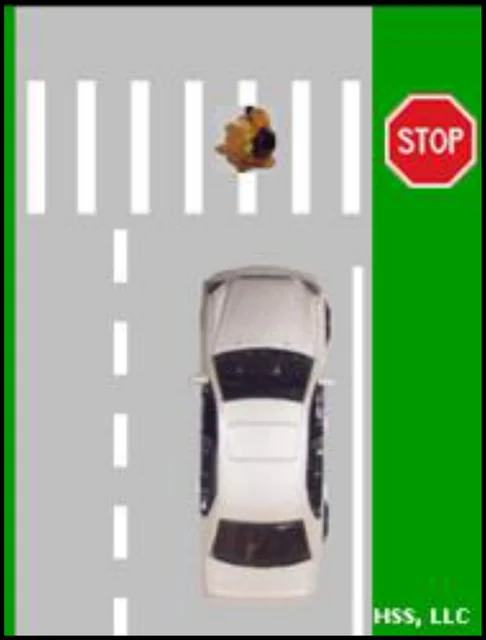
When a sign or signal requires you to stop, stop behind the stop line or crosswalk. If there's neither, stop at the point nearest the intersection where you can see both ways without entering cross traffic.

Handbook p. 74 ↗

Know the rule

Crosswalks define where pedestrians may cross. You must yield to pedestrians entering or in a crosswalk, and not all crosswalks are marked.

Handbook p. 74 ↗

Know the rule

If crosswalks aren't apparent, stop before entering the intersection. If a stop line comes before the crosswalk, obey the stop line first.

Handbook p. 74 ↗
Crosswalk
A marked crosswalk with stop sign

Put it into practice

You're on a two-lane road behind a slow tractor. The center has a solid yellow line on your side and a dashed line on the other side. You may not pass here, even though oncoming drivers may.

Check your understanding

Read the question, decide on an answer, then open it to check the explanation. These are Roadwise study questions based on the source handbook.

A dashed yellow center line on your side of the road generally means:
  1. Passing is prohibited on both sides
  2. The road is one-way
  3. You must stay in your lane at all times
  4. Passing is permitted on your side

Answer: Passing is permitted on your side

A two-direction roadway allows passing on your side when the dashed line is on your side of the center line.
Handbook p. 72 ↗
A solid yellow line on both sides of the center line means:
  1. Passing is banned in both directions
  2. Passing is permitted in both directions
  3. Passing is allowed with caution
  4. You may cross only to pass a bicyclist

Answer: Passing is banned in both directions

Solid yellow lines on both sides of the center line mean passing is prohibited in both directions.

Handbook p. 72 ↗
A dashed white line between lanes generally means:
  1. Passing is prohibited
  2. The lane is for buses only
  3. Passing is permitted
  4. The lane ends ahead

Answer: Passing is permitted

The manual labels a dashed white line on a one-direction roadway as 'passing permitted.'

Handbook p. 73 ↗
If you must stop at an intersection and no crosswalk is apparent, where must you stop?
  1. After your front bumper enters it
  2. Only if cross traffic is present
  3. Wherever the car ahead stopped
  4. Before entering the intersection

Answer: Before entering the intersection

If crosswalks are not apparent, you must stop before entering the intersection.

Handbook p. 74 ↗
If there is a stop line before a crosswalk, which must you obey first?
  1. The stop line
  2. The crosswalk
  3. Neither; you may stop anywhere
  4. Whichever is closer to the intersection

Answer: The stop line

If there is a stop line before the crosswalk, the stop line must be obeyed first.

Handbook p. 74 ↗
You must yield to pedestrians in a crosswalk:
  1. Only if the crosswalk is marked
  2. Even if the crosswalk is unmarked
  3. Only during school hours
  4. Only if a crossing guard is present

Answer: Even if the crosswalk is unmarked

You must yield to pedestrians entering or in a crosswalk, even if it is unmarked.

Handbook p. 74 ↗
Take the lesson checkpoint in the app

More in Signs, Signals & Markings