roadwise.Open study app

South Carolina driving lesson · Signs, Signals & Markings

Regulatory signs: stop, yield, speed & lanes

A 3-minute lesson from the South Carolina course. Read the rules and examples, follow the handbook page references, and check your understanding before you move on.

Read time
3 minutes
Course unit
Signs, Signals & Markings
Checkpoint questions
6
Source pages
68, 69

Regulatory signs state laws you must obey, such as traffic direction, lane use, turning, speed and parking. Ignoring one is a violation, not just a risk.

Know the rule

Regulatory signs are square, rectangular or a special shape, and white with black, red or green letters or symbols.

Handbook p. 68 ↗

Know the rule

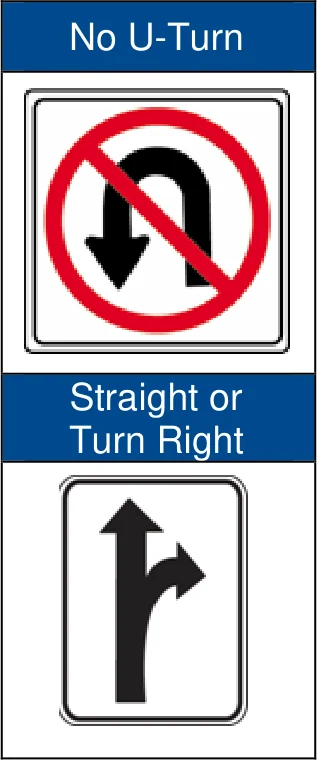
A red circle with a red slash over a symbol prohibits that action.

Handbook p. 68 ↗
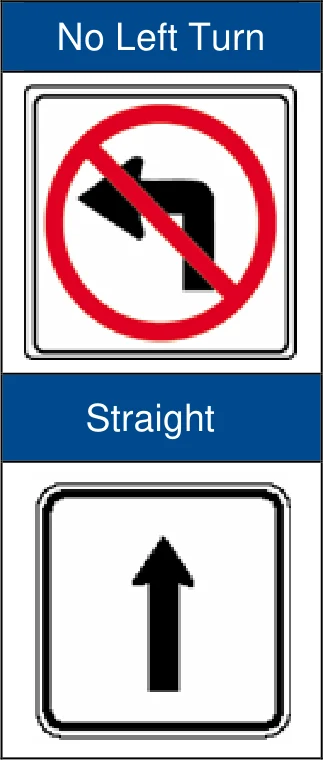
No left turn
No Left Turn / Straight only
No U-turn
No U-Turn / Straight or Turn Right

Know the rule

Speed limit signs are black and white and show the maximum legal speed in ideal conditions.

Handbook p. 69 ↗
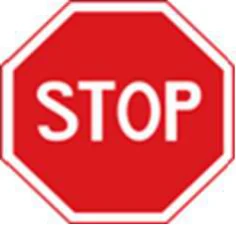
Stop
Stop sign

Know the rule

A stop sign has eight sides and is red with white letters. Stop behind the stop line or crosswalk if there is one.
Handbook p. 69 ↗

Know the rule

No stop line? Stop at the point nearest the intersection where you can see both ways without entering the cross traffic lane. Look for vehicles and pedestrians in all directions and yield.

Handbook p. 69 ↗
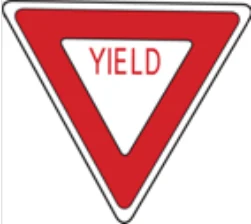
Yield
Yield sign

Know the rule

A yield sign is a red and white downward-pointing triangle with red letters. Slow down and let traffic with the right-of-way cross before you enter.

Handbook p. 69 ↗
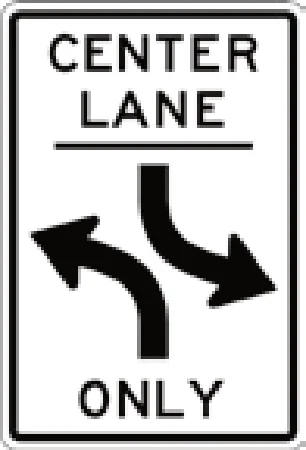
Center lane left turn only (two-way left turn)
Shared center lane, left turn only

Know the rule

Shared Center Lane Left Turn Only: the lane is reserved for left-turning vehicles from either direction, not for through traffic or passing.

Handbook p. 69 ↗

Know the rule

One-Way Street signs mean traffic flows only in the arrow's direction. Never turn against the arrow or drive the wrong way on a one-way street.

Handbook p. 69 ↗

Put it into practice

You come to a stop sign with no painted stop line and a hedge blocking your view. Stop first, then creep forward to the point nearest the intersection where you can see both ways, without entering the cross lane. Yield before going.

Check your understanding

Read the question, decide on an answer, then open it to check the explanation. These are Roadwise study questions based on the source handbook.

A stop sign has how many sides?
  1. Six
  2. Seven
  3. Eight
  4. Five

Answer: Eight

A stop sign has eight sides and is red with white letters.
Handbook p. 69 ↗
A yield sign is what shape and color?
  1. An orange diamond
  2. A blue rectangle
  3. A green octagon
  4. A red and white downward-pointing triangle

Answer: A red and white downward-pointing triangle

A yield sign is a red and white downward-pointing triangle with red letters.

Handbook p. 69 ↗
If a stop sign has no stop line or crosswalk, where should you stop?
  1. The nearest point where you can see both ways
  2. As far back from the intersection as possible
  3. Anywhere within the intersection
  4. Even with the stop sign post

Answer: The nearest point where you can see both ways

If a stop line is not present, stop at the point nearest the intersection where you can see in both directions.

Handbook p. 69 ↗
Regulatory signs with a red circle and red slash over a symbol mean:
  1. The action shown is required
  2. The action shown is prohibited
  3. The action shown is recommended
  4. Construction is ahead

Answer: The action shown is prohibited

Some regulatory signs have a red circle with a red slash over a symbol, which prohibit certain actions.

Handbook p. 68 ↗
Speed limit signs indicate:
  1. The minimum required speed at all times
  2. The average speed of other traffic
  3. The legal maximum in ideal conditions
  4. The speed recommended only for trucks

Answer: The legal maximum in ideal conditions

Speed limit signs indicate the maximum legal speed allowed in ideal conditions.

Handbook p. 69 ↗
A shared center lane marked 'Left Turn Only' may be used for:
  1. Passing slower traffic
  2. Through traffic in either direction
  3. Right turns into driveways
  4. Left turns from either direction

Answer: Left turns from either direction

This lane is reserved for left-turning vehicles from either direction and is not for through traffic or passing.

Handbook p. 69 ↗
Take the lesson checkpoint in the app

More in Signs, Signals & Markings