roadwise.Open study app

Pennsylvania driving lesson · Turns, Intersections and Highways

Roundabouts, jughandles and divided highways

A 3-minute lesson from the Pennsylvania course. Read the rules and examples, follow the handbook page references, and check your understanding before you move on.

Read time
3 minutes
Course unit
Turns, Intersections and Highways
Checkpoint questions
6
Source pages
53, 54

Some intersections don't look like a simple crossroads. Roundabouts send everyone counterclockwise, jughandles replace direct left turns, and divided highways are really two one-way roads. Each has its own rules for who yields and where to turn.

Know the rule

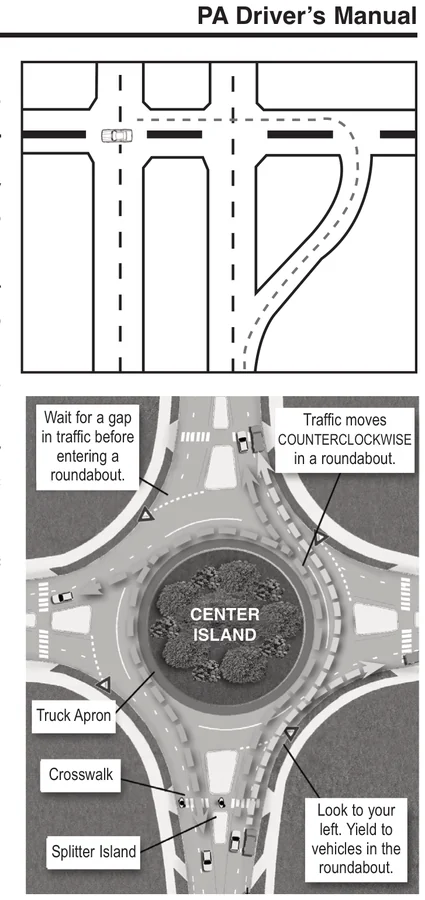
In roundabouts and traffic circles, traffic moves counterclockwise, so every turn into and out of the circle is a right turn. This eliminates head-on, left-turn and right-angle crashes.

Handbook p. 54 ↗

Know the rule

Roundabouts have YIELD signs and painted yield lines at each entry; most also have a destination sign on the approach. Wait for a gap before entering.

Handbook p. 54 ↗
Roundabout diagram
Parts of a roundabout: yield line, crosswalk, splitter island, truck apron, center island

Entering a roundabout

  • Slow down and be prepared to yield to pedestrians in the crosswalk
  • Pull up to the yield line and look left: circulating traffic has the right-of-way
  • Enter when there is an adequate gap in traffic
Handbook p. 54 ↗

Exiting a roundabout

  • Proceed counterclockwise to your exit; you now have the right-of-way
  • Use your RIGHT turn signal as you approach your exit
  • Watch for pedestrians in the crosswalk and be prepared to yield, then exit
Handbook p. 54 ↗

Know the rule

Emergency vehicles: don't enter the roundabout; pull to the side. If already in it, exit immediately and pull over. Never stop in the roundabout.

Handbook p. 54 ↗

Know the rule

Bicyclists may act as a vehicle or a pedestrian in a roundabout. Never overtake a bicyclist acting as a vehicle. Yield to pedestrians when entering and exiting.

Handbook p. 54 ↗

Know the rule

The most frequent cause of roundabout crashes is drivers failing to yield before they enter.

Handbook p. 54 ↗

Jughandle

On divided roads with NO LEFT TURN or ALL TURNS FROM RIGHT LANE signs, a right-side lane curves back to meet the main road at a light, where you then turn left.

Handbook p. 54 ↗

Know the rule

To turn left onto a divided highway, cross the first roadway when traffic from the left leaves a safe gap, then turn left beyond the barrier when traffic from the right on the second roadway is clear. Turning left too early means a head-on crash.

Handbook p. 53 ↗

Know the rule

DO NOT ENTER, WRONG WAY and ONE WAY signs appear together where roads meet divided highways. A right turn onto a divided highway is like any other right turn.

Handbook p. 53 ↗

Put it into practice

A car is circling toward you as you reach the roundabout's yield line. Let it pass; it has the right-of-way. Enter when there's a gap, go counterclockwise, and signal right as you approach your exit.

Check your understanding

Read the question, decide on an answer, then open it to check the explanation. These are Roadwise study questions based on the source handbook.

Who has the right-of-way when entering a roundabout?
  1. Vehicles entering from the right
  2. Vehicles already circulating in the roundabout
  3. Whichever vehicle arrives first
  4. Vehicles entering have priority over circulating traffic

Answer: Vehicles already circulating in the roundabout

Circulating traffic inside a roundabout always has the right-of-way over entering vehicles.
Handbook p. 54 ↗
In a roundabout, which direction does traffic move?
  1. Clockwise
  2. It varies by roundabout
  3. Counterclockwise
  4. Clockwise in multi-lane roundabouts

Answer: Counterclockwise

Traffic in a roundabout moves counterclockwise, so all turns become right turns.

Handbook p. 54 ↗
What should you do if you're in a roundabout and an emergency vehicle is approaching?
  1. Stop immediately wherever you are
  2. Pull onto the truck apron by the center island
  3. Speed up to exit before the vehicle arrives
  4. Exit the roundabout, then pull to the side

Answer: Exit the roundabout, then pull to the side

If you are in the roundabout when an emergency vehicle approaches, immediately exit and pull to the side; never stop in the roundabout.

Handbook p. 54 ↗
According to the handbook, what is the most frequent cause of crashes at roundabouts?
  1. Drivers failing to yield before entering
  2. Drivers going too slowly inside the circle
  3. Pedestrians ignoring crosswalks
  4. Vehicles exiting too early

Answer: Drivers failing to yield before entering

Failing to yield before entering is cited as the most common cause of roundabout crashes.

Handbook p. 54 ↗
What are 'jughandles' used for on some divided roads?
  1. Providing extra parking near intersections
  2. Making left turns from a right-side loop lane
  3. Marking pedestrian crossing areas
  4. Giving buses a place to stop

Answer: Making left turns from a right-side loop lane

Jughandles let drivers make left turns using a right-lane loop instead of crossing oncoming traffic directly.

Handbook p. 54 ↗
Traffic in a roundabout moves clockwise in Pennsylvania.
  1. True
  2. False

Answer: False

Roundabout traffic moves counterclockwise, making every turn a right turn.

Handbook p. 54 ↗
Take the lesson checkpoint in the app

More in Turns, Intersections and Highways