roadwise.Open study app

Pennsylvania driving lesson · Turns, Intersections and Highways

Driving through curves

A 3-minute lesson from the Pennsylvania course. Read the rules and examples, follow the handbook page references, and check your understanding before you move on.

Read time
3 minutes
Course unit
Turns, Intersections and Highways
Checkpoint questions
3
Source pages
55

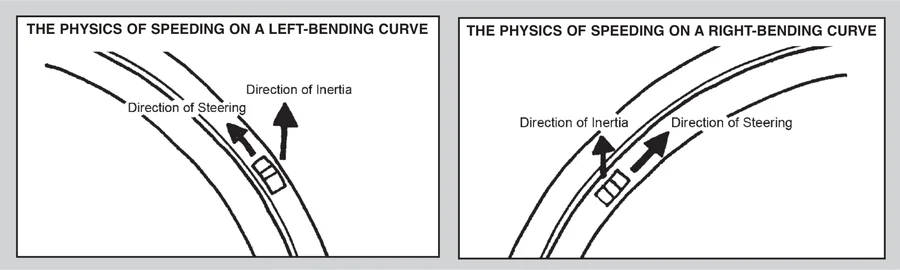
You can't beat the laws of physics. A heavy vehicle going too fast keeps moving straight no matter how you steer or brake. On a left curve you run off the road; on a right curve you drift into oncoming traffic. It doesn't take much speed.

Know the rule

Too fast on a curve, your vehicle keeps going straight: off the road on a left-bending curve, into the other lane on a right-bending curve. Sharp curves on wet or icy roads need the biggest speed reduction.

Handbook p. 55 ↗

Know the rule

Slow down before you enter the curve, not in it.

Handbook p. 55 ↗
Physics of speeding on a curve (diagram)
The physics of speeding on left- and right-bending curves

Know the rule

Curve warnings are yellow diamonds showing how the road bends. A 90-degree bend may have a rectangular yellow sign with a large arrow, and chevrons through sharp curves help at night and in poor visibility.

Handbook p. 55 ↗

How to drive through curves

  • Keep slightly right of lane center on right curves, and in the middle of your lane on left curves
  • The sharper the curve, the more you reduce your speed
  • Watch for oncoming traffic; a speeder could stray into your lane
  • Steer by looking at the inside edge of the curve, and of each curve ahead if there are several
Handbook p. 55 ↗
3,291 crashes

Single-vehicle run-off-the-road crashes, the most frequent type for 16-year-old PA drivers (2013 to 2017; 20 killed)

Handbook p. 55 ↗

Put it into practice

A curve warning sign shows a sharp right bend ahead on a wet night. Brake gently while the road is still straight, then drive through slightly right of lane center, eyes on the inside edge of the curve.

Check your understanding

Read the question, decide on an answer, then open it to check the explanation. These are Roadwise study questions based on the source handbook.

On a curve, the sharper the curve is, the more you should:
  1. Increase your speed to maintain momentum
  2. Steer toward the outside edge
  3. Accelerate through the apex
  4. Reduce your speed

Answer: Reduce your speed

Sharper curves require more speed reduction to maintain control.
Handbook p. 55 ↗
When driving through a right-bending curve, where should you position your vehicle in the lane?
  1. Slightly to the right of the lane center
  2. Slightly to the left of the lane center
  3. As close to the centerline as possible
  4. It doesn't matter as long as you slow down

Answer: Slightly to the right of the lane center

On right curves, position slightly right of center; on left curves, stay centered.

Handbook p. 55 ↗
What happens if you drive too fast on a curve, according to the physics explained in the handbook?
  1. The vehicle leans but stays in its lane
  2. Your vehicle keeps going straight
  3. Nothing changes as long as your tires are new
  4. The vehicle turns more sharply than intended

Answer: Your vehicle keeps going straight

Excess speed on a curve causes inertia to carry the vehicle straight rather than around the bend.

Handbook p. 55 ↗
Take the lesson checkpoint in the app

More in Turns, Intersections and Highways