New York practice test
New York permit practice test.
Get to know the format, try six study questions, and check the explanations before opening a full Roadwise practice test. This course’s simulation is based on the format described below.
- Questions
- 20
- Correct to pass
- 14
- Practice timer
- No timer
- Study question bank
- 633
The format in this course
New York Class D Knowledge Test
To pass this Roadwise simulation, answer at least 14 of 20 questions correctly and meet each scored section’s threshold. Answers and explanations appear after you finish. Unanswered questions count as incorrect.
| Section | Questions | Correct needed |
|---|---|---|
| Traffic signs | 4 | 2 |
This Roadwise practice format has no countdown, so you can take the time you need.
The handbook states you must correctly answer at least 14 of the 20 questions, and separately answer at least 2 of the 4 road-sign questions within that same 20-question test (the 4 sign questions are a subset of the 20, not additional).
Try a few practice questions
Read the question, decide on an answer, then open it to check the explanation. These are Roadwise study questions based on the source handbook.
A vehicle's GVWR is 30,000 lbs. Which license do you need to drive it?
- Class D
- Class E
- A CDL
- Class DJ
Answer: A CDL
A CDL is required once GVWR exceeds 26,000 lbs, so 30,000 lbs needs a CDL.
Handbook p. 6 ↗How long is a standard passenger vehicle registration valid for a vehicle under 18,000 lbs GVW?
- 1 year
- 3 years
- 5 years
- 2 years
Answer: 2 years
Registrations for most vehicles with a maximum gross weight of 18,000 lbs or less are valid for two years.
Handbook p. 25 ↗An oncoming vehicle would be within 150 feet of you before you could safely return to your lane. May you pass on the left?
- Yes, 150 feet is enough room
- Yes, if you speed up to finish quickly
- No; you need 200 feet to return
- Yes, if you flash your headlights first
Answer: No; you need 200 feet to return
You cannot pass on the left if you can't safely return to the right lane before an oncoming vehicle comes within 200 feet.
Handbook p. 39 ↗A 150-lb man has one standard drink. About how much does his BAC rise?
- About .08 percent
- About .002 percent
- About .10 percent
- About .02 percent
Answer: About .02 percent
For a 150-lb male, one standard drink raises BAC by about .02 percent.
Handbook p. 55 ↗What information must you exchange with other drivers after a property-damage-only crash?
- Only your insurance company's name
- Nothing, if no one is hurt
- Name, address, license, and insurance info
- Only your name and phone number
Answer: Name, address, license, and insurance info
Even for property-damage-only crashes, you must exchange name, address, license number, and insurance information.
Handbook p. 77 ↗What does this sign mean?
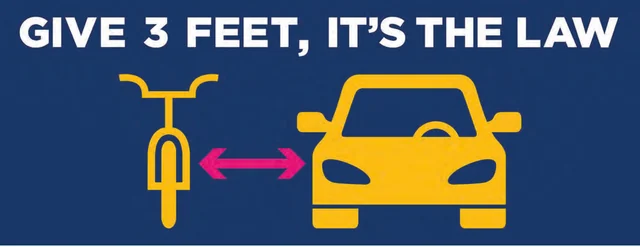
- Drivers must leave at least 3 feet when passing a bicyclist.
- Provides a phone number to report a problem at this railroad crossing.
- Provides a phone number for road and weather conditions.
- Shows gas, food, and lodging services available at the next right.
Answer: Drivers must leave at least 3 feet when passing a bicyclist.
3-foot passing law (bicycles): Drivers must leave at least 3 feet when passing a bicyclist. Give at least 3 feet of space when passing a cyclist.
Handbook p. 29 ↗What to study next
The practice question pool spans the course. Use the topics below to read the rules behind an answer, then return to practice.
7 lessons
Your License
License classes, applying, permits, junior rules & the road test
Explore5 lessons
How to Keep Your License
Suspension, revocation, tickets, points & penalties
Explore4 lessons
Owning a Vehicle
Registration, title, insurance, inspection & upkeep
Explore6 lessons
Traffic Control
Signs, signals, pavement markings & officers
Explore5 lessons
Intersections and Turns
Right-of-way, emergency vehicles, turns & U-turns
Explore3 lessons
How to Pass
Passing on the left, on the right & school buses
Explore3 lessons
Parallel Parking
How to park, and where you can't
Explore7 lessons
Defensive Driving
Distractions, speed, seat belts, work zones & roundabouts
Explore6 lessons
Alcohol and Other Drugs
BAC, chemical tests, Zero Tolerance & penalties
Explore6 lessons
Special Driving Conditions
Railroad crossings, expressways, night, weather & emergencies
Explore6 lessons
Sharing the Road
Pedestrians, cyclists, motorcycles, mopeds & large vehicles
Explore3 lessons
Crashes & Driver Assistance
At the scene, reporting a crash, and using ADAS safely
Explore