roadwise.Open study app

New York driving lesson · Special Driving Conditions

Railroad crossings

A 4-minute lesson from the New York course. Read the rules and examples, follow the handbook page references, and check your understanding before you move on.

Read time
4 minutes
Course unit
Special Driving Conditions
Checkpoint questions
6
Source pages
60, 61

A train can't swerve and can't stop quickly, and the one you see is closer and faster than it looks. At every railroad crossing, expect a train. Trains can run on any track, at any time, from either direction.

Grade crossing

The point where train tracks cross a roadway. It is considered an intersection.

Handbook p. 60 ↗

Know the rule

Never race a train to a crossing, never drive around lowered gates, and don't stop on the tracks. When crossing, stay in your lane and in the same gear.

Handbook p. 60 ↗

Know the rule

Active crossings have flashing red lights or gates. Don't go until the gates are completely raised and the lights are off; going around lowered gates or crossing while lights flash is illegal and dangerous.

Handbook p. 60 ↗

Know the rule

Passive crossings have no gates or lights. Slow down, be ready to stop, and make sure no train is coming. With multiple tracks, wait until you can clearly see down all of them in both directions.

Handbook p. 60 ↗
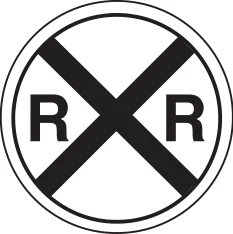
Railroad crossing ahead
Railroad crossing warning sign

Know the rule

Railroad crossing warning sign (yellow, black "RR" and "X"): a crossing is ahead; use caution and be prepared to stop. Most buses and some trucks must stop at crossings, so be careful when following them.

Handbook p. 61 ↗
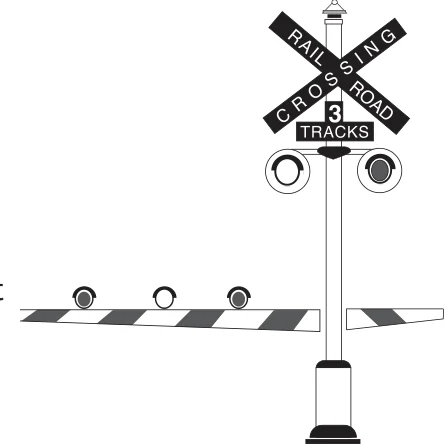
Railroad crossing signals and gate
Crossbuck with flashing lights and gate; the sign shows the number of tracks
15 feet

Stop at least this far from the tracks for flashing lights, lowered gates and/or a bell

Handbook p. 61 ↗

Know the rule

Don't cross until the lights and bell have stopped and the gates are completely up. Never drive around or under a gate that is moving up or down.

Handbook p. 61 ↗

Know the rule

A crossbuck (an X-shaped sign reading RAILROAD CROSSING) means yield. If there are multiple tracks, the sign shows how many. If a train is close or fast enough to be a danger, don't cross, even if there are no signals or they aren't working.

Handbook p. 61 ↗

Know the rule

Cross only if your entire vehicle will clear all the tracks and there's room on the other side. Where pavement markings warn of a crossing, stay behind the stop line while a train passes.

Handbook p. 61 ↗

These vehicles must stop at ALL railroad crossings:

  • School buses, with or without passengers
  • Other buses carrying passengers
  • Vehicles carrying explosives or flammable cargo
Handbook p. 61 ↗
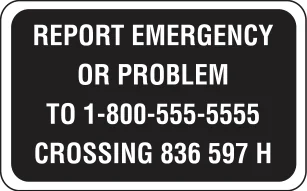
Railroad crossing emergency notification sign
Emergency Notification System sign at a crossing

If you stall on the tracks:

  • 1. GET OUT, and get everyone out, including children, babies and elderly passengers
  • 2. Get away from the tracks, even if you don't see a train
  • 3. Find the Emergency Notification System sign and call the number to report the stalled vehicle
Handbook p. 61 ↗

Know the rule

If a train is coming, run toward it but away from the tracks at a 45-degree angle. Running "down the track" in the train's direction can get you hit by debris when it strikes your vehicle.

Handbook p. 61 ↗

Put it into practice

Traffic is backed up just past a crossing and the only open space is on the tracks. Stay behind the stop line and wait until there's room for your whole car on the far side. Never stop on the tracks.

Check your understanding

Read the question, decide on an answer, then open it to check the explanation. These are Roadwise study questions based on the source handbook.

How far from the tracks must you stop when a railroad crossing's lights are flashing or gates are down?
  1. At least 50 feet
  2. At least 15 feet
  3. At least 5 feet
  4. At least 100 feet

Answer: At least 15 feet

Flashing lights, lowered gates, or a bell mean you must stop at least 15 feet from the tracks.
Handbook p. 61 ↗
You approach an unmarked (passive) railroad crossing with no gates or lights. What should you do?
  1. Cross immediately since there are no signals
  2. Only slow down if you see a train
  3. Slow, be ready to stop, and check for trains
  4. Stop only if the sign shows several tracks

Answer: Slow, be ready to stop, and check for trains

At unmarked, passive grade crossings, slow down and be prepared to stop, making sure a train isn't coming before you cross.

Handbook p. 60 ↗
Which vehicles must stop at all railroad crossings, even without visible warning signals?
  1. Only vehicles towing trailers
  2. Only vehicles going faster than 35 mph
  3. Only vehicles with more than four passengers
  4. School buses and flammable/explosive loads

Answer: School buses and flammable/explosive loads

School buses with or without passengers, other buses with passengers, and vehicles with explosive or flammable cargo must stop at all crossings.

Handbook p. 61 ↗
Your vehicle stalls on the tracks and a train is approaching. Which direction should you run?
  1. Toward the train, angled away at 45°
  2. Away from the train, down the tracks
  3. In the same direction the train is traveling
  4. Directly across the tracks to the other side

Answer: Toward the train, angled away at 45°

If a train is approaching, run toward the train but away from the tracks at a 45-degree angle; running down the track risks being hit by debris.

Handbook p. 61 ↗
What must be true before you cross any railroad tracks?
  1. Only that no train is currently visible
  2. Room to fully clear the tracks
  3. Only that the gates are not lowered
  4. Only that your speed is under 20 mph

Answer: Room to fully clear the tracks

You cannot go across railroad tracks unless your entire vehicle will clear all the tracks and there's room on the other side.

Handbook p. 61 ↗
You are following a bus approaching a railroad crossing. What should you expect?
  1. Buses never stop at railroad crossings
  2. The bus may stop, so be ready to stop
  3. Only school buses must stop, not other buses
  4. You should pass the bus before the crossing

Answer: The bus may stop, so be ready to stop

Most buses and some trucks must stop at railroad crossings, so be careful if you're following one.

Handbook p. 61 ↗
Take the lesson checkpoint in the app

More in Special Driving Conditions