New York driving lesson · Special Driving Conditions
Expressway driving
A 3-minute lesson from the New York course. Read the rules and examples, follow the handbook page references, and check your understanding before you move on.
Expressways combine high speeds with heavy traffic, so you have to think faster and handle your vehicle more precisely than on most roads. Most of the skill is in getting on and off smoothly and planning ahead so you never need a last-second move.
Expressway
Any divided highway where traffic moves one way on two or more lanes, normally entered and exited by ramps (controlled access). Examples: the NYS Thruway, major interstates, parkways.
Plan your entrance and exit on a map beforehand. If you get on in the wrong direction or miss your exit, stay on until the next exit. Backing up on a ramp or crossing the median is dangerous.
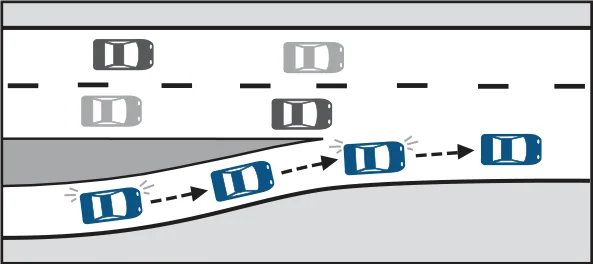
Entering an expressway: use the ramp to speed up and merge
Know the rule
Unless there's a STOP or YIELD sign or light on the entrance ramp, use the ramp to accelerate to expressway speed. Signal, look over your shoulder, and slow down if needed to merge safely.
On the expressway, signal every lane change, check over your shoulder, and make sure your signal turns off. Watch for traffic entering ahead, and if possible move out of the right lane near entrances.
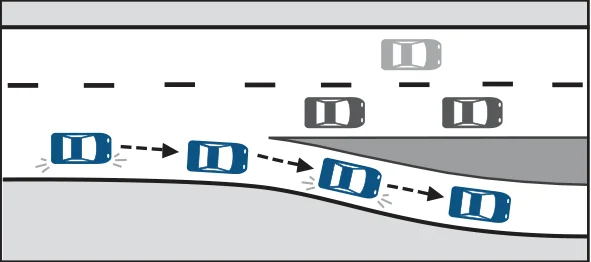
Exiting an expressway: move into the exit lane and slow down on the ramp
Know the rule
Get into the correct lane for your exit ahead of time. Slow down on the exit ramp; it often has a lower speed limit. After you leave the expressway, check signs and your speedometer: you're probably not on a 55 mph road anymore.
You realize you've just passed your exit on the Thruway. Don't back up or cut across the median. Stay on to the next exit, figure out your route, and get back on if you need to.
Check your understanding
Read the question, decide on an answer, then open it to check the explanation. These are Roadwise study questions based on the source handbook.
What is the normal expressway speed limit, and how high can it be posted in some rural areas?
45 mph normally, up to 55 mph rural
65 mph normally, up to 75 mph rural
55 normally, up to 65 rural
55 mph normally, up to 70 mph rural
Answer: 55 normally, up to 65 rural
The expressway speed limit is normally 55 mph, but can be posted at 65 mph in some rural areas.