roadwise.Open study app

New York driving lesson · Special Driving Conditions

Rain, fog, snow & winter driving

A 4-minute lesson from the New York course. Read the rules and examples, follow the handbook page references, and check your understanding before you move on.

Read time
4 minutes
Course unit
Special Driving Conditions
Checkpoint questions
6
Source pages
63, 64

Winter is the hardest season to drive in: snow and ice plus fewer hours of daylight. Even a little rain, snow or ice, or wet leaves, makes roads slippery. Slow down, leave more following distance, and take extra care on curves, turns and expressway ramps.

Hydroplaning

In heavy rain, tires riding on a layer of water on the road, which can cause complete loss of traction and steering. Likelier at high speed or with worn or underinflated tires.

Handbook p. 63 ↗

Know the rule

In heavy rain, drive more slowly, and if you start to lose traction, slow down even more. Good tires with deep tread help prevent hydroplaning.

Handbook p. 63 ↗

Know the rule

New York requires headlights whenever weather requires wipers to clear rain, snow, sleet or fog; daytime running lights don't qualify. Use low beams: high beams reflect off rain, fog and snow. Signal turns earlier and brake early.

Handbook p. 63 ↗

Know the rule

Fog lights must be an approved type and correctly installed. Front fog lights may be amber or white; rear fog lights must be red. Switch them off when visibility improves so they don't glare at others.

Handbook p. 63 ↗

Know the rule

Before winter, make sure your vehicle is in good condition and put good snow tires on before the first storm. Never mix radial and non-radial tires on the same vehicle.

Handbook p. 64 ↗
Oct 16 – Apr 30

The only dates tires with metal studs may be used in New York

Handbook p. 64 ↗

Know the rule

During ice or snow storms, don't drive unless you must. If you do, clear ice and snow from the lights, wipers, hood, roof and all windows, and fill the washer reservoir with freeze-resistant fluid. Drive slowly, but don't go faster than the flow of traffic.

Handbook p. 64 ↗

Know the rule

A rear-wheel-drive car usually lets you feel a slide beginning; a front-wheel-drive car may give no warning. Front- and four-wheel drive handle better but still skid without warning, so don't let them tempt you to go faster.

Handbook p. 64 ↗

If your rear wheels skid:

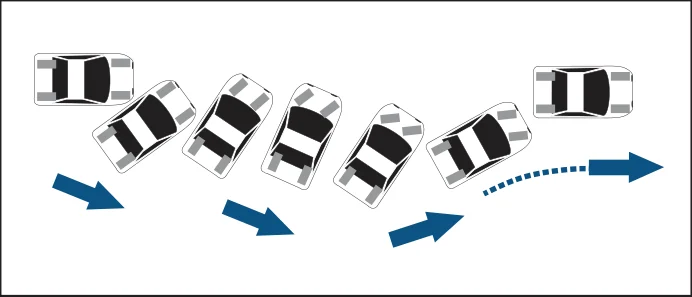
  • Steer where the vehicle is trying to go: rear slides left, steer left; slides right, steer right
  • If it swings the other way as you recover, steer toward that side; you may need to do this several times
  • With anti-lock brakes (ABS), keep even pressure on the brake pedal
  • Without ABS, pump the pedal carefully, faster only as the car slows; braking hard makes it worse
Handbook p. 64 ↗

If your front wheels skid:

  • Take your foot off the gas and shift to neutral or push in the clutch; don't try to steer yet
  • As the wheels slide sideways they slow the car and traction returns
  • Then steer where you want to go, shift to drive or release the clutch, and accelerate carefully
Handbook p. 64 ↗
Lane weaving and merging path
A car sliding on a slippery road

Know the rule

To prevent skids, brake early, carefully and gently: press in slow, steady strokes so the wheels keep turning. If they begin to lock, ease off the pedal. You can also shift to a lower gear as you slow.

Handbook p. 64 ↗

Know the rule

When sleet, freezing rain or snow starts, bridges, ramps and overpasses freeze first. Slippery spots can remain even after plows clear the snow.

Handbook p. 64 ↗

Put it into practice

On an icy curve your car's rear end swings out to the right. Ease off, steer right, toward the slide, and if it whips back left, steer left. With ABS, hold steady pressure on the brake rather than pumping it.

Check your understanding

Read the question, decide on an answer, then open it to check the explanation. These are Roadwise study questions based on the source handbook.

During what months are studded snow tires legally permitted in New York?
  1. Year-round, with no restriction
  2. November 1 through March 1
  3. December 1 through February 28
  4. October 16 through April 30

Answer: October 16 through April 30

Tires with metal studs can be used in New York only from October 16 through April 30.
Handbook p. 64 ↗
What should you do with your headlights while driving in heavy rain or fog?
  1. Keep them on low beam
  2. Switch to high beam for maximum visibility
  3. Turn them off to reduce glare for others
  4. Use only your parking lights

Answer: Keep them on low beam

Keep headlights on low beam in rain, fog, or snow; high beams reflect off the precipitation and reduce visibility.

Handbook p. 63 ↗
If your rear wheels start to skid to the left, which way should you steer?
  1. Steer right, opposite the slide
  2. Steer left, into the slide
  3. Do not steer at all, only brake
  4. Steer straight and accelerate

Answer: Steer left, into the slide

If your rear wheels slide left, steer left; if they slide right, steer right, in the direction the vehicle is sliding.

Handbook p. 64 ↗
Your vehicle has anti-lock brakes and starts to skid. How should you apply the brake?
  1. Pump the brake pedal rapidly
  2. Take your foot completely off the brake
  3. Keep steady pressure
  4. Slam the brake pedal to the floor

Answer: Keep steady pressure

With ABS, keep even pressure on the brake pedal; without ABS, pump the pedal carefully.

Handbook p. 64 ↗
What should you do if your vehicle begins hydroplaning in heavy rain?
  1. Brake hard immediately to regain control
  2. Accelerate to push through the water
  3. Slow down even more
  4. Turn the wheel sharply to break the hydroplane

Answer: Slow down even more

If your vehicle begins to lose traction from hydroplaning, decrease your speed even further.

Handbook p. 63 ↗
Your front wheels start to skid on ice. What should you do first?
  1. Steer hard the way you want to go
  2. Ease off the gas; don't steer yet
  3. Brake hard to stop the skid
  4. Accelerate to regain traction

Answer: Ease off the gas; don't steer yet

If your front wheels skid, take your foot off the gas and shift to neutral, but do not try to steer immediately; steer once traction returns.

Handbook p. 64 ↗
Take the lesson checkpoint in the app

More in Special Driving Conditions