Roadwise States New Jersey Driving lessons Stopping distance, braking, and signals New Jersey driving lesson · Driver Responsibility
Stopping distance, braking, and signals A 3-minute lesson from the New Jersey course. Read the rules and examples, follow the handbook page references, and check your understanding before you move on.
Read time 3 minutes
Course unit Driver Responsibility
Checkpoint questions 6
Source pages 54, 55, 56 The faster you go, the longer it takes to stop: reaction distance grows with speed and braking distance grows much faster. Knowing these numbers, braking smoothly and signaling early give everyone time to react.
Stopping distance depends on Your reaction time Weather and visibility Vehicle weight Brake condition Tire condition and type Roadway conditions Speed Handbook p. 54 ↗ 88 feet per second How far a vehicle travels each second at 60 mph
Handbook p. 55 ↗ 3/4 second Typical reaction time for most drivers in most traffic (deceleration is about 14 feet per second)
Handbook p. 55 ↗ Know the rule
Brake with steady, gentle pressure for a controlled stop. Slamming the pedal when there's no emergency jerks the car and wears out brakes and tires.
Handbook p. 55 ↗ Know the rule
With ABS, don't pump the brakes or violently jerk the wheel: an ABS-equipped vehicle may lose control at only 35 mph if you do, even on dry pavement.
Handbook p. 55 ↗ Know the rule
Use your right foot for both the brake and the gas. With a manual transmission, use the left foot for the clutch.
Handbook p. 55 ↗ Know the rule
Signal when turning, changing lanes, stopping or slowing. Turn the signal on at least 100 feet before turning and cancel it after the turn.
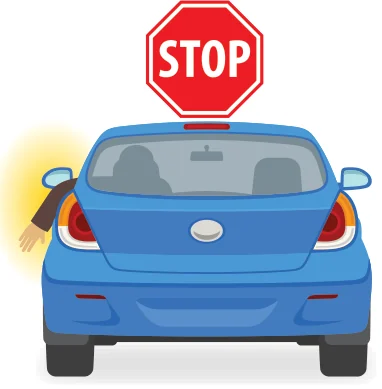
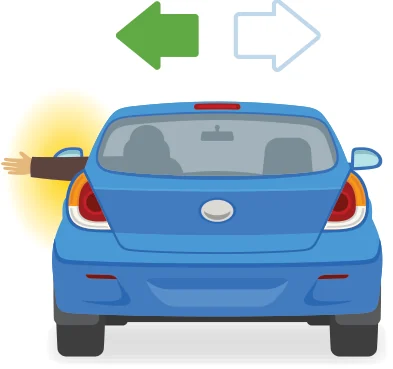
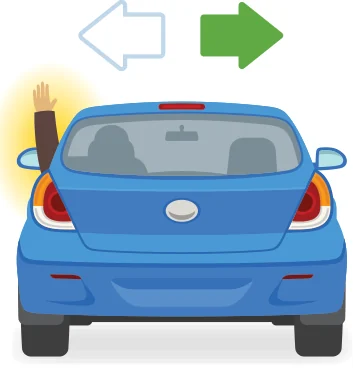
Handbook p. 56 ↗ Hand signals (arm well out of the window) Stop or slow down: hand and arm downward, palm facing to the rear Right turn: hand and arm upward Left turn: hand and arm straight out Handbook p. 56 ↗ Stop or slow: arm down Left turn: arm straight out Right turn: arm up Know the rule
You may sound the horn when passing another vehicle outside a business or residential zone. A horn should be audible for at least 200 feet. Only emergency vehicles may use sirens, whistles or bells.
Handbook p. 56 ↗ Know the rule
Bicyclists, skateboarders and inline skaters use the same hand signals, but may also signal a right turn with the right arm straight out.
Handbook p. 56 ↗ Put it into practice
At 50 mph you spot a hazard. In your 3/4-second reaction time you travel 55 feet before touching the brake, then need about 192 more feet to stop: 247 feet in all, most of a football field.
A useful reminder Double the speed from 30 to 60 mph and total stopping distance more than triples (102 ft to 343 ft).
Check your understanding Read the question, decide on an answer, then open it to check the explanation. These are Roadwise study questions based on the source handbook.
Approximately how many feet per second does a vehicle travel at 60 mph? 88 feet per second 60 feet per second 100 feet per second 44 feet per second Answer: 88 feet per second
A vehicle traveling at 60 mph covers about 88 feet every second.
Handbook p. 55 ↗ According to the manual's stopping distance table, what is the typical reaction time for most motorists under most traffic conditions? 1.5 seconds 3/4 second 2 seconds 1/4 second Answer: 3/4 second
Most motorists have a typical daytime reaction time of about 3/4 second, based on the manual's stopping distance chart.
Handbook p. 55 ↗ According to the manual's stopping distance table, approximately what is the total stopping distance at 60 mph? 247 feet 453 feet 343 feet 167 feet Answer: 343 feet
The chart shows a total stopping distance of about 343 feet at 60 mph, factoring reaction and braking distance.
Handbook p. 55 ↗ An ABS-equipped vehicle may lose control at what speed if a motorist violently jerks the steering wheel while braking, even on dry pavement? 55 mph 15 mph 75 mph 35 mph Answer: 35 mph
An ABS-equipped vehicle may lose control at only 35 mph if the motorist violently jerks the wheel while braking, even on dry pavement.
Handbook p. 55 ↗ A motorist must signal how far in advance of making any turn? At least 25 feet At least 100 feet At least 500 feet At least 10 feet Answer: At least 100 feet
State law requires signaling at least 100 feet before making any turn.
Handbook p. 56 ↗ Under normal conditions, how far should a vehicle's horn be able to be heard? At least 50 feet At least 500 feet At least 200 feet At least 20 feet Answer: At least 200 feet
Under normal conditions, the horn should be able to be heard for at least 200 feet.
Handbook p. 56 ↗ Previous lesson Starting out: seat, mirrors and steering Next lesson Reversing, turning, K-turns, and parking More in Driver Responsibility About the source Roadwise’s New Jersey course uses the driver handbook edition supplied with this study pack. This lesson cites source pages 54, 55, 56. The linked PDF is a third-party mirror of the handbook, rather than a government-hosted page.
Open the handbook source PDF · View the source edition
For current application requirements, fees, appointments, and the format that applies to your age or license type, check New Jersey’s MVC. Roadwise provides study material and does not issue permits or licenses.