Roadwise States New Hampshire Driving lessons Pavement markings New Hampshire driving lesson · Signs, Signals, and Markings
Pavement markings A 3-minute lesson from the New Hampshire course. Read the rules and examples, follow the handbook page references, and check your understanding before you move on.
Read time 3 minutes
Course unit Signs, Signals, and Markings
Checkpoint questions 6
Source pages 30, 31 Lines, arrows, words and symbols painted on the road divide lanes, show where you may pass or change lanes, which lanes turn, where pedestrians cross and where to stop. Color tells you direction; solid or broken tells you what you may do.
Know the rule
Double white or yellow lines: you may not pass if the line on your side is solid; if the line on your side is broken, you may pass when safe.
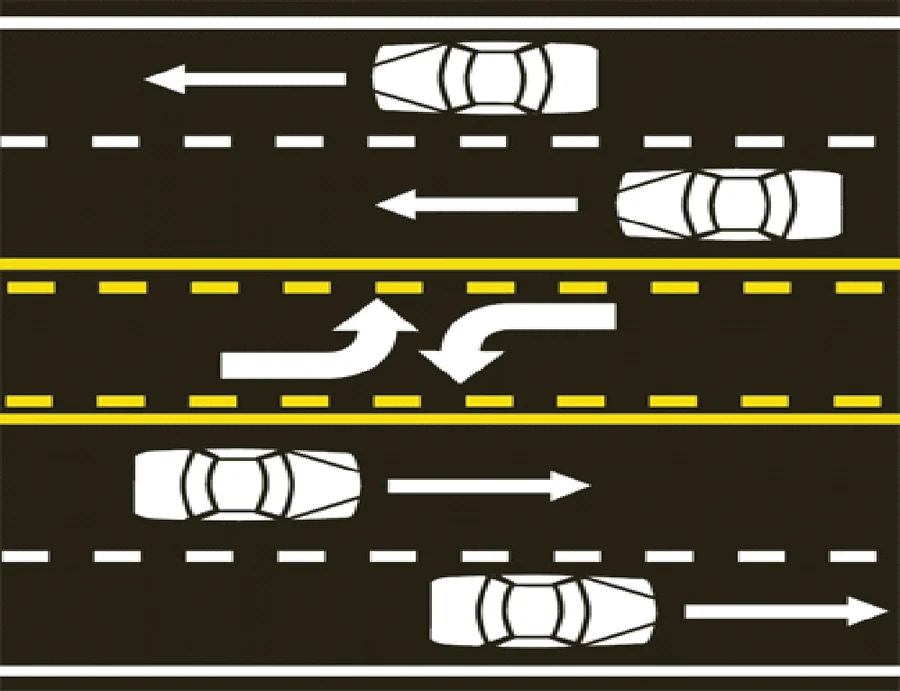
Handbook p. 30 ↗ Lane lines and a shared center turn lane Where to stop: At the white stop line, if there is one No stop line but a crosswalk: before the crosswalk Neither: come to a full stop before entering the intersection Handbook p. 30 ↗ Know the rule
After stopping at the required point, look both ways and move forward only when it's safe to continue into the intersection.
Handbook p. 30 ↗ Know the rule
Yield to pedestrians crossing in marked crosswalks, and at intersections even when no crosswalk lines are painted.
Handbook p. 30 ↗ Know the rule
White arrows on the road guide you into the proper lane for turning or going straight.
Handbook p. 31 ↗ Know the rule
Shared center turn lanes are for left turns only, from either direction; never for through traffic or passing.
Handbook p. 31 ↗ Put it into practice
You're on a two-lane road with a solid yellow line on your side and a broken line on the other. Oncoming drivers may pass when it's safe; you may not.
Check your understanding Read the question, decide on an answer, then open it to check the explanation. These are Roadwise study questions based on the source handbook.
White broken (dotted) lane lines on a roadway mean what? Lanes of traffic moving in the same direction Lanes of traffic moving in opposite directions A closed lane ahead The edge of a one-way road Answer: Lanes of traffic moving in the same direction
White lines mean the lanes are moving in the same direction.
Handbook p. 30 ↗ What do solid white lane lines mean for a driver? Changing lanes or passing is prohibited Passing is allowed when safe The lane ends ahead The lane is for emergency vehicles only Answer: Changing lanes or passing is prohibited
Solid white lines prohibit changing lanes or passing.
Handbook p. 30 ↗ With double yellow lines, when may a driver pass? When the line on their side is broken and it's safe Never, double yellow always prohibits passing Whenever traffic allows, regardless of the lines Only at night with headlights on Answer: When the line on their side is broken and it's safe
If the line on the driver's side is broken, they may pass when safe; a solid line on their side prohibits it.
Handbook p. 30 ↗ If there is no stop line but a crosswalk is present, where must a driver stop? At least 50 feet before the crosswalk Anywhere within the crosswalk Before the crosswalk As close to the intersection as possible, ignoring the crosswalk Answer: Before the crosswalk
Without a stop line, drivers must stop before the crosswalk.
Handbook p. 30 ↗ Are drivers required to yield to pedestrians crossing at an intersection with no crosswalk lines painted? No, only marked crosswalks require yielding Yes, drivers must yield even without painted lines Only if a crossing guard is present Only during school hours Answer: Yes, drivers must yield even without painted lines
Drivers must yield to pedestrians crossing at intersections even without crosswalk lines.
Handbook p. 30 ↗ What color are edge markings on the left edge of a one-way road? White Orange Yellow Double white Answer: Yellow
The left edge of a one-way road is marked with a yellow line.
Handbook p. 30 ↗ Previous lesson Work zone signs and barriers Next lesson Toll roads and turning More in Signs, Signals, and Markings About the source Roadwise’s New Hampshire course uses the driver handbook edition supplied with this study pack. This lesson cites source pages 30, 31. The linked PDF is a third-party mirror of the handbook, rather than a government-hosted page.
Open the handbook source PDF · View the source edition
For current application requirements, fees, appointments, and the format that applies to your age or license type, check New Hampshire’s DMV. Roadwise provides study material and does not issue permits or licenses.